
Do glossy magazines recycle or do they go in the paper bin?
You’ll find the answer on posters over bins throughout the Killam Library, courtesy the Dal Libraries Green Team and their ongoing PROG 101 campaign!
Do glossy magazines recycle or do they go in the paper bin?
You’ll find the answer on posters over bins throughout the Killam Library, courtesy the Dal Libraries Green Team and their ongoing PROG 101 campaign!
We’re offering you access to two archival collections from EBSCO, on a trial basis until mid-April. Check them out and let us know what you think!
EBSCO has partnered with the American Antiquarian Society (AAS) to provide digital access to a comprehensive collection of American periodicals published between 1691 and 1877. In total, more than 6,500 periodicals are available.
The ATLA Historical Monographs Collection consists of two Series that contain more than 29,000 titles focused on religion and theology. In its entirety, the collection contains over 10 million pages, representing a core collection for colleges and universities with programs in history, theology, religion, sociology, political science and other disciplines.
Series 1, consisting of titles from the 13th Century through 1893
Series 2, consisting of titles published from 1894 through 1923
Guest post by D. Kelley, Faculty of Science

D. Kelley
Recently, my graduate student and I concocted a new scheme for a particular type of scientific analysis. As is often the case for those who scurry about in the research trenches, the work had no early element of “research” in the sense that the public (or a librarian) might understand the word. In particular, we did not begin by consulting the literature. We simply used all that we knew at that time, to try to address our challenge. (The cheeky dictum “some read the literature, others write it” is actually not a bad mantra for researchers.)
As initial tests of the method showed more and more promise, however, we started to get interested in the literature! We had to decide whether to cite someone on the method, or whether to write a new paper that others could cite.
This is where our story approaches the context of this blog.
How did we check whether our technique was new? The answer is that we used the Swiss army knife of lazy research: Google Scholar. Sure, we have other steps that we will follow, e.g. searching from within the websites of the key journals, and phoning friends who work on similar things. But these are second steps. The point is that our first step did not involve our university library. We did not visit the library website, we did not phone our friendly and skillful subject specialist librarian, we did not step one foot towards that building with the good coffee.
The question is: did we do the right thing, or did we short-change ourselves? Might we have found deeper, more reliable results, outside the Google comfort zone? Basically, has Google addled us? Have we been, to coin a word, “gaddled”?
Next post: Crown, Copyright, Common Wealth
The Dalhousie Libraries are offering you access on a trial basis to Sustainability Watch, a new EBSCO database. The trial runs until April 14, 2011.
Sustainability Watch provides information on over 200 sustainability related topics. Monitoring thousands of journals and periodicals, this product presents best practices in a variety of areas, including environmental impacts and pollution prevention initiatives, corporate citizenship, and long-term sustainable business practices.
Sustainability Watch provides a wide range of search and browse options, allows you to save your searches, set up alerts, and create bibliographies, and even offers an article translation service. Explore Sustainability Watch now and let us know what you think!

How do we love you? Let us count the ways!
We love you to the depth and breadth and height
Librarians can reach when searching for
The answers to your research needs.
We love you to the level of each day’s
Most complex paper or most feared exam.
We love you freely as our ebooks all are free;
We love you purely as your quest for info’s pure.
Our love is on Live Help and–can you guess?
We love you more than Novanet Express!
(With apologies to Elizabeth Barrett Browning….)
 We’re delighted to introduce you to Suzanne Hayes, who began working as a full-time Stack Maintenance / Circulation Assistant at the Killam Library on February 1, 2011.
Suzanne is currently in the third year (part-time) of a Library Technician Program at the Nova Scotia Community College. She comes to us from Dal’s Department of Anatomy & Neurobiology where she worked as Administrative Secretary for a year and a half. Suzanne has also held positions in Admissions at Saint Mary’s and the Mount, so she’s completely at home in a university environment.
Suzanne’s job with the Circulation Dept. involves doing maintenance—reshelving books, tidying up around the copiers etc.—in the stacks and working at the Circ Desk. Or as she puts it, “I do the quiet stuff in the mornings and the socializing in the afternoons!”
Suzanne enjoys sports and is an avid volleyball and basketball player. She also loves to read, particularly historical fiction and biographies. Her experience working with students and her lovely smile will make her a real asset to the Libraries!

In 2005 the Dalhousie Libraries were invited to participate in the national Our Roots digital collection project. Our commitment was to digitize and make available resources covering Black Nova Scotian History on the Our Roots website, which is an online collection of Canadian local histories.
“Historical Roots: Blacks in Nova Scotia” offers additional resources that would benefit anyone searching for information concerning Black Nova Scotian history. These include a report on the Black experience in Nova Scotian sports (written by sports historian Sandy Young), and links to other educational & cultural organizations that contain material or support the study of Black Nova Scotia heritage and culture.
February is Black History Month, the perfect time to explore our Historical Roots collection online!
When the staff at the Dalhousie Gazette decided to do a retrospective of Gazette journalism, they knew there was one place that could provide access to the student newspaper’s rich history: the University Archives and Special Collections.
The University Archives and Special Collections holds extensive materials relating to student life at Dalhousie. We have issues of the Dalhousie Gazette dating back to its founding in 1868, yearbooks, university calendars, and other materials that document the history of the university and its students and faculty.
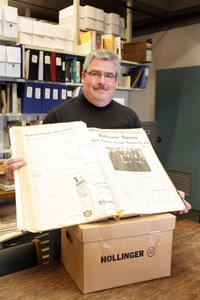
University Archivist Michael Moosberger displaying an issue of the Dalhousie Gazette
Gazette staff worked tirelessly to comb through issues from each decade of the newspaper and select articles that showed the important role student journalism has played on campus. Archives and Special Collections staff then digitized these articles for the Gazette to include in its print edition.
The Gazette also interviewed University Archivist Michael Moosberger. Michael explains what archivists do, what challenges they face, and why projects like this is exactly what the University Archives and Special Collections is here for.
For a behind-the-scenes look at how the special Archives issue was put together, check out this video that shows how the Gazette team worked with the University Archives and Special Collections to put the issue together.
If you haven’t seen it yet, grab a copy! The Gazette put together a truly remarkable retrospective that affirmed the student newspaper’s long history as a crucial voice in Nova Scotia journalism.
The reading room and reference desk at the Archives and Special Collections (5th floor of the Killam Library) will be closed on Friday, February 4, 2011.
Regular hours will resume on Saturday. Have a great weekend!
 Which of these things does NOT go in the Recycle bin?
This month the PROG 101 awareness campaign is all about recycling–you’ll find the answer on new posters at bins throughout the Killam Library. More sustainable information from the Dal Libraries Green Team!