by Marlo MacKay
Library doors may be closed, but access to many scholarly e-resources has opened up, allowing students and researchers to use hundreds of additional online e-books and e-journal articles during the pandemic. The Dal Libraries have taken steps to help everyone in the community to discover this wealth of expanded content.
Around mid-March, schools, offices, and libraries across North America started closing their doors to slow the spread of COVID-19. As difficult as it was to close their spaces, libraries across the continent quickly transitioned to serving their communities in an online only environment.
“Luckily, libraries in general have been building their electronic collections over the past two decades, and the Dalhousie Libraries is no exception,” says Donna Bourne-Tyson, Dean of Libraries. “In many cases, electronic resources are preferred by libraries because they are accessible at all times, regardless of your location, allow simultaneous use by multiple users in some cases, and they don’t take up physical space in your buildings. There is only so much space available in the Dal Libraries, and students want to use the space for individual silent study and group study meetings; any space we don’t need to devote to stacks is appreciated by our students.”
As prepared as the Dal Libraries was to deliver services in an online only environment, there were challenges, some of which stemmed from the licensing restrictions on electronic resources. These restrictions had always been there, but they were felt even more deeply once libraries closed their doors.
“Licensing restrictions limit who can remotely access our electronic resources. Only Dalhousie students, faculty, and staff — not community members — have off-campus access to the eResources to which we subscribe,” explains Michelle Paon, Associate Dean Resources and Head of the Sexton Design & Technology Library. “Community researchers can access our electronic resources from computers on campus, but once we closed our physical spaces, that access was removed for non-Dalhousie researchers.”
Another challenge that is sometimes posed by licensing restrictions on electronic resources are limitations on the number of users who can access a single resource concurrently. “This is especially difficult when a faculty member has assigned a reading to their entire class, if only one student at a time can access the resource,” says Paon. “In some cases, a license can be purchased to allow for more simultaneous users, if we know that is needed.”
Libraries knew these challenges would become even bigger issues in the online only environment, and so, on behalf of all libraries, the International Coalition of Library Consortia (ICOLC) made an appeal to hundreds of publishers and vendors.
The ICOLC is an informal, self-organized group comprising approximately 200 library consortia in North and South America, Europe, Australia, Asia, and Africa. In March, they asked publishers to provide wider access to their electronic resources in the face of library, university, and school closures, and the mass move to remote teaching.
The ICOLC appeal alerted publishers to the difficulties that students and researchers would soon be facing in accessing adequate resources. The appeal encouraged publishers to adopt a number of measures to reduce the barriers to information that libraries knew learners and educators everywhere would encounter.
Well over one hundred publishers and vendors responded to the appeal. The ICOLC relied on crowd sourcing to pull together the list of titles with expanded or free access. Many scholarly publishers lifted some of the stiff restrictions on accessing their content, but sorting out what was freely available was another matter. The result was an extensive, but ultimately difficult-to-navigate list that would be more likely to overwhelm users before they would find it helpful.
“Without some coordination on our part, it would be easy for library users to miss out on being able to take advantage of these resources,” says Paon. “With publishers responding in different ways to the ICOLC appeal, we had to look at each offer individually and curate a list for the Dalhousie audience.”
In addition to the crowd-sourced ICOLC list, there were offers from publishers coming in via the Council of Atlantic University Libraries (CAUL) and directly to the Resources department of the Dal Libraries.
Next, some of the librarians and Resources staff got together and did what librarians and libraries do best — organize information. “We created an internal spreadsheet, adding titles as the information came in, which at that time, was fast and furious,” says Sarah Stevenson, Associate Dean Planning and Head of the Killam Memorial Library. “Then we developed a LibGuide for our users, and David Ryan (MLIS, 2008), a library assistant at the Sexton Library, helped to further organize the content into something our users could digest and use.” LibGuide is the term used for the online library guides created by librarians, compiling the best resources on a given topic into one guide.
The resulting LibGuide is called Temporary Access to Additional Scholarly Resources During COVID-19. It untangles the complicated business of understanding what exactly is on offer from each publisher. The LibGuide divides the content into four categories: totally open resources that are available to anyone, eResources that are available only to the Dalhousie community over and above current subscriptions, standards, and courseware.
“The new LibGuide features all of the publishers we know of, what aspect of their collection is now available as a temporary free resource, and when that access is currently scheduled to end,” says Ryan, who spent a couple of weeks wrangling the content into an organized LibGuide. Ryan also spent time adding the Dal Libraries’ “Ezproxy” link to URLs where applicable, ensuring that off-campus users not logging in through the VPN would be able to access the various resources.
The LibGuide, which covers many disciplines, also has a tab linking to a LibGuide on COVID-19 research, which is an ongoing compilation by Robin Parker, a librarian whose subject specialties include family medicine, surgery, and internal medicine.
“This LibGuide is constantly evolving,” says Paon. “We’re updating it as soon as we hear of another offer, and removing content when access has expired. We’re very thankful that the ICOLC made this appeal and that so many publishers responded responsibly. It was a big job to sort out these resources but it was important that we took the time to do that. Every little bit that we can do for our users at this time helps.”
 On behalf of the Dalhousie Libraries, I’m offering heart-felt congratulations to you all. We know the hard work and sacrifice it took for you to get to this day and we are very proud of you!
 Canada’s New Digital Research Infrastructure Organization (NDRIO) launched earlier this year and recently named their inaugural board. Dalhousie’s Dean of Libraries Donna Bourne-Tyson is on the fifteen-member board, representing academic libraries and the data management sector.

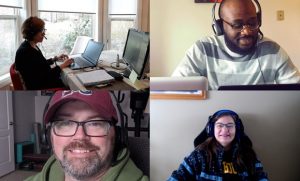 Try a virtual drop-in session to ask members of our Instructional Technologies Team questions about Brightspace, and tools such as Panopto (for video streaming and lecture capture) and Collaborate Ultra (for virtual classroom and web conferencing).