
In the new year, Rai-Lee will be answering some of the most frequent questions she receives in the blog content and via video!
Do you have a question you’d like to ask?
Your guide to dining in residence
In the new year, Rai-Lee will be answering some of the most frequent questions she receives in the blog content and via video!
Do you have a question you’d like to ask?

Heading into the winter season, you may need a pick-me-up to keep you energized. Don’t miss these tips!

Coffee itself is loaded with phytonutrients and antioxidants which bring a whole host of health benefits; the confusion arises when asked whether the caffeine has more health benefits or costs. The truth is that not all of us metabolize coffee equally. Nutrigenomics has discovered 2 categories: fast metabolizers and slow metabolizers. The category you fit in determines how much caffeine is healthy for you.

It’s that time of the semester once again. Long study sessions, running on no sleep and bottomless coffee. Nutrition quickly falls off the radar when such important priorities are on the list. When it comes to preparing for exams, it’s important to treat them like a mental marathon where endurance is key. Eating the right foods at the right times will alert and energize you through those long study sessions. Your Food Services team have put together some simple tips so you can eat your way to an A!
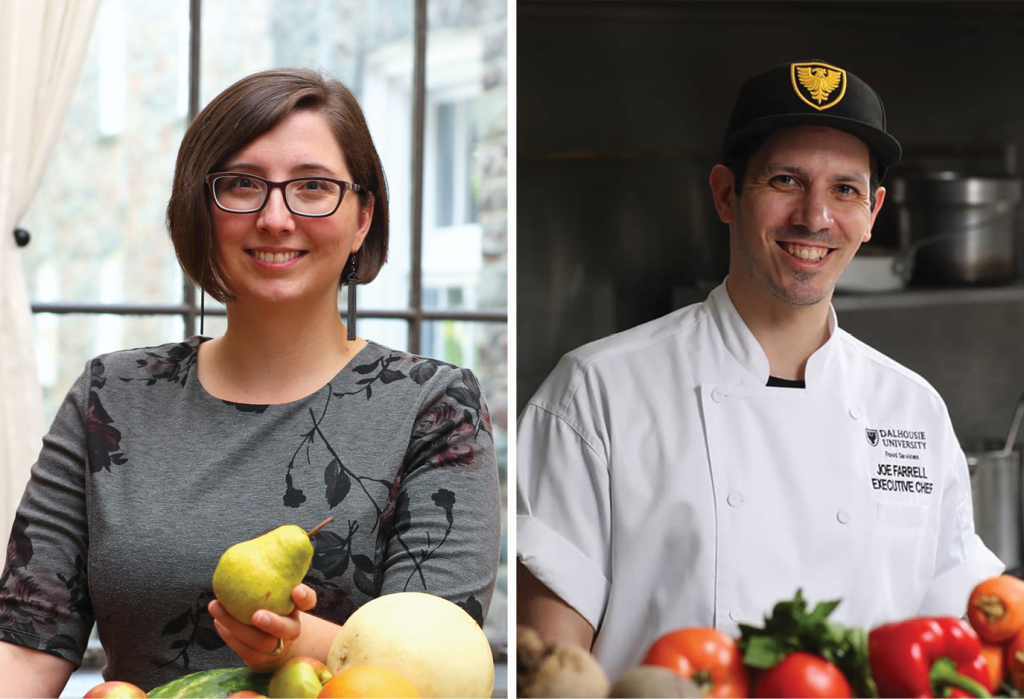
You may have noticed some big changes in the menu this year at the dining halls. The Dalhousie Food Services team has been working hard to make your dining experience the best possible. Now, Dalhousie Food Services Executive Chef Joe Farrell and Dietitian Rai-Lee Gardiner are giving you the scoop on how the menu is designed and what you can look forward to in the dining halls!

You may have heard that eating chocolate is good for your health. Newspapers, magazines and health food stores are packed with articles about the health benefits of chocolate. But, are all these articles true?
 Waste Reduction Week is a Canada wide event that focuses on sustainability, a circular-economy, and waste reduction (1). This year it occurred from October 15th to 21st. You may have noticed posters around your dining halls or the board displaying the amount of food waste in Howe.
Food waste is a major concern across the globe and here in Canada. In Canada, it’s hard to believe that 40% of all our food is never consumed and goes to waste, that’s $31 billion or 6 million tons of food(2). All that food goes to a landfill or gets composted. Decomposing organic matter in landfills, like wasted food, produces methane gas. Methane gas is 25 times worse for the environment than carbon dioxide (3).
 Food waste is a very real problem all over the world. Nearly a third of food produced globally is lost and never nourishes someone (1,2). This loss of food is unsustainable and happens at home, in restaurants, in hotels, and in our dining halls.
In Canada, we waste 40% of the food we produce (1). This amounts to $31 billion lost every year! Food waste contributes to the global hunger epidemic, wasting of resources, and destruction of the environment. Reducing your food waste while eating in the dining hall can be as easy as making a small change to the way you eat!
 If you have Celiac Disease, come talk to me
We all know university can be extremely stressful at times. What we don’t often realize is how much more stress can be added when trying to manage chronic diseases like Celiac Disease.
What is Celiac Disease?
Celiac disease (CD) is a common autoimmune disorder that permanently affects the digestive system (1). CD is triggered in people who are genetically susceptible when they eat gluten. When a person with celiac disease eats a food that contains gluten, it causes an immunological reaction in the small intestine, which inflames and flattens the villi in the interior of the small intestine (2). This damage causes malabsorption of the nutrients needed for good health. There is no cure for CD, and the only way to manage it is with a gluten free diet.
 Quite simply, vegan means only eating grains, vegetables, dried beans, chickpeas, lentils, seeds and nuts. Foods derived from animals like meat, fish, poultry, dairy, eggs, honey, and products containing these foods, are not part of a vegan diet.
Vegan diets are growing in popularity, and there are many reasons why someone may follow a vegan diet. One of the most common reasons is that a healthy vegan diet can provide many health benefits including lower rates of obesity, heart disease, high blood pressure, high blood cholesterol, type 2 diabetes and certain types of cancer.It may take planning to get enough protein, iron, zinc, calcium, vitamins D and B12 and omega-3 fats from foods or supplements Yet, studies show that a healthy vegan diet can meet all your nutrient needs at any stage of life, whether you’re in your teens, twenties or even older.