RESOLVED: This issue was has been resolved. Updated November 9 at 3:46.
EBSCO eBooks is currently DOWN (not allowing access to full-text). We have reported the problem to EBSCO and are hoping for a quick resolution.
with content from Creighton Barrett and Sarah Stevenson
The Dalhousie Libraries is delighted to share wonderful news that the Archives was recently the recipient of two awards from the Council of Nova Scotia Archives. The Archives serves as Dalhousie’s corporate memory by identifying, preserving, and making available institutional records of enduring value, including textural, photographic, audiovisual, and electronic materials. The Archives also acquires records of independent student, alumni and employee organizations, private papers from prominent faculty and alumni, and university publications. Together, these records document the work of the university, and tell the story of the Dalhousie community and its people over time.
Doug Kirby Award for outstanding achievement in archival preservation
The Dalhousie Archives won the Doug Kirby Award for their Digital Preservation System Project, which began in 2018. Led by Digital Archivist Creighton Barrett, the Archives’ need for a robust digital preservation solution became increasingly apparent as the Libraries began digitizing historic university records to celebrate Dalhousie’s 200th anniversary in 2018.
With support from the senior leadership team of the Dalhousie Libraries and colleagues in Procurement, Creighton outlined the functional requirements and wrote a request for proposals for a digital preservation system based on the Open Archival Information System (OAIS) and other international digital preservation standards.
After years of testing and development, the Archives created its first standards-compliant Archival Information Packages (AIPs) in April 2021. While this research and development was under way, the Dal Libraries also took other initiatives to support its emerging digital preservation program:
The Dal Libraries continues to work with Artefactual Systems to configure and maintain the digital preservation system.
Dr. Phyllis R. Blakeley Award for outstanding accomplishment in archival work
The Dalhousie Archives won the Dr. Phyllis R. Blakeley Award for the Ronald St. John MacDonald fonds processing project. Paulo Matheus de Sousa Lima, Archives Assistant, was the primary staff person for this project, receiving support from the Digital Archivist, the University Records Manager, and staff Archives Assistants.
The project ran from September 2020–March 2021 and was funded through a grant from the Provincial Archival Development Program (PADP). This funding allowed the Dalhousie University Archives to hire Matheus to focus on the personal archives of Ronald St. John MacDonald, an international law professor and judge. The archival fonds includes 15.64 metres of textual records and other material.
Matheus conducted an archival appraisal and then created and carried out a detailed plan to arrange and describe the fonds. He also rehoused the material in archival quality file folders and boxes. In total, Matheus created 691 file-level descriptions, 25 sub-series level descriptions, four series-level descriptions, and one fonds-level description. He also drafted an archival authority record that describes the life and career of Ronald St. John MacDonald. The archival appraisal and processing project resulted in the deaccessioning of 1.5 metres of textual records.
The finding aid for the Ronald St. John MacDonald fonds is available here: https://findingaids.library.dal.ca/ronald-st-john-macdonalds-fonds
Congratulations to the entire Dalhousie Archives team on the completion of these extensive projects and for winning two well-deserved awards! With thanks to Creighton Barrett and Sarah Stevenson for providing much of the content for this message.
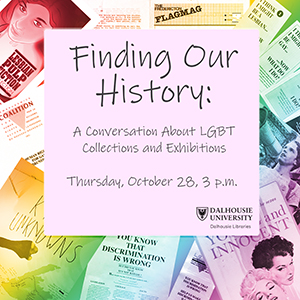
To celebrate LGBT History Month, join our group of panelists for a showcase of 2SLGBTQIA-focused collections, exhibitions, and history projects from across Atlantic Canada. Moderated by Nova Scotia LGBT Seniors’ Archive founder Jacqueline Gahagan, panelists will discuss how these projects enable members of the community to find, access, and interact with information about 2SLGBTQIA history in the region.
This event is presented by the Dalhousie Libraries, home of the NS LGBT Seniors’ Archive.
The Dalhousie Libraries is trialing the recently launched online version of the MLA handbook. You can access the trial here: https://dal.ca.libguides.com/mlahandbook
The trial ends on November 14, 2021.
Guidance on how to use the Handbook is available here: https://mlahandbookplus.org/pages/how-to-use
Feedback about the MLA Online Handbook can be sent to Library.Collections@Dal.ca
This year’s theme for Open Access Week is It Matters How We Open Knowledge: building structural equity. This theme really highlights that making your research open benefits not only our local community but the world — anywhere researchers, professionals, or decision-makers lack the subscriptions necessary to access the research they need.
To celebrate Open Access Week this year, we put together five tips to engage and introduce the Dalhousie University community to ways we can open our work using Dalhousie tools and resources. See below for more information on Open Access Week and quick links to the OA Week tips we featured all week on social media.
For more information on open access week, visit: http://www.openaccessweek.org/
Tip #1: Author’s Rights
https://dal.ca.libguides.com/open_access/2021_Tip1
Tip #2: Versions of a manuscript and Sherpa Romeo
https://dal.ca.libguides.com/open_access/2021_Tip2
Tip #3: DalSpace
https://dal.ca.libguides.com/open_access/2021_Tip3
Tip #4: Gold OA & APCs
https://dal.ca.libguides.com/open_access/2021_Tip4
Tip #5: Impact of Open Data
https://dal.ca.libguides.com/open_access/2021_Tip5
Join us for a reading and discussion with Francesca Ekwuyasi, the author of this year’s Dal Reads book, Butter Honey Pig Bread. This is event is presented by Dal Reads, Dalhousie’s unity reading program.
The eBook is available to all current students, faculty, and staff of Dalhousie.
This event will be online and is open to members of the public. Please register to receive the link to attend.
by Louise Gillis
If you are a faculty member, researcher, or graduate student who wants to know more about Research Data Management — this webinar series is for you! The CAUL-CBUA Research Data Management (RDM) Webinar Series will teach you everything you need to know about the Tri-Agency Research Data Management Policy and how you can be ready to meet the policy requirements.
Session 1 — RDM Basics – What You Need to Know
Date: Thursday, October 7, 2021
Session 2 — Help! I Need a Data Management Plan! Get Started Using the DMP Assistant and More
Date: Thursday, October 21, 2021
Session 3 — Where to Deposit Your Data: Dataverse? FRDR? Other?
Date: Thursday, November 4, 2021
Session 4 — Leveraging Advanced Digital Research Infrastructure to Support Research Data Management
Date: Thursday, November 18, 2021
More information and registration: https://caul-dpsc.github.io/
Sessions are also available in French:
Jeudi 14 octobre: Introduction à la GDR – Ce que vous devez savoir
Jeudi 28 octobre: À l’aide! J’ai besoin d’un plan de gestion de données! Utilisez l’assistant PGD et plus encore
Jeudi 11 novembre (changement de date possible à confirmer en raison d’un conflit d’horaire avec le Jour du souvenir): Où déposer vos données – Dataverse? DFDR? Autre?
Jeudi 25 novembre: Exploiter l’infrastructure de recherche numérique d’avant-garde pour soutenir la gestion des données de recherche
More information and registration: https://caul-dpsc.github.io/
As part of Dalhousie’s ongoing commitment to reconciliation, the Dalhousie Libraries is administering a course titled 4 Seasons of Reconciliation which is available to all Dalhousie faculty, staff, and administration. This year, the course is funded by the Faculty of Engineering; responsibility for funding the course will be shared across different faculties and units in future years.
According to Theresa Rajack-Talley, Vice-Provost for Equity and Inclusion: The urgency for us to act on the Truth and Reconciliation Commission’s Calls to Action has never been more immediate as the horrific uncovering of thousands of unmarked children’s graves at former residential school sites continues across Canada, further amplifying the damage that residential schools have done.
The Truth and Reconciliation Commission (TRC), formed in 2008, was created to work towards a stronger and healthier future by telling the truth about what happened at residential schools and rebuilding and renewing relationships between Indigenous Peoples and Canadian settlers. The process of rebuilding relationships is called reconciliation and it applies to both institutions and individuals. It is an ongoing commitment we all must undertake.
For individuals ready to take action now, the online course 4 Seasons of Reconciliation is a good place to start. The course provides decolonialized education in line with the Truth and Reconciliation Commission’s Calls to Action. The course is broken down into 10 modules and does not have to be completed in one sitting. It can take approximately 3.5–4.5 hours to complete the course and a certificate is issued upon completion.
“In partnership with the Dal Libraries, we launched this initiative for Engineering faculty and staff in July. We are very pleased to see that it can now be extended to all Dalhousie faculty and staff,” said John Newhook, Dean, Faculty of Engineering.
The course was developed by Reconciliation Education, an e-learning producer of online resources, and the First Nations University of Canada for workplaces and the education sector. An Indigenous Advisory Circle, comprised of Elders, Knowledge Keepers, educators, and members of the First Nations University of Canada, was consulted on the creation of the course.
Register now for the 4 Seasons of Reconciliation course.

Roger Brush, pictured third from left in the back row, with the rest of the Classroom Technologies Team; Director of ATS Marc Comeau; Manager of Services, Support & Training for ATS Mick Bottom; former Dalhousie President Richard Florizone; and Dean of Libraries Donna Bourne-Tyson.
At the end of July, our colleague Roger Brush retired. Roger’s affiliation with Dalhousie began in the 80s; as a student, he worked in the Language Lab in the basement of the Killam before being hired as the lab supervisor in 1987.
Over the years, Roger has worked in various roles with the Centre for Learning & Teaching and Information Technology Services. We were fortunate to have him join the Dal Libraries in April 2017 when the Classroom Technologies department was created within our Academic Technology Services unit.
Roger’s wealth of experience made him an incredibly valuable member of the Classroom Technologies team. During his time with us, Roger worked in the Life Sciences Centre AV support office — a very busy location — but he always rose to the challenges that came his way. He consistently provided excellent service and ensured that the classroom technology needs of faculty were met.
Please join us in thanking Roger for his hard work and wish him the best on his retirement!
Several users have flagged an issue with accessing Elsevier products including Scopus and ScienceDirect articles.
We have contacted Elsevier, who is working on the problem. At this time, they do not have any more information on the issue, or when it will be resolved.