Following this afternoon’s power outage on campus, the Killam Memorial Library and the Wallace McCain Learning Commons will reopen at 5 p.m. today. We apologize for the inconvenience.
Two Locations of the Dalhousie Libraries Open on the National Day for Truth & Reconciliation
 Friday, September 30 is the National Day for Truth & Reconciliation. It is a day to honour the children who never returned home and Survivors of residential schools, as well as their families and communities.
While there will be no classes and the university will be closed, the two locations of the Dalhousie Libraries that have Indigenous Community Rooms will be open on holiday hours:
Killam Memorial Library: 1–8 p.m.
MacRae Library: 12–5 p.m.
Dalhousie Libraries Services Update: Tues., Sept. 27
All six Halifax locations of the Dalhousie Libraries are OPEN today (Tues., Sept. 27). Halifax campuses are open but classes are cancelled.
The MacRae Library is CLOSED along with the rest of the Truro campus.
Live Help is unavailable today due to the ongoing impacts of Hurricane Fiona.
Library Hours on Sept. 19 (National Day of Mourning for Queen Elizabeth II)
Dalhousie University will follow the precedent set by our federal and provincial governments in recognizing the holiday on Monday, September 19 in honour of Her late Majesty Queen Elizabeth II’s funeral service.
Three of our locations will be operating on holiday hours, while our other locations will be closed:
Sir James Dunn Law Library: CLOSED
W. K. Kellogg Health Sciences Library: CLOSED
Kellogg Library Learning Commons (CHEB): 10 a.m.–6 p.m.
Killam Memorial Library: 1–8 p.m.
MacRae Library: 12–5 p.m.
Sexton Design & Technology Library: CLOSED
Wallace McCain Learning Commons: CLOSED
Orange Shirt Day Pin Beading Workshop (in-person, two sessions)

An Orange Shirt Day pin in progress by Michelle McDonald.
Orange Shirt Day, which is now also the National Day for Truth & Reconciliation, is coming up on September 30. In preparation for that important date, Michelle McDonald, a beader originally from Sipekne’katik who is an Instructional Support Technician with the Dalhousie Libraries, is offering an in-person beading workshop where participants will learn how to bead their own Orange Shirt Day pin.
What to know in advance:
- All materials will be supplied. There is no cost to attend.
- Only sign up if you can attend BOTH sessions of the workshop in person in the Ko’jua Okuom in the Killam Memorial Library (Sept. 14 AND 21 from 10:30 a.m.–12 p.m.).
- Beginners are welcome. It is helpful if you have sewing or embroidery experience, but it is not required.
- Due to the small size of the beads, you may find it helpful to bring an additional pair of magnifying glasses, etc.
A Very Happy Retirement to Dean of Libraries Donna Bourne-Tyson!

Donna Bourne-Tyson
After two terms as Dean of Libraries and 11 years of impressive leadership and service to Dalhousie and the community, Donna Bourne-Tyson is retiring on August 14.
Donna joined Dalhousie in 2011 as the University Librarian, making significant contributions to both physical and digital services, collections, and spaces at Dalhousie. Since Donna’s arrival, the Dalhousie Libraries expanded with the addition of two new stand-alone spaces, the Kellogg Library Learning Commons in the Collaborative Health Education Building, and the Wallace McCain Learning Commons. Additionally, all five of the Dalhousie Libraries underwent renovations, increasing student study spaces wherever possible, including significant renovations to the MacRae and W.K. Kellogg Health Sciences libraries.
Donna was instrumental in establishing a hub of the National Centre for Truth & Reconciliation at the MacRae Library, a Gord Downie & Chanie Wenjack Legacy Space and the soon-to-be launched Indigenous Community Room in the Killam Library, and the position of Indigenous Services Librarian. Other new roles created under her leadership include digital archives, scholarly communications, knowledge synthesis, and data services.
She played a leadership role in the creation of university policies and supporting services for copyright, records management, data access, and research data management. In 2013, the Dal Libraries took on the responsibility for instructional technology — Brightspace, Urkund, Panopto and other critical online teaching tools which have served Dal well throughout the last two years of the pandemic. The Libraries also took on the management of classroom technologies, continuing the Dal Libraries’ model to provide excellent services and support in both virtual and physical learning environments.
Under Donna’s leadership, Dalhousie has made significant gains in the digital world. The Dal Libraries’ capacity to provide eResources, online instruction, and services has grown exponentially. Donna recently co-chaired the process to develop Dalhousie’s Digital Strategy, a plan that will lead to a seamless digital student experience, increased digital literacy for all Dalhousieans, and equitable access to digital systems and training.
In 2019, Donna received the Ken Haycock Award for her remarkable range of board roles in regional, national and international associations and consortia, for founding and shepherding multiple new organizations, and for her leadership and dedication as an ambassador and role model for librarianship. This year, she was honoured with the Canadian Association of Research Libraries (CARL) Award for Distinguished Service to Research Librarianship.
While Dean of Libraries, Donna made significant contributions to research librarianship through her leadership and engagement in national and international organizations. Donna served as Chair (2017–2019), Vice-Chair/Chair elect (2015–2017), and Treasurer (2009–2011) of the Council of Atlantic University Libraries, in addition to leading a diversity of initiatives and committees. The same is true at a provincial level within the Novanet consortium, having served as Chair and Vice-Chair.
She was CARL President from 2017–2019, preceded by terms as Vice-President/President-Elect (2015–2017) and Treasurer (2012–2015), leading CARL through a period of dramatic evolution in the world of research libraries and preparing us well for the pandemic era.
Donna served as Vice-Chair of the Canadian Research Knowledge Network (2011–2014) and most recently as an elected member on the inaugural Board of Directors of the Digital Research Alliance of Canada (2020–2022). She has also continued to represent the Canadian library perspective and enhanced international alignment as a board member of the International Association of University Libraries (IATUL) serving as Treasurer (2019–2021) and Secretary (2022). She also brough the IATUL conference to Dalhousie in 2016, welcoming librarians from across the globe to our campus.
She was a founding member of the BlueSky Network, a partnership of public, academic, and First Nations libraries in Northern Ontario. Representing the Atlantic Provinces Library Association (APLA), she was one of the original members of The Partnership, Canada’s national network of provincial and territorial library associations. She also co-chaired the Interim Board during the founding days of the Canadian Federation of Library Associations (CFLA).
Please join us in congratulating Donna on her outstanding career and accomplishments and thanking her for her time at Dalhousie, as we wish her the very fondest of farewells.
Happy Retirement, Joan Chiasson!
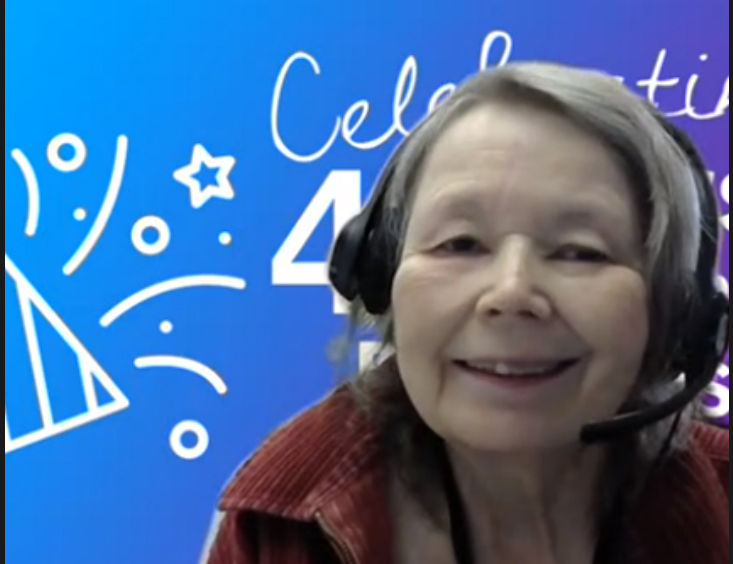 The Dalhousie Libraries is bidding farewell to one of its longest-serving employees, Joan Chiasson.
Joan’s career with the Libraries began in 1981 as part of the Government Documents department. At that time, Government Documents was a separate unit under the leadership of librarian Shelagh Keene with a staff of two: Joan, and colleague June Tasker. The department received, catalogued, and shelved all documents representing federal, provincial, municipal, and international governments, sometimes several hundred a day. They also answered reference questions relating to governmental organization and publications. During Joan’s time with Gov Docs, the collection was moved six times. Anyone who has worked with government publications will recognize the challenge of moving so many short publications that are not in hard cover binding. Joan says that the days leading up to provincial and federal elections were always fun.
Joan has seen many changes in library services over the years. When a reorganization of the public service areas in the library, the reference queries that had been going to the Government Documents Department were directed to the general reference desk. Joan then started working regular shifts at the general reference desk. She credits the subject specialists for helping her through the steep learning curve of the other subject areas. In return, she was often called on as a resource person for government documents queries. She has also been a regular service provider for the Novanet LiveHelp chat reference service.
With the increase of electronic publication of government materials and further restructuring in the Libraries to meet changing needs, Joan moved to the Archives and Special Collections unit in 2012-2013. There she learned to provide reference assistance for another set of specialized collections. She also learned new standards for cataloging materials, this time for processing archival collections and mediating thesis deposits for DalSpace, the university’s institutional repository.
The primary highlight of her varied career has been the people she has worked with over the years, particularly Shelagh Keene, June Tasker, Jane Archibald, Andrew Finch, Sharon Longard, Geoff Brown, Phyllis Ross, Donna Bourne-Tyson, Michael Moosberger, and Courtney Bayne.
Outside of the Libraries, Joan is skilled at needlework and costume design. She has had a long association with a local medieval group and has created many beautiful medieval gowns and costumes for fellow society members.
Thank you, Joan, for over 40 years of dedicated service to the Dalhousie Libraries. We wish you all the very best for your next set of adventures in retirement!
All Locations of Dalhousie Libraries Closed Monday, August 1 (Natal Day)
 All locations of the Dalhousie Libraries will be closed Monday, August 1 for the Natal Day holiday. Enjoy the long weekend, everyone!
Intern Profiles 2022: Annette Amenta

Annette Amenta (she/her)
What is your favorite summer activity? Or your favourite Halifax activity?
Since moving to Halifax, I love seeing what’s in bloom at the Public Gardens, visiting local bookstores, and walking along the Waterfront.
What internship are you affiliated with?
I’m the Archives Intern at Dalhousie University Archives, located in the Killam Memorial Library.
What brought you to the Master of Information (MI) program at Dal?
I have always loved helping others research and find relevant information using a critical lens. I thought that the MI program at Dal would complement my history and teaching background perfectly.
What drew you to the internship opportunity at the Dal Libraries?
I thought the internship opportunity would be a great way to gain practical experience in a field that was still relatively new to me. I would get to know the day-to-day roles of archivists and other information professionals and see if it was the right fit for me — which it definitely is!
What’s your educational background?
B.A. Combined Honours French and History (McMaster University)
M.A. History (Western University)
B.Ed. Intermediate/Senior French as a Second Language and History (Western University)
What projects have you worked on so far during your internship?
I have been working primarily on the Joy O’Brien fonds, which consists of material related to the Nova Scotia Mass Choir, a local choir that has performed throughout North America and was, and is, highly involved in anti-racism initiatives. This is a bigger collection that involves processing, rehousing, and describing thousands of photographs, in addition to textual records, video cassettes, and audio cassettes.
I have also started work on processing, describing, and rehousing Paul Cram’s musical scores and recordings. Paul Cram was a local, Juno-nominated jazz musician and composer.
Some upcoming projects include processing and describing exhibition catalogues and files from the Dalhousie Art Gallery fonds and creating a video tutorial for a file transfer tool using Camtasia.
In Search of His Roots: Residential school survivor Jim Prosper’s extraordinary book collection finds new home at Dal
story originally published in Dal News on June 21, by Marlo MacKay

Selections from the collection are on display now in the Indigenous Community Room, which opened Tuesday on National Indigenous Peoples Day. (Collection photos by Matt Reeder, others contributed)
When Jim Prosper was born in 1925, his mother was eighteen and not married. As was common for a young woman in that situation at the time, she gave up her son for adoption. Jim lived the first five years of his life in a Halifax orphanage, and in 1930 became a resident of the Indian Residential School in Shubenacadie, which was the same year it opened. He lived there until he was 18.
Upon leaving the residential school, Jim, a proud Mi’kmaw, served in the Second World War. When he returned to Mi’kma’ki, Jim attended St. Francis Xavier for two years to study engineering, followed by two more years at the Nova Scotia Institute of Technology (which later became the Technical University of Nova Scotia and then Dalhousie’s Faculty of Engineering) to complete his engineering degree. Jim is believed to be the first Indigenous engineering graduate from both institutions.

Jim Prosper’s 1952 graduation photo from the Nova Scotia Institute of Technology.
After a distinguished career that included being a lead engineer on Cold War intelligence projects, Jim retired in 1984. It was during this period of retirement that Jim decided to spend his time researching his genealogy in the hope of learning more about his mother and finding anything he could about his father. He made many visits back to the East Coast from his home in Ottawa, travelling to First Nations communities in the region and talking with the people who lived there.
Through his visits, Jim eventually learned who his mother’s family was, meeting people who knew his mother and who could also tell him about his father — believed to be an American sailor. When he visited these communities and got to know the people, Jim kept hearing the same thing everywhere he went: “This reserve is shrinking, the land is being taken away.”
This topic ignited a passion in Jim, and he soon became an ardent researcher of colonialism, aboriginal treaties, rights, and sovereignty. That’s when he began curating an impressive book collection — one that has now found a new home at Dalhousie.
“My father was the hardcopy Google before Google,” says Ron Prosper, one of Jim’s three grown children. “For my dad, it was important to have hard copies of everything. He never got into digital, and he never wanted to leave information behind. He had to own the book; it wasn’t enough that he could borrow it from a library.”
Book dealers on ‘speed dial’
Jim amassed his extraordinary book collection over twenty years, dealing with some of the most well-known antiquarian book sellers in Canada. “He had antiquarian book dealers on speed dial,” says Ron. The most unique books in Jim’s collection are bibles, hymnbooks, and catechisms in Mi’kmaq, some dating to the late 1800s.
Eventually, Jim’s book collecting slowed down, and once he reached his nineties, it became challenging for him to continue living alone. His family helped him move to a senior’s residence — where, at 97, he still lives — and then came the difficult job of packing up the homestead.

The bookplate that appears in all donated books. Artwork by Chelsea Brooks, Indian Brook Reserve.
Ron knew his father’s book collection was special, having seen how much love and effort he had put into curating it. “I knew that if the collection was ever going to survive intact, there were very few institutions that would have the capacity to take it on. I felt that a university, being an institution devoted to learning, would be the best place for the collection. I also wanted to take it somewhere close to my father’s birthplace, and that was how I decided upon donating the collection to Dalhousie,” says Ron.
Exceedingly rare and old
Phil Laugher, a digital asset technician in the Dalhousie Libraries with a twenty-two-year background in the antique book trade, assessed Jim’s collection and says it is one of the most thorough he’s ever encountered. “This collection was developed through a meticulous effort. It was a true labour of love in both the quality and quantity of the materials. There are 100-year-old items in pristine condition, and in some cases, only two other libraries in the world have some of these titles,” says Laugher.
The exceedingly rare and old books will be securely housed in Dalhousie Libraries Special Collections, while the more contemporary books will be found on the shelves in the newly launched Indigenous Community Room, found on the first floor of the Killam Memorial Library in the Gord Downie and Chanie Wenjack Legacy Space. The room, collaboratively designed with members of the Indigenous community at Dalhousie, creates a welcoming gathering place for Indigenous students, staff, and faculty to host and attend Indigenous ceremonies and events.

Jim’s personal stamp, which appears in many of the books he donated.
“Things just could not have gone better,” Ron says, of the process of donating more than 700 books from his father’s collection to the Dalhousie Libraries. “There were so many people with the right expertise working on this donation at Dalhousie, and the timing of the donation coinciding with the opening of the Indigenous Community Room in the Killam Library, it’s all part of the wonderment of how this unfolded.”
Jim was not able to travel to the official opening Indigenous Community Room on Tuesday morning where his collection was being introduced to the Dalhousie community, but Ron and some members of his family were honoured guests at the event, with Ron giving remarks about his father.
“There is a unique story behind each of the collections that our donors give to the Dalhousie Libraries,” says Donna Bourne-Tyson, dean of Libraries. “The genesis of this particular collection and how it supported Jim Prosper’s understanding of his family and his Mi’kmaq heritage makes it a very special and moving story. We are honoured to be entrusted with the preservation and sharing of this collection.”


