The MacRae Library is closing at 4 pm today due to weather conditions. Check with the Agricultural Campus for information on what times other buildings on campus are closing.
The MacRae Library is closing at 4 pm today due to weather conditions. Check with the Agricultural Campus for information on what times other buildings on campus are closing.
 We are pleased to introduce Deborah Hemming, our new limited term Learning & Instruction Librarian. Deborah will be at the Dal Libraries until October 31.
Deborah has worked as a librarian at Simon Fraser University and as a research and innovation coordinator at Acadia. In 2016/17, Deborah worked as a reference assistant in the Killam Library while she completed her Master of Library and Information Studies degree. Deborah also holds a Bachelor of Arts and a Masters of Arts, both in English.
Deborah is a published author. Her novel Throw Down Your Shadows is published by Vagrant Press and will be released in June of this year.
Please join us in welcoming Deborah!
 We are pleased to introduce Louise Gillis, our new limited term Data Librarian. Louise will be at the Dal Libraries until October 31.
Louise has worked as a research librarian in Australia and as a bookmobile librarian in Nova Scotia. She has also worked as a research assistant, a summer reading program coordinator, and an executive assistant. She has experience with data management, developing collections, building resources, and preparing and delivering instructional material. In addition to holding her Master of Library and Information Science, Louise holds a Bachelor of Science in Psychology.
Over the last fifteen years, Louise has lived and worked in five different countries, developing strong communication skills and an appreciation for diversity.
Please join us in welcoming Louise!
Dalhousie University, along with a number of members of the Council of Atlantic University Libraries (CAUL) and other universities across Canada, has entered in to a Service Agreement with the Ontario Council of University Libraries (OCUL) to host an institutional Dataverse on the Scholars Portal Dataverse. Dataverse is an open-source web application used to deposit, share and cite research data. It was developed by the Institution for Quantitative Social Science at Harvard University.
Why deposit data in Dataverse?
There are many benefits for a researcher to depositing data in the Dataverse repository. Research Data Management Librarian Erin MacPherson suggests that Dataverse can help you to effectively manage your data and save time. “There are useful features such as the ability to assign roles and permissions and licenses. Publishing your data in a data repository helps to meet emerging grant and funding requirements. Finally, publishing your data can help increase research visibility,” observes MacPherson.
Benefits of an Institutional Repository for Dalhousie University on Scholars Portal Dataverse
Dean of Libraries Donna Bourne-Tyson notes, “One of the biggest benefits with having an Institutional Dataverse on the SP Dataverse is that we are contributing to the effort for a robust national data repository. We already have a strong collective effort to develop research data management tools and resources through the Canadian Association of Research Libraries’ Portage Network, and this will further assist these endeavors.”
Some of the other benefits include:
What happens to the Dalhousie’s existing Dataverse?
The Dalhousie Libraries currently hosts a local instance of Dataverse; however, from this point onwards, all new datasets and users will be directed to use Dalhousie’s institutional Dataverse hosted on the Scholars Portal Dataverse site. Over the coming year, the data management team will be in touch with existing users about migrating their data to the Dalhousie Institutional repository hosted on Scholars Portal Dataverse site. A decision will be made about maintaining a locally hosted instance at the end of the year.
Want to learn more?
If you are interested in using Dataverse to publish your data or would like a demonstration, please contact data.management@dal.ca and have a look at some of our training materials:
Most of our locations are now running on holiday hours. We will close at noon on December 24 and reopen on January 2, except for the Killam Library, which will be open for reduced hours on December 28 and 29. Please check the hours widget on libraries.dal.ca for exact hours before heading to any of our locations this week. Happy holidays from all of us at the Dalhousie Libraries! 
(by Marlo MacKay, originally appeared in Today @ Dal)
A significant new collection of over 500 books is now available at the Dalhousie Libraries. The materials were all handpicked by one of Canada’s most eminent landscape architects, Cornelia Hahn Oberlander.

Cornelia Hahn Oberlander
Ms. Oberlander, a Companion of the Order of Canada and one of the first women to graduate from Harvard with a landscape architecture degree in 1947, has designed both high-profile buildings in Canada, Europe and the U.S. and landscapes for low-income housing projects. She also designed landscapes for playgrounds, including the Children’s Creative Centre Playground, Canadian Federal Pavilion, featured at Expo ’67 in Montréal.
With over 70 years of experience as a landscape architect, Ms. Oberlander has amassed a significant professional library. Recently, she donated that collection to the Dalhousie Libraries.
Ms. Oberlander reached out to Christine Macy, then dean for the Faculty of Architecture & Planning, in June 2018. She wanted to donate her professional collection to Dalhousie University after hearing about the construction of the new Emera IDEA Building at Dalhousie’s Sexton campus and because the university was working towards starting a master’s program in landscape architecture at Sexton Campus.
“The materials in the Oberlander collection are wonderfully diverse, including books on grasses, trees, flowers, and the importance of bees, butterflies, and insects. This collection will be invaluable to aspiring and experienced landscape architects,” says Donna Bourne-Tyson, Dean of Libraries. “On behalf of the Dalhousie Libraries, I’d like to express our sincere thanks to Cornelia Hahn Oberlander for this significant gift.”
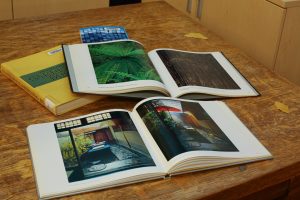
A selection of books from the collection.
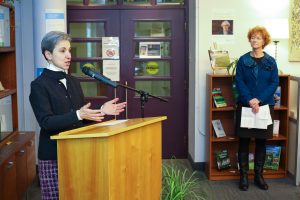
Dean of Architecture and Planning Joseli Macedo and Dean of Libraries Donna Bourne-Tyson
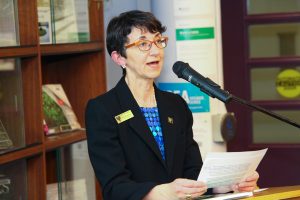
Associate Dean Resources and Head of Sexton Design and Technology Library Michelle Paon
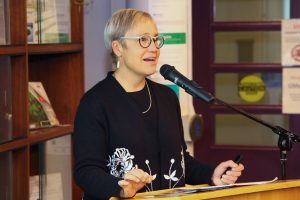
Landscape Architect Sue Sirrs
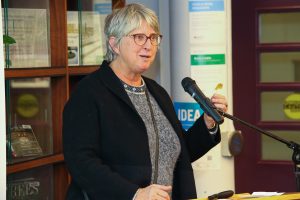
Former Dean of Architecture and Planning Christine Macy
Most of the collection is at the Sexton Design & Technology Library and some of the collection is at the MacRae Library, but books can be sent to any Novanet library through the Novanet Express service, making them accessible to a much wider audience. Many of the titles are unique to the Novanet catalogue.
To celebrate this extraordinary acquisition, the Dal Libraries recently held a reception with attendees from the local architecture community, faculty members from the Faculties of Architecture & Planning and Agriculture and other special guests. (Ms. Oberlander, based in Vancouver, was not available to attend.)
Donna Bourne-Tyson hosted the event, which featured remarks from the Dean of Architecture & Planning Joseli Macedo, Associate Dean Resources and Head of the Sexton Design & Technology Library Michelle Paon, local landscape architect Sue Sirrs, and former Dean of Architecture & Planning Christine Macy.
Both Sue Sirrs and Christine Macy know Ms. Oberlander personally. Sue Sirrs shared a collection of personal photographs featuring Ms. Oberlander and a group of local landscape architects, remarks from Ms. Oberlander’s convocation address when she received an honorary doctorate from Dalhousie in 2008, as well as a humorous anecdote praising Ms. Oberlander’s steadfast nature.
Christine Macy explained the significance of the ginko leaf, Ms. Oberlander’s personal symbol, which represents longevity and endurance. Like the ginko leaf, Ms. Oberlander herself embodies longevity and endurance as she maintains her landscape architecture practice into her 90s. In correspondence with the Dal Libraries, Ms. Oberlander explained that she found a ginkgo leaf in Nanjing in 1976 on a walk to the tomb of Sun Yat-sen, a Chinese philosopher, physician, and politician considered by many to be one of the greatest leaders of modern China.
The task of processing and preparing the collection for the shelves has taken staff and librarians at the Dal Libraries the better part of this year, and as they worked, they delighted in becoming acquainted with this unique collection. In addition to the materials added to library shelves, the Dal Libraries will be making some items, mostly duplicate titles, freely available to students, according to Ms. Oberlander’s wishes, giving students the opportunity to add to or start their own professional libraries.
“Thanks to Ms. Oberlander’s generosity, this collection adds a significant dimension to the landscape architecture resources of the Dalhousie Libraries,” says Michelle Paon. “Faculty, students, alumni, community members, and researchers will have access to a wider range of relevant materials as well as the opportunity to consult books and journals that both informed and inspired Ms. Oberlander’s landscape architecture decisions.”
Cornelia Hahn Oberlander continues to inspire the landscape architecture community. Recently, The Cultural Landscape Foundation (TCLF) announced that the $100,000 International Landscape Architecture Prize will be named for Ms. Oberlander, who they call “the Dean of Canadian landscape architects.”
More information about the Oberlander collection, including the complete lists of titles added to the Dalhousie Libraries, is available at the Dal Libraries website.
 Dr. Guylaine Beaudry is Vice-Provost, Digital Strategy and University Librarian at Concordia University. She led the major renovation of the Webster Library and the transformation of the chapel of the Grey Nuns motherhouse into a reading room.
Since August 2017, she has been leading the university-wide digital strategy. She was previously Executive Director of Érudit (www.erudit.org), a publishing platform for humanities and social sciences scholarly books and journals. She wrote many publications on scholarly publishing, notably, the books La communication scientifique et le numérique (Hermès/Lavoisier, Paris); Le nouveau monde numérique et les revues scientifiques (Les Presses de l’Université de Montréal [PUM] and La Découverte, Paris, France), that was translated and published by University of Calgary Press (Scholarly Journals in the New Digital World); and Profession : bibliothécaire (PUM).
She was recently elected member of the Royal Society of Canada and served in 2014 on its Expert Panel on the status and future of libraries and archives in Canada. She holds a doctorate in history of the book from École pratique des hautes études (Paris). Her thesis is entitled “Scholarly communications and the digital revolution: Analysis of a mutation period from a historical perspective”.
Wednesday November 27, 4 p.m.
Room 3089, Rowe Management Building
Reception with light refreshments to follow.
Presented by the School of Information Management and Dalhousie Libraries.
 Starting on November 17, the Kellogg Library Learning Commons in the CHEB, the first floor of the Killam Library, and the Student Learning Commons in the MacRae Library will stay open till 3 a.m., Sundays through Thursdays.
Prefer mornings? Starting November 23, the MacRae Library will open at 10 a.m. on Saturdays and the Killam Library will open at 8 a.m. on Saturday and Sunday mornings.
Are you a night owl or an early bird? Either way, the Dal Libraries are here for you.
Night Owls is for Dalhousie and King’s students. A valid DalCard is required.
 Renowned landscape architect Cornelia Hahn Oberlander CC donated her extensive professional collection to the Dalhousie Libraries. Please join University Librarian Donna Bourne-Tyson, Dean Joseli Macedo, and special guests as we celebrate the donation of an important new collection.
All are welcome.
Thursday, November 21, 4:30 p.m.
Sexton Design & Technology Library
5620 DaCosta Row, Building B, 3rd floor
RSVP: marlo.mackay@dal.ca
Learn more about Cornelia Hahn Oberlander and see bibliographies of the donated titles here.
(This story originally appeared in Today @ Dal on October 31, 2019.)
by Marlo MacKay
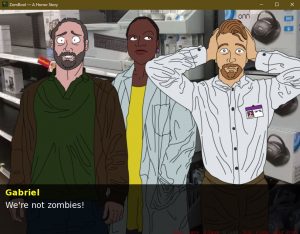 Zombie video game helps students with search skills
From 1968’s Night of the Living Dead by George Romero to each week’s episode of The Walking Dead, zombies are a perennial pop culture favourite. And with the Halloween season upon us, you’re probably seeing even more references to zombies — even in the Dal Libraries.
No, you can’t blame zombies in the library for why you didn’t turn in last week’s paper on time — but you could have zombies in the library to thank for your superior researching skills when your next assignment comes in ahead of schedule.
Enter ZomBool, a video game in which you try to survive the zombie apocalypse by successfully applying search strategies. A passion project created by data librarian Julie Marcoux, the game combines a zombie-themed, chose-your-own adventure storyline using Boolean search strategies to play the game.
Play the game: Download Zombool
Players start out learning that zombies have reached their city and are asked to help a character named Évangeline build a creature made of body parts of the dead to use in the fight against the zombies. The creature can’t be reanimated without a defibrillator, so the player has to make a decision — will they go to a pharmacy to find a defibrillator, find a weapon to defend themselves, or find Évangeline’s friend who may have a defibrillator in their dorm room?
“The choices you make will have an impact on the overall story,” says Julie. “The number of survivors and the endings change depending on how well the player does with the search strategies.”
 Scarily effective Boo-lean strategies
Julie has been an academic librarian since 2011. After about a year in the role, she noticed a pattern — many students had difficulty when it came to searching for information.
In particular, they were struggling with Boolean searches — combining keywords with AND, OR and NOT to produce more relevant results.
(For example, if you search museum AND Halifax, the results would be limited to documents that contain both of the keywords. Searching for museum OR Halifax would include documents that contained either of those terms, while a search for museum NOT Halifax gets results about museums with no reference to Halifax.)
“[It] works like math,” explains Julie. “In math, you use operators to put numbers in relation to one another. In Boolean searching, you instead use operators that work with words. It’s a phenomenon that’s been recorded in librarian literature – digital natives [people who’ve grown up with the Internet in their lives] don’t always have the strongest searching skills.”
And so, in her free time, Julie developed a game to teach students how to become better library researchers. She started working on the game in 2012, before she started working at Dal. As time allowed, she’d work on the game, eventually putting in hundreds of hours before completing it in 2018.
“I’ve always liked doing little bits of light programming, but I’d never made a game before so I had to learn how to do that. Then I had to put together a story, different paths, different endings, as well as finding the art and the music. It was my idea but I had help.”
This included assistance from her family and her partner, who created the original artwork in the game. Some of the characters are even based on a few of her Dalhousie librarian colleagues, who gamely posed for photos that were then sketched into digital art. (Her colleagues helped test the game, too.)
Julie introduces many students to the game during her classroom visits, but she hopes students will also find the game fun enough to play outside of the classroom.
“I would really like for Dal students to start playing the game and I’d love to see universities across Canada and even the world try out the game — I have made it open access so that kind of sharing is possible,” says Julie.
Zombool can be played in English or French and is accessible for the visually impaired. With three possible paths and four possible endings, it can also be played multiple times, and for repeat players, there’s a little humour to go along with the gory theme. “If the player decides to replay the game, they get the same story options, but are given the opportunity to add more kittens,” says Julie.
The game is available for download from the Dal Libraries website or you can access the game on the computers at the Halifax locations of the Dal Libraries (except for the “express” computers).
Julie is proud of the game, which is a product of both her love for video games and helping students become better researchers.
“It’s really nice when a student can do a search and suddenly they get relevant results. They’re no longer trying random searches just hoping to find what they need,” says Julie.