Blind date with a book is happening now in the libraries!
We want to set you up with the book of your dreams – find love in a library near you.
Find our book displays at the Killam, Kellogg, Sexton, and Dunn libraries.

Blind date with a book is happening now in the libraries!
We want to set you up with the book of your dreams – find love in a library near you.
Find our book displays at the Killam, Kellogg, Sexton, and Dunn libraries.
 We are pleased to share our recently published 2022-2023 annual report, which contains stories about our programs and collections, project updates, event information, and library news.
Our annual report is a celebration of students, staff, and the Dalhousie community. In it, you will read about how we are leading the way in developing citation guidance for artificial intelligence, preserving critical works like the Stirling County Study by Alexander H. Leighton, and providing space for learning about and celebrating Mi’kmaw language and culture. You will read about critical systems updates, as well as the retirement of several dedicated library staff – five of whom worked at Dalhousie Libraries for more than 40 years.
We hope you enjoy our 2022-2023 annual report.
 In honour of ICPSR’s International Love Data Week 2024, which has the theme of “My Kind of Data”, Dal Libraries is hosting a series of presentations open to everyone, aimed at providing insights into varied aspects of working with data. Whether your kind of data is easy to digest or complex, you may very well find the right tool or approach that you need during a Love Data Week event.
Taking place from February 12-16, these (free) presentations include:
To register for more online sessions presented by Dalhousie Libraries and other organizations in Atlantic Canada – including a great talk for faculty and staff from Dalhousie’s Dr. Margaret Robinson hosted on Monday, February 12, from 2 pm to 3 pm by the Council of Atlantic Academic Libraries CAAL-CBPA – check out our Love Data Week Research Guide. You will find registration links with more information in our Events section.
Please note, as part of the Killam Library Deep Energy Retrofit, the McNab Reading Room and Upper Learning Commons on the second floor of the Killam will be closed from January 29 until March 16, 2024.
We apologize for the inconvenience. Students are encouraged to find alternative study space at the Killam or any of our other Halifax campus locations:
By Catherine Gracey and Hailey Wills
Now that the school year is well underway, the W.K. Kellogg Health Science Library is pleased to highlight resources that can help you prepare for learning and clinical placements, as well as practice for upcoming licensing exams. The Clinical Specialties Guide contains a study tools section that details many of the key resources across the Health Sciences, including media resources, a list of reference books, calculators, fast facts, and clinical practice guidelines. Listed in the guide is The Secrets Series, comprised of books containing question-and-answer content on numerous clinical specialties and topics. In our print collection, there are several physiology and anatomy-focused colouring books that can supplement your studying. These can be found by searching the Novanet catalogue for “colouring book” and narrowing the search to “DAL Health Science Library” using the filters on the left side of the screen, or by visiting us in-person at the Tupper Medical Building.
Acland’s Video Atlas and Anatomy.tv are both tools that can be useful for studying anatomy. Acland’s has 5 volumes of anatomy videos that feature real human cadavers, and an affiliated quiz for each volume. To access the quizzes, simply create a personal account using your Dalhousie email. Anatomy.tv has an extensive and interactive 3D atlas of the human body and a quiz with various settings for question types and difficulty. You can also download a variety of Health Mobile Apps, including Medscape, which contains simulations and quizzes.
Of particular interest to students in Medicine, you have access to BoardVitals, an effective medical exam review tool. After registering register with your Dalhousie email address, browse questions by clicking on “My Dashboard” on the top right-hand corner of the screen and select either USMLE Step 1, 2, or 3, or choose from specialized question banks in various specialties. Once you have selected your question bank, you can browse, start a quiz, and track your performance.

Access Medicine is another popular resource that also offers practice questions. With its Clinical Practice & Board Review questions and flashcards on multiple topics (found under the Study Tools dropdown menu), there are a variety of options to help with your studies. You can design custom questions based on Katzung & Trevor’s Pharmacology: Examination and Board Review, a key textbook in Pharmacology, among many other core texts. To do this, navigate to the book and locate “Go to Review Questions” under the title. From there, you can generate a random quiz, or build a custom version by selecting the number of questions you would like from various topics.
Bates’ Visual Guide and Jarvis Physical Assessment Video series can also support your studies, specifically in physical examination and assessment preparation, including for OSCEs (Objective Structured Clinical Examinations). Finally, Mosby’s Video Series and Films on Demand will be of particular interest to those in nursing, as they contain useful nursing skill demonstrations.
No matter your program or year of study, we are here to support you in your learning and research endeavours. Don’t hesitate to contact us by email at kellogg@dal.ca, by telephone at (902) 717-5244, or by stopping into our locations in the Collaborative Health Education Building or the Sir Charles Tupper Medical Building. Happy studying!
 As of December 31, 2023, Dalhousie ended its subscription to UNIWeb. UNIWeb was implemented in 2019 as an information repository for researchers’ academic activity, intended to simplify the management of curriculum vitae (CVs including CCV), annual reports, promotion packages, and funding applications. It also allowed researchers to connect with colleagues and collaborators on topics of interest and to share information about their research.
Following a procurement and consultation process in 2022-23, Dalhousie decided to end its subscription to UNIWeb and encourage the use of other tools to maintain researcher profiles, such as ORCID iD, a permanent digital identifier system supported by Dalhousie through our membership of the ORCID Consortium in Canada.
“I am pleased to support Dal Libraries’ recommendation of the full use of ORCID as an alternative platform for our research community,” says Dr. Alice Aiken, Dalhousie’s vice president, research and innovation. “ORCID provides flexibility that allows scholars of all disciplines to choose how they share their activities and achievements, ensuring recognition for their work effectively and consistently over time, and it is recognized and used worldwide, including by Dalhousie scholars.”
More about ORCID and other tools that provide similar features:
1) ORCID iD – A unique identifier that ensures your research is correctly attributed to you, ORCID also provides a space to collect your research outputs, grant awards, different professional activities and links to social media and web profiles.
ORCID makes it easy to add works to your profile and determine their level of visibility. ORCID’s auto-update feature allows you to link your ORCID profile to trusted third-party sources to have it updated automatically with information from those sources to save you time.
If you don’t have an ORCID iD, registration is simple, and free. Find out more about the benefits of ORCID, and how to register or link an existing ORCID account to your Dalhousie NetID in our LibGuide.
We will also be holding an Introduction to ORCID webinar in January 2024, so stay tuned and watch our events calendar.
2) Google Scholar – If you have published in an electronic journal, information about that article, including your name as author, is probably available in Google Scholar. Google Scholar groups works by the same author together, but these profiles may be inaccurate or incomplete as Google doesn’t read the bibliographic metadata the way databases do. Because this information is already available to searchers, authors are advised to claim their Google Scholar profiles to ensure their information is accurate.
3) Scopus – Like Google Scholar, if you have published articles they are indexed in Scopus. The database creates a profile and list of your articles which may not be fully accurate. These profiles are not publicly available but they are widely consulted within academia. If you are thinking about your publicly available web profiles and haven’t already claimed and cleaned your Scopus profile, now is an ideal time. Information on how to update your Scopus profile so it is accurate and complete is available on the Author Profiles/IDs LibGuide.
As always, the Scholarly Communications team is happy to assist with any questions at scholarly.communications@dal.ca.

We are excited to announce that the 2023-2024 book title for Dal Reads is The Boat People by Sharon Bala!
About The Boat People:
In the tradition of Lawrence Hill’s The Illegal, Chris Cleave’s Little Bee, and Khaled Hosseini’s The Kite Runner, and inspired by a real incident, this high-stakes and increasingly timely novel powerfully evokes what it means to leave behind everything you have ever known to seek out a better life in a strange land.
When the rusty cargo ship carrying Mahindan and five hundred fellow refugees reaches the shores of British Columbia, the young father is overcome with relief: he and his six-year-old son can finally put Sri Lanka’s bloody civil war behind them and begin new lives. Instead, the group is thrown into prison, with government officials and news headlines speculating that hidden among the “boat people” are members of a terrorist militia. As suspicion swirls and interrogation mounts, Mahindan fears the desperate actions he took to survive and escape Sri Lanka now jeopardize his and his son’s chances for asylum.
Told through the alternating perspectives of Mahindan; his lawyer Priya, who reluctantly represents the migrants; and Grace, a third-generation Japanese-Canadian adjudicator who must decide Mahindan’s fate, The Boat People is a high-stakes novel that offers a deeply compassionate lens through which to view the current refugee crisis. Inspired by real events, with vivid scenes that move between the eerie beauty of northern Sri Lanka and combative refugee hearings in Vancouver, where life and death decisions are made, Sharon Bala’s stunning debut is an unforgettable and necessary story for our times.
About Dal Reads:
Dal Reads is designed to encourage people in the Dalhousie community to share their love of books. Launched in 2009, the program brings the Dalhousie community together through the shared experience of reading the same book and taking part in programming related to the book.
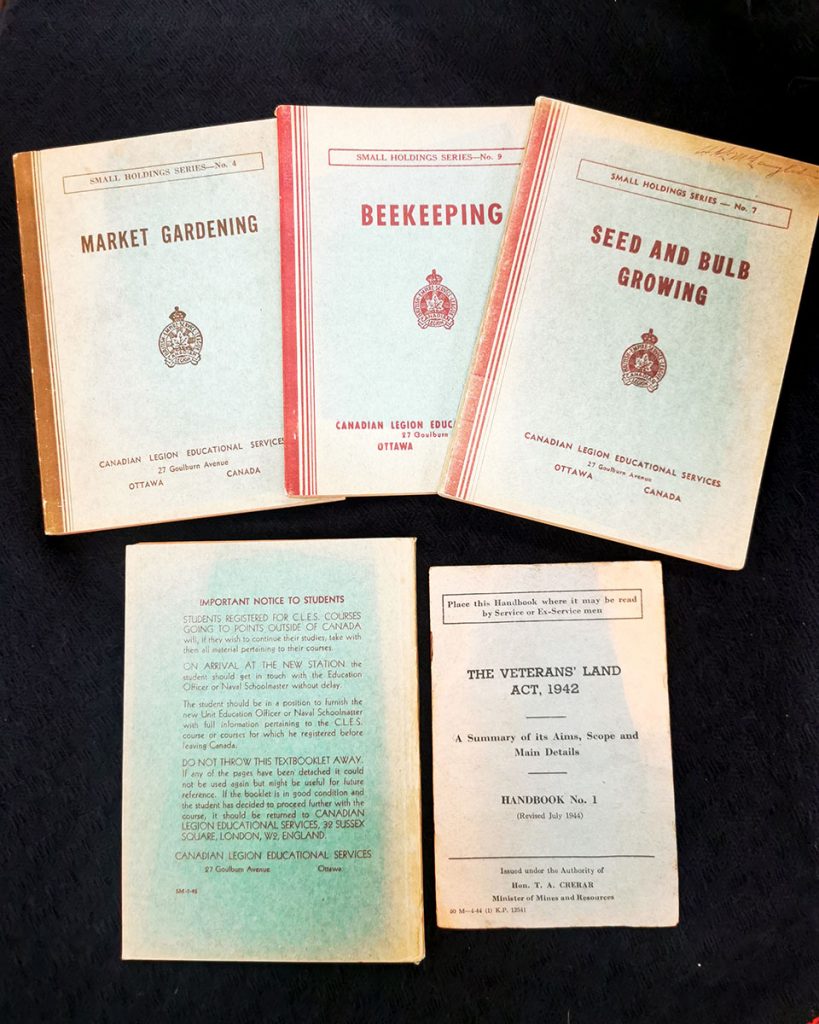 A Canadian Legion Educational Services publication series was identified while processing historical government documents at the MacRae Library. They appear to be unique, with very few copies found elsewhere in Canada.
The University of Fraser Valley’s online resource, The Encyclopedia of Canadian Adult Education, indicates that these items were under the care of the Canadian Legion Educational Services from 1939 to 1946. The series at the MacRae aligns with the Encyclopedia’s records, with imprints of 1945 and 1946.
The text on the back of the series instructs students enrolled in courses to carry their textbooks with them while traveling overseas. Upon arrival at their new stations, they were encouraged to promptly connect with the Education Officer or Naval Schoolmaster.
These agricultural textbooks were not just academic resources; they were intended to travel with soldiers during the peak of World War II. They provide powerful insight into the hopes and dreams these students had for their futures.
Visit the MacRae Library to view this publication series.
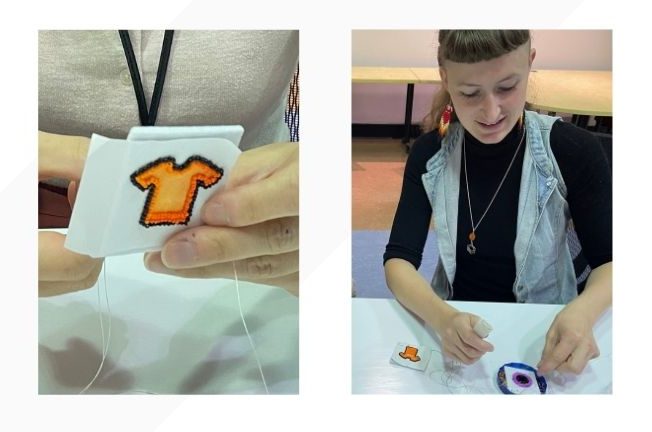 In recognition of and preparation for Orange Shirt Day and the National Day of Truth & Reconciliation on September 30, Dal Libraries presents a free two-part workshop to make Orange Shirt Day pins.
Instructional Support Technician Michelle McDonald, a beader from Sipekne’katik, is offering a two-part, in-person beading workshop where participants will learn how to bead their own pin.
When? September 21 & 28, 10:30 a.m.–12:00 p.m.
REGISTER NOW!
 Hidden Gems contest alert!
The MacRae Library on the Dal Agricultural Campus is hosting a self-guided library tour and gem hunt.
Find the gems, discover the secret phrase, and enter to win a prize!
The contest runs until October 3; the winner will be notified by email.
Good luck!