 EBSCO has received multiple reports of customers unable to access their eBook collection. Their engineering teams are currently investigating the issue and we will update you when more information is available.
We apologize for the inconvenience.
EBSCO has received multiple reports of customers unable to access their eBook collection. Their engineering teams are currently investigating the issue and we will update you when more information is available.
We apologize for the inconvenience.

by Ann Barrett
Looking for an easy way to keep your author profile up to date? Are your publications under multiple name variants making them hard to collect? Tired of having to enter the same information in multiple submission systems?
An ORCID (Open Researcher and Contributor ID) may be the solution for you. ORCID is a unique number used to distinguish scholars around the world from one another. Over 1,000 student and faculty researchers affiliated with Dalhousie have already registered with ORCID.
ORCID provides researchers with a persistent identifier plus an easy mechanism for linking research outputs and activities to that identifier. ORCID is open, non-proprietary, transparent, community-based, and available free of charge.
Your ORCID record will belong to you throughout your scholarly career to distinguish you from other researchers and ensure consistent, reliable attribution of your work.
ORCID is also integrated into many systems used by publishers, funding agencies, institutions, and other research-related services, allowing you to input once, reuse often.
As members of the ORCID Consortium in Canada the Dalhousie Libraries encourage graduate students and faculty members register for a free ORCID.
To get started:
Want to know more? Check out the ORCID Knowledge Base , watch this short 4 minute video from ORCID, or contact your Dalhousie Libraries’ subject specialist.
SPARC, the Scholarly Publishing and Academic Resources Coalition, is a global coalition that advocates for open access, open data, and open education. They are hosting a webcast free for all individuals from SPARC member institutions (yes, Dalhousie is a member). Registration is required: https://sparcarldc.memberzone.com/eventregistration/register/25
 Here is some information from SPARC about predatory publishers:
The problem of “predatory” publishers is often the first issue raised by faculty in conversations about Open Access. Authors (rightly) complain of being spammed with solicitations to publish in questionable journals. Attempts to combat the problem with “blacklists” and similar tactics have met with only limited success. However, there are emerging efforts to provide the community with reliable information on how to distinguish low-quality predatory publications from legitimate Open Access journals.
These efforts include work by the well-known Directory of Open Access Journals (DOAJ), which has undergone a rigorous process of strengthening its criteria for inclusion in its index to ensure that those journals listed meet stringent editorial standards. At the same time, the Open Access Scholarly Publishers Association (OASPA), the international trade association of Open Access publishers, is enforcing similar standards before a publisher qualifies for membership. A multi-lingual, cross-industry collaboration called “Think. Check. Submit.” has also been launched to provide a resource directly to authors to walk them through reviewing potential publishing venues and weed out predatory journal options.
Please join us on Thursday, March 1 at 3 p.m. for a SPARC webcast on community-based efforts to combat “predatory” publishing with representatives from these three initiatives. The discussion will focus on equipping librarians to address these quality concerns as they come up on campus.
Registration is free but required, and all individuals from SPARC member institutions are invited to attend. You can register by clicking here.
Taylor & Francis Online will be upgrading the security settings on their platform beginning January 31st. If you use an older browser, specifically IE10 or earlier, you will receive an error message when trying to access the platform. Many other vendors are making similar changes so they can continue to offer a secure online experience.
 If you do use an older browser, we encourage you to upgrade it now to continue to access our online resources seamlessly and securely. If you have any questions about how to upgrade your browser, please contact one of the IT Help Desks https://libraries.dal.ca/help/it-help-desk.html

A stack of Kipling scrapbooks that were recently digitized.
The Dalhousie Libraries is excited to announce the launch of the Kipling Scrapbook digital exhibit: http://kipling.library.dal.ca
This project involved digitizing and contextualizing the Rudyard Kipling Scrapbooks — part of the internationally renowned Kipling Collection held in the Dalhousie Libraries’ Special Collections. The project was profiled in 2017 as part of a series of blog posts — one highlighting the project and the collection and another exploring the scrapbooks themselves.”
“Digitizing the Kipling scrapbooks is part of the Libraries’ ongoing efforts to digitize its archival and special collections and make them broadly available to the world as well as to preserve the unique and rare materials that the library holds. It is hoped that by making these collections more broadly available that new forms of research and scholarship will be enabled through the use of these materials,” said Roger Gillis, Digital Humanities Librarian.
“The entire Kipling Project Team are to be congratulated on a beautifully prepared exhibit that highlights one of the Libraries’ important and valuable collections,” said Michael Moosberger, Associate University Librarian for Archives, Special Collections and Records Management. “The development of this project, which integrates geospatial technology along with high-resolution digitization and sophisticated metadata, will allow students and faculty the opportunity to engage with these historical publications in new and innovative ways. The project also illustrates how the field of digital scholarship is an important and growing part of the Libraries’ mandate and can breathe new life and new opportunities into iconic library resources whose importance to teaching and learning has not diminished.”
About the Kipling Collection
The Dalhousie Libraries Kipling Collection has an international reputation as the most comprehensive collection of Rudyard Kipling’s publications in the world. Containing an exhaustive selection of Kipling’s literary and journalistic works, the Kipling Collection holds important research ephemera and support material by and about Kipling, such as manuscripts, letters, pamphlets, original illustrations included in Kipling’s works, autographs, sketches, and sheet music for poems set to music.
The Kipling Collection also contains the Kipling Collection Scrapbooks: eleven scrapbooks created by notable nineteenth and twentieth century Kipling enthusiasts from England and the United States. There are seven known collectors: Sir William Garth, Ellis Ames Ballard, G. D. Wells, James Todman Goodwin, and three unidentified collectors. (The collectors of these scrapbooks will be explored in a future post in this series.) These scrapbooks are informal compilations, which preserve Kipling’s early journalistic works, as well various versions and editions of poems, short stories, and serials, many of which no longer survive in their original form. The full scrapbooks are available in Dalspace.
About the Exhibit
In 2017, Dalhousie Libraries’ digitized the scrapbooks and developed a digital exhibit via the Libraries’ new digital exhibit space using Omeka, an open source web-publishing platform. The project team consisted of Roger Gillis (Project Manager / Digital Humanities Librarian), Diana Doublet (Digitization Assistant), and Jessica Ruzek (Digital Exhibit Assistant), and Karen Smith (Special Collections Librarian).
The Exhibit features contextual information on Kipling, the scrapbooks, as well as British travel writing, as well as an interactive timeline and map that features a Map exploring some of Kipling’s travels and writing during his time as a journalist in late nineteenth-century India.
SPARC (the Scholarly Publishing and Academic Resources Coalition) is a global coalition that advocates for open access, open data, and open education. They are committed to making “Open” the default for research and education.
SPARC works to enable the open sharing of research outputs and educational materials with the goals of democratizing access to knowledge, accelerating discovery, and increasing the return on our investment in research and education.
How do they do this?
The Internet has changed the way we create and interact with knowledge. No longer do we have to be a world where knowledge is accessible by only the privileged few.
SPARC collaborates with stakeholders—authors, publishers, libraries, students, funders, policymakers and the public. As advocates, they build on the opportunities created by the Internet to promote changes to infrastructure and culture to make research and education Open.
With over a decade of experience and more than 200 members that are primarily academic and research libraries in the U.S. and Canada, SPARC members use its resources and support to promote Open Access to scholarly articles, the open sharing of research data, and the creation and adoption of Open Educational Resources on their campuses.
“Publishing models that restrict access to knowledge for the sake of profit limit everyone’s potential. Widespread adoption of SPARC’s Open Agenda will speed the pace of discovery, benefiting society in many ways, including medical breakthroughs, employment opportunities, and environmental solutions. As a research institution, Dalhousie has a responsibility to participate in this global movement,” said Donna Bourne-Tyson, University Librarian.
Net neutrality is the principle that Internet service providers must treat all data on the Internet the same, and not discriminate or charge differently by user, content, website, platform, application, type of attached equipment, or method of communication.[4] For instance, under these principles, internet service providers are unable to intentionally block, slow down or charge money for specific websites and online content. (Wikipedia)
This is an important issue for Canadians and libraries. Recently, the Canadian Association of Research Libraries released a statement on net neutrality. Read it here: http://www.carl-abrc.ca/news/carl-statement-net-neutrality/
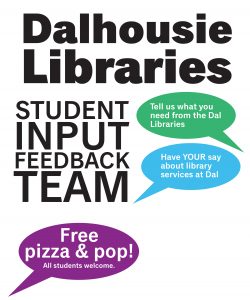 Have YOUR say about library services at Dal and tell us what you need from the Dal Libraries.
There will be free pizza and pop. All students welcome.
Carleton Campus
Mon., Jan. 22
3 p.m.,
C268, CHEB
Studley Campus
Wed., Jan. 31
12 p.m.,
Rm G70, first floor, Killam Library
In the spring of 2017, the Dal Libraries began a collaboration with Ancillary Services to inventory and rearrange the Shirreff Hall Library collection. Two recent graduates of the NSCC Library Technician program, Guy LeLievre and Kendra Gauvin, performed the work. Guy and Kendra entered 1,560 titles in LibraryThing (an online service that allows anyone to create a catalogue of their books) arranged in the categories of fiction, non fiction, biography, and sets. The books in the library were also rearranged into these four categories. Staff at the Sexton Library did four boxes-worth of repairs to books. With contents of the existing collection known, purchase decisions about new acquisitions could then be made.
 In the fall of 2017, four Faculty of Mangement SIM students, Rebekah Prette, Sarah Davis, Alicia Whidden, and Victoria Roberts, enrolled in Dr. Joylene Makani’s Information Resources Management Course created a collections policy for the Shirreff Hall Library. The policy outlines collection criteria, acquisitions, collection maintenance, and disaster planning, while remaining true to the mission and values of the Shirreff Hall Library. Rebekah, Sarah, Alicia and Victoria have volunteered to continue their collaboration with the Shirreff Hall Library in 2018, by identifying specific new purchases and updating the LibraryThing catalogue.
Our Web of Science database has been updated with some new features.
Major Highlights
Early Access publications:
Peer-reviewed, final, accepted publications are available in Web of Science prior to publication. Records have a document type of “Early Access” and may accrue citations. The Early Access record is merged with the “Published” version of the record. Early Access record types will be included in InCites in early 2018.
Open Access expansion:
This feature identifies open, legal articles in gold journals, hybrid journals, and those open access articles that reside in repositories. Will be included in InCites in early 2018.
Other highlights:
For more information, please contact your liaison librarian.