
Spines of Kipling scrapbooks, some dating to the nineteenth century. These scrapbooks are the focus of the Digital Kipling Project.
by Roger Gillis, Digital Humanities Librarian; Diana Doublet, Digitization Assistant; and Jessica Ruzek (digital exhibit assistant)
This post is the first in a series that will highlight the Dal Libraries’ Digital Kipling project. The project involves digitizing and contextualizing the Rudyard Kipling Scrapbooks — part of the internationally renowned Kipling Collection held in the Dalhousie Libraries’ Special Collections.
The Dalhousie Libraries’ Kipling Collection has an international reputation as the most comprehensive collection of Rudyard Kipling’s publications in the world. Containing an exhaustive selection of Kipling’s literary and journalistic works, the Kipling Collection holds important research ephemera and support material by and about Kipling, including manuscripts, letters, pamphlets, original illustrations from Kipling’s works, autographs, sketches, and sheet music for poems set to music. Kipling was one of the most popular authors in the UK in the nineteenth and twentieth centuries and is the author of The Jungle Book.
The Kipling Collection also contains the Kipling Collection scrapbooks: 11 scrapbooks created by notable nineteenth and twentieth century Kipling enthusiasts from England and the United States. There are seven collectors behind the 11 scrapbooks: Sir William Garth, Ellis Ames Ballard, G. D. Wells, James Todman Goodwin and three unidentified collectors. (The collectors of these scrapbooks will be explored in a future post as part of this series.) These scrapbooks are informal compilations, which preserve Kipling’s early journalistic works, as well various versions and editions of poems, short stories, and serials, many of which no longer survive in their original form.
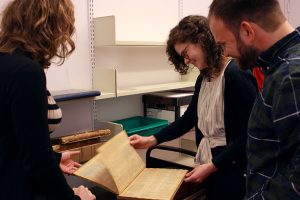
The Digital Kipling Project team of Diana, Roger, and Jessica gingerly explore one of the scrapbooks, brittle with age.
This summer, the Dalhousie Libraries’ Digital Kipling Project team will be digitizing the scrapbooks and creating a digital humanities exhibit via the Libraries’ new digital exhibit space using Omeka, an open source web-publishing platform. The project team consists of Roger Gillis (project manager/digital humanities librarian), Diana Doublet (digitization assistant), and Jessica Ruzek (digital exhibit assistant). The team is working with digital archivist Creighton Barrett and special collections librarian Karen Smith to bring this project to fruition.
By digitizing the scrapbooks, this project will enhance the accessibility of the Kipling Collection, provide contextual and background information crucial to the scrapbooks, and will further support research surrounding Kipling. The Digital Kipling online exhibit will launch in the fall of 2017. Updates and information on the site can be found here: http://kipling.library.dal.ca



 The collection chosen to be our guinea pig was a recent donation of work from esteemed Canadian ecologist and environmental scientist, Bill Freedman, who taught and conducted research at Dalhousie from 1979 to 2015. The fonds is a hybrid of analogue and digital materials dating from 1988 to 2015. Digital media carriers include: 1 computer system unit, 5 laptops, 2 external hard drives, 7 USB flash drives, 5 zip disks, 57 CDs, 6 DVDs, 67 5.25 inch floppy disks and 228 3.5 inch floppy disks. This is more digital material than the archives is likely to acquire in future accessions, but the Freedman collection acted as a good test case because it provided us with a comprehensive variety of digital formats to work with.
