Holiday Hours at the Dalhousie Libraries

For details about the holiday hours at each of the Dalhousie Libraries, please see below.
Sir James Dunn Law Library
Thursday, December 20 8 a.m.-4:30 p.m.
Friday, December 21 8 a.m.-4:30 p.m.
Saturday, December 22 & Sunday, December 23 Closed
Monday, December 24 8 a.m.-12 p.m.
Tuesday, December 25 – Tuesday, January 1 Closed
Regular hours resume Wednesday, January 2.
W.K. Kellogg Health Sciences Library
Monday, December 17 7:30 a.m.*-11 p.m.
Tuesday, December 18 – Friday, December 21 7:30 a.m.*-6 p.m.
Saturday, December 22 & Sunday, December 23 Closed
Monday, December 24 8 a.m.-12 p.m.
Tuesday, December 25 – Tuesday, January 1 Closed
* Circulation staff available 30 minutes after library opens
Regular hours resume Wednesday, January 2.
Killam Memorial Library
Tuesday, December 18 – Friday, December 21 8 a.m.–6 p.m.
Saturday, December 22 & Sunday, December 23 10 a.m.–6 p.m.
Monday, December 24 8 a.m.–12 p.m.
Tuesday, December 25 – Thursday, December 27 Closed
Friday, December 28 & Saturday, December 29 10 a.m.–6 p.m.*
Sunday, December 30 – Tuesday, January 1 Closed
Wednesday, January 2 – Friday, January 4 8 a.m.–6 p.m.
Saturday, January 5 & Sunday, January 6 10 a.m.–6 p.m.
* Please note that the Reference Desk will be closed. The Circulation and Help Desks will be open.
Regular hours resume Monday, January 7.
Dalhousie University Archives
(located fifth floor, Killam Library)
Thursday, December 13 & Friday, December 14 9 a.m.-5 p.m.
Saturday, December 15 & Sunday, December 16 Closed
Monday, December 17 – Friday, December 21 9 a.m.-5 p.m.
Saturday, December 22 – Tuesday, January 1 Closed
Wednesday, January 2 – Friday, January 4 9 a.m. – 5 p.m.
Saturday, January 5 & Sunday, January 6 Closed
Regular hours resume Monday, January 7.
Dalhousie University Archives & Special Collections Reading Room
(located fifth floor, Killam Library)
Thursday, December 13 & Friday, December 14 9 a.m.-5 p.m.
Saturday, December 15 & Sunday, December 16 Closed
Monday, December 17 – Friday, December 21 9 a.m.-5 p.m.
Saturday, December 22 – Tuesday, January 1 Closed
Wednesday, January 2 – Friday, January 4 9 a.m.-5 p.m.
Saturday, January 5 & Sunday, January 6 Closed
GISciences Centre
(located second floor, Killam Library)
Monday, December 24 8 a.m.–12 p.m.
Tuesday, December 25 – Tuesday, January 1 Closed
Regular hours resume Wednesday, January 2.
MacRae Library
Friday, December 14 8:30 a.m.-4:30 p.m.
Saturday, December 15 & Sunday, December 16 Closed
Monday, December 17-Friday, December 21 8:30 a.m.-4:30 p.m.
Saturday, December 22 & Sunday, December 23 Closed
Monday, December 24 8:30 a.m.-12 p.m.
Tuesday, December 25 – Tuesday, January 1 Closed
Wednesday, January 2 8:30 a.m.-4:30 p.m.
Sexton Design & Technology Library
Tuesday, December 18 – Friday, December 21 8 a.m.-4 p.m.
Saturday, December 22 – Tuesday, January 1 Closed
Regular hours resume Wednesday, January 2.
Accessing SpringerLink
The migration to the new SpringerLink platform took place last week. Since then, we’ve been unable to access some archival journal content and some eBook content on the new platform.
Springer is aware of the problem and is taking steps to resolve it. In the meantime, you should be able to access archival and eBook content on the old platform, which can be reached by clicking on “access old SpringerLink” in the upper right hand corner of the new platform.
Killam Library Artist Residency

THIS OPPORTUNITY IS NOW CLOSED.
CALL FOR LOCAL ARTIST: KILLAM LIBRARY ARTIST RESIDENCY
6 week residency, January 21 – March 1, 2013
Application deadline: Wednesday, December 5, 2012 at midnight
Call for an artist in residency at the Killam Library, Dalhousie University, with support from the Dalhousie Art Gallery, and funded by HRM residency initiative.
The Killam Library is architecturally distinct internally and externally. Completed in 1971 in the Brutalist style, the lack of exterior windows is in sharp contrast to the interior glass courtyard filled with greenery. The slate floors and concrete or glass walls bounce sound through a space intended for research and quiet contemplation. These contradictory architectural qualities are intriguing potentials for an artist to consider, as are the notions of libraries as repositories of knowledge, the physicality of books themselves, student interactions, and the notion of multidisciplinarity. This library is active visually, aurally, socially, and academically.
The following resources are available:
- Archives and special collections – rare books, Canadian small press, comics, music
- Public learning commons, computers, microfiche stations, historic newspapers, a government documents repository, digital resources such as eBooks and eJournals, data databases, and reference librarians to assist with research
- 3D printer, large format printer, lecture halls, viewing rooms
The selected artist will be compensated $500/week for six weeks, to utilize the residency environment at least 15 hours a week. A dedicated work space will be made available in addition to library resources. Applicants must be professional artists with at least three years of public exposition or publication, an HRM resident (living and working in HRM for 6 months), and not currently a student. We welcome applications that are based in any medium of production, performance, and digital media. The artist will be expected to respect the staff and faculty, library users, and the infrastructure.
The Dalhousie Art Gallery is a public art gallery and academic support unit within Dalhousie University. Programming includes an extensive array of contemporary and historical art exhibitions, and critical discourse through presentations and lectures. Killam Memorial Library is the largest of the Dalhousie Libraries and specifically serves the Arts and Humanities, Computer Science, Social Sciences, Science and Management departments. It contains over one million books and is the largest library in the Maritimes.
Your digital only application should include:
- A 250 word description of your proposed project
- 5 images (each file no larger than 400 kb) / short video or sound files (links to online files) / documents of previous and/or proposed work
- CV (no longer than 3 pages)
Send to: residencykillamdag@gmail.com
We thank all applicants for their interest, only finalists will be contacted.
For more information or questions regarding this call, contact: art.gallery@dal.ca or 902.494.2195.
More Chairs on the Way
This time of year, the demand for seating at the Dal Libraries increases beyond capacity. That’s why, when we can, we develop new seating areas: like the four tables and twelve chairs we repurposed after the Killam atrium renovation that are now set up in the lobby of the Killam.
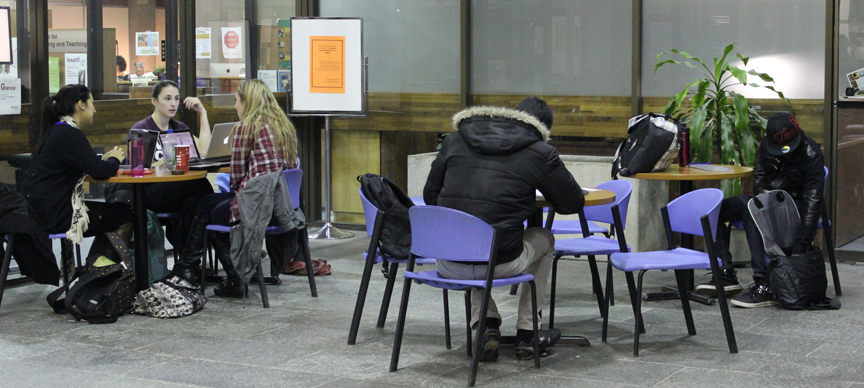
The newest seating area in the Killam is proving to be very popular.
And more good chair-related news: we are currently waiting on a number of chairs to arrive at the Sexton, Kellogg and Killam Libraries. We don’t know exactly when the chairs will arrive, but we’re expecting them soon.
What is Document Delivery?
Ever noticed the

or the

or the

or the

and wondered what Document Delivery is?
No? Well that’s a shame because the Dal Libraries’ Document Delivery service can often get material for you that you can’t find at Dalhousie but that you need for your research. Document Delivery is affiliated with libraries worldwide and has especially close ties to the other Canadian Atlantic University Libraries (CAUL). We even share the same document delivery management system which we also use to connect to other international document delivery systems like OCLC based in Ohio and RapidILL based in Colorado.
Document Delivery requests material from other libraries on your behalf – that means books get delivered to us for you to pick up at the Dalhousie library of your choice. Articles from journals get delivered directly to your Dalhousie email as a PDF link. Articles are normally delivered within 1-3 days as are books from the other CAUL libraries. Books from libraries outside of the Atlantic region are normally delivered by mail so can take a week to several weeks to arrive depending on the location of the lending library.
Last year Document Delivery processed a total of 39,000 requests – 22,000 from Dalhousie patrons, of which 14,000 were for articles, and 17,000 from other libraries for their patrons. And the best part – the service is free for Dalhousie students, faculty and staff. So please keep us in mind when you need an article or a book for your research and you can’t find it at Dal.
For more information about this service, visit the Document Delivery web page.
3D Printing at Startup Weekend Halifax
Startup Weekend Halifax recently took place in the Learning Incubator & Networking Centre (LINC) room of the Killam Library. Based out of Seattle, Startup Weekend is a grassroots movement that encourages entrepreneurs to get together over a single weekend, pitch their ideas, form teams and start companies. Startup Weekend usually features a variety of students and business professionals, mentors and investors.

3D Printing Friday Night at Startup Weekend
The Killam Library’s 3D printer was used at this event to create quick, on-the-spot prototypes for products created during this event.
One of the groups formed during the event was working on a more efficient solution to the panic buttons currently given to at-risk patients in hospitals. A prototype of the groups’ device was designed in Solid Edge and then 3D printed right in time for their final presentation in front of potential investors.

3D Model of a New Medical Device

The 3D Printed Version
There were a few web-based companies at the event who weren’t working with any physical products, but who still took advantage of the 3D printer to get their logos printed. One of these companies, U-Ride, turned their logo into a 3D printed stamp.

U-Ride Logo

U-Ride 3D Logo

3D Printing the U-Ride Logo
The Killam Library’s 3D printer is available from 9 a.m.-9 p.m., Monday to Friday, at the Help Desk in the Learning Commons. Learn more about the 3D printer and what it can do, or come to the Help Desk in person. If you already have a 3D model you want to print, you can send it to 3Dprint@dal.ca for a quote.
LibQUAL+ Survey 2013
Beginning January 28, the Dalhousie Libraries are asking students, faculty and staff to participate in the LibQUAL+ survey.
The LibQUAL+ survey provides the Dal Libraries with valuable information about your library experience. It is essential for the libraries to receive this information so that we can strive to match your expectations with your experience in the Dalhousie Libraries.
The LibQUAL+ survey is used in over 17 different countries in a wide variety of library environments.
Below are two examples of data that we have gathered from the last time we did the LibQUAL+ survey, in 2010.


Survey Questions
Affect of Service
AS-1 Employees who instill confidence in users
AS-2 Giving users individual attention
AS-3 Employees who are consistently courteous
AS-4 Readiness to respond to users’ questions
AS-5 Employees who have the knowledge to answer user questions
AS-6 Employees who deal with users in a caring fashion
AS-7 Employees who understand the needs of their users
AS-8 Willingness to help users
AS-9 Dependability in handling users’ service problems
Information Control
IC-1 Making electronic resources accessible from my home or office
IC-2 A library Web site enabling me to locate information on my own
IC-3 The printed library materials I need for my work
IC-4 The electronic information resources I need
IC-5 Modern equipment that lets me easily access needed information
IC-6 Easy-to-use access tools that allow me to find things on my own
IC-7 Making information easily accessible for independent use
IC-8 Print and/or electronic journal collections I require for my work
Library as Place
LP-1 Library space that inspires study and learning
LP-2 Quiet space for individual activities
LP-3 A comfortable and inviting location
LP-4 A getaway for study, learning, or research
LP-5 Community space for group learning and group study
Local Questions
LC-1 Access to Archives, special collections
LC-2 Browsing library materials in the stacks
LC-3 Making me aware of library resources and services
LC-4 Providing health information when and where I need it
LC-5 Timely document delivery/interlibrary loan
General Satisfaction
GS 1 In general, I am satisfied with the way in which I am treated at the library.
GS 2 In general, I am satisfied with library support for my learning, research and/or teaching needs.
GS 3 How would you rate the overall quality of the service provided by the library?
Information Literacy Outcomes
IL 1 The library helps me stay abreast of developments in my field(s) of work.
IL 2 The library aids my advancement in my academic discipline or work.
IL 3 The library enables me to be more efficient in my academic pursuits or work.
IL 4 The library helps me distinguish between trustworthy and untrustworthy information.
IL 5 The library provides me with the information skills I need in my work or study.
Sexton Library, Remembrance Day HOURS
Weekend Operating HOURS
Saturday, November 10th, 2012
- 9:00am – 9:00pm
Sunday, November 11th, 2012
- 10:00am – 12:00Midnight
Monday, November 12th, 2012
- 10:00am – 6:00pm
Reference Desk available:
Saturday and Sunday – 2:00pm – 5:00pm
The Open Access Rainbow

The open access logo.
In today’s installation for International Open Access Week, we’re taking a closer look at the Open Access rainbow. Green, blue, yellow, white and gold make up the open access rainbow, with each colour relating to a different option or model in the open access journal world.
Before we dive into what each colour means, we first have to understand the concepts of pre-print, author’s final version and post-print. Pre-prints are the draft, uncorrected version of an article. The author’s final version is the article written exactly as it will appear in a journal. Post-prints are how the article looks in a journal—this includes the typeface and layout as it appears on the pages of the publication. Usually this is a PDF of the article from the publication.
Each colour in the open access rainbow refers to different levels of open access allowed by publishers.
Green
When a publisher allows both the pre-print and the post-print to be archived, they are considered a green publisher producing green journals. Many publishers will allow the author’s final version to be archived but not the post-print. Such publishers are still considered green as they allow a version to be archived that has the same content as the published version.
Blue
Blue publishers will not allow pre-prints to be archived but will allow post-prints or the author’s final version to be archived.
Yellow
If a publisher allows their authors to archive their pre-prints but not their post-prints, then they are considered a yellow publisher.
White
Publishers that refuse to grant their authors any rights to archive their work online are called white publishers. Their journals are known as white journals.
Gold
Gold refers to open access journals that are available to readers free of charge. Usually, these are electronic journals and the material is openly accessible on the Internet. These journals are financed by payments for the article to be published, as opposed to being financed through reader subscriptions. Sometimes referred to as “author-pays publishing,” when generally the publishing fee is paid from a research grant as part of the cost of doing research.
We hope that the blog posts featured on the LibVine throughout Open Access Week have shed light on some of the issues facing the academic world. In recognition of Open Access Week, the School of Information Management is launching the latest issue of their journal, the Dalhousie Journal of Interdisciplinary Management, as an open access edition. The launch will take place today (Fri., Oct. 26) from 12-1 p.m. in room 3089 of the Rowe Building.
Source: Green, Blue, Yellow, White & Gold: a brief guide to the open access rainbow, by Bill Hubbard. http://www.sherpa.ac.uk/documents/sherpaplusdocs/Nottingham-colour-guide.pdf