Update: Friday, June 1, 11:40 a.m., access has been restored
Due to a damaged communications cable, Rock’s Backpages is currently unavailable. The publisher plans to update us later today (Friday, June 1). We apologize for this inconvenience. 
Update: Friday, June 1, 11:40 a.m., access has been restored
Due to a damaged communications cable, Rock’s Backpages is currently unavailable. The publisher plans to update us later today (Friday, June 1). We apologize for this inconvenience.
On Tuesday, three staff members from the Dalhousie Libraries graduated with their Master of Library & Information Studies (MLIS). Congratulations to Sarah Davis, Margaret Vail, and Brian Lesser! Brian was also recently profiled by the Faculty of Management about his degree.

At Dal Libraries, one of the ways we exercise accountability to the community we serve and to the goals of Dalhousie is through our assessment program.

Click twice to enlarge.
Through assessment, we evaluate the needs and behaviours of our user community; how our services, resources and spaces meet those needs; and what impact the Dal Libraries have on institutional goals.
A full description of our assessment program,
along with links to current projects, reports, recommendations, follow-up actions, and interactive data visualizations can be viewed on the new Library Assessment section of the Dal Libraries website. Content will be regularly added and updated, so visit the assessment page often.

Linda Bedwell is the Coordinator of Assessment for the Dalhousie Libraries.

Click twice to enlarge.
(This story originally appeared in Today @ Dal as part of the series highlighting the graduates of 2018. The story was written by Dal Libraries’ communications intern, Jen Schwetje.)
Sometimes what you pick up outside of the classroom is as valuable as what you learn in a lecture. Graduating Master of Engineering (MEng) Internetworking students Olayinka Oluwole and Arun Kumar share how working at the Sexton Design and Technology Library enhanced their student experience at Dal.

Olayinka
Olayinka came to Halifax for school in 2016. It was her first time out of Nigeria, and it wasn’t easy.
“I had second thoughts because my mom passed away in 2015 and it was tough. I thought about not leaving Nigeria,” she says, “but when I thought about it again… my mom would want me to leave and become that person that people would look up to and say, ‘Even though she has experienced some things in life, she strived, she became better and she got something done for herself.’”
When she first arrived she was lonely, “I can remember I cried for two days,” she says, “but then I told myself, no, you can do this. Remember, you’re independent!” She wiped her tears and made some friends. After that she found it easy to incorporate herself into the community. “Going out you meet people, even at the bus stop,” she says. “I just discovered OK, it’s not that bad—it can only get better and not worse. No, I do not want to go home yet.”
“I have been a computer freak for years”
The first time Arun touched a computer was in ninth grade. There were only three computers in that class, but from then on he was hooked. He knew if he wanted to pursue this new passion, he would need to transfer to a private school. “Government schools were taught in Hindi and had very qualified instructors but there were no computers,” says Arun.
He travelled out of state to take the qualifying exam and transferred to a private school for his last two years of secondary school.
The first month at the new school was very challenging for Arun as it was all in English. “I called my father and said, ‘I don’t know if I’ll pass or not.’ He said, ‘That’s OK, at least you’re there. So try your best, if you fail, you fail. Don’t worry, you’ll try next time then.’” His father’s unwavering support helped motivate Arun to do his best and get top marks in every subject.
Olayinka initially intended to study chemical engineering and work in Nigeria’s oil center; however, when she applied to the University of Ilorin, she was offered telecommunications. “They do that,” she says, “when a lot of people try to get into the [same] program, they check some of the subjects you did in secondary school and say, ‘I think this person should work in this field’ and then they offer you that. It’s still up to you to say yes or no.” Olayinka said “Yes,” and with that began her career in tech.
“Have you ever wondered how you could have a lot of computers talking at once?” asks Olayinka. “Getting to know more about how this technology works has been really fascinating. You think it’s like rocket science but it’s not. It’s actually simple and straightforward and that’s what I love about it.” Olayinka thinks she may be the first Nigerian woman in the Internetworking program.

Arun on the job at the Sexton Library.
Arun earned a bachelor’s in electronics and communications engineering at Eternal University in India in 2012, then completed the automation engineer certification and found a job right away. After three years he felt a need to reevaluate. “I did my training in manufacturing and production [but] I came to realize these are not the things I’m looking for,” he says. He was interested in networking and so in 2016 he came to Dal.
Both Olayinka and Arun chose to study Internetworking at Dal because of the strong practical lab component. They both also speak highly of the program’s instructors. “You must have heard of Dr. Shrini,” says Arun. “He’s so amazing. I like the way he treats students, like everyone’s unique.”
Before getting hired at Sexton Design and Technology Library, Olayinka did not spend much time in libraries at all. She laughs about her first training shift where she had to admit to her supervisor that she has not yet registered her DalCard at the library. She learned how to register new patrons by first registering herself.
Olayinka quickly grew to love being at the library. She discovered her natural talent for leadership and troubleshooting—skills that will benefit her as she plans to take on management roles in a new field.
Olayinka loves being in a position to help other people, whether it is fixing a paper jam at the printer or tracking down an important book someone needs. Helping others is more than a job to her, it’s a life philosophy. “I believe in being selfless. If you have an opportunity to help someone, just do it. It’s going to go a long way, because saving one person might save the world,” she says.
For Arun, part-time work at the library provided much more than a paycheque. He took the job for some extra cash but also ended up with extra confidence and skills that helped him succeed in his degree.
Arun lights up when he talks about the library. “Back home the libraries weren’t that big. Here it’s all technical, everything is online. At home we had to write down on paper on a registrar,” he says. He could hardly believe how friendly and helpful the staff were.
It wasn’t until he started working at the Sexton Library that he fully realized all the resources that were available and to what lengths the librarians and staff would go to help. He was excited to share this information with his classmates. “I told my friends as much as I could. You have a lot of facilities here—use them!” he says.
He became familiar with all the books that were available for his courses and tried to help out his colleagues whenever he could. If there was only one or two copies of an important resource to share with 90 students, he asked his supervisor to order more.
Working at the library also helped Arun improve his English. He remembers how he was afraid to talk to people at first, but eventually he looked forward to it. “We had to deal with all people and that was my favourite part. I like to interact with the people, to get to know people from different countries,” he says.
Olayinka is proud of what she’s accomplished, “Moving out here was tough, and I succeeded, I did well at school and I took care of myself,” she says. She has no doubts about the path she has chosen. “I fell in love with this program and I feel I’m going to take it to any level possible. I know I’m going to get something great out of it.”
Of all the things Arun will miss about Dal — which is pretty much everything — he will miss the people the most. “Always interact with the people. Interact with people from different religions and different places. That’s how you know the beauty of Canada.”
As part of a sustainability project for the Agricultural Campus, the Office of Sustainability installed 800 LED T8 bulbs in the MacRae Library.
The work was carried out by Agricultural Campus Facilities project team members Carl Baillie, Stephanie MacKenzie and Ritchie Davidson (pictured).
Thanks to both the Office of Sustainability and the Facilities teams for our new lighting!

Carl Baillie, Stephanie MacKenzie and Ritchie Davidson who installed the lights.
Our new lights in action.


Compute Canada/Acenet and Dalhousie Libraries are teaming up to offer a two-day workshop on using Compute Canada’s cloud environment for researchers in the social sciences and humanities, with a particular focus to those who might be thinking about, or currently working in the Digital Humanities. The workshop is limited to faculty members and graduate students at Halifax-based universities affiliated with Compute Canada.
What: Cloud Powering Digital Humanities Research workshop
Where: 6135 University Avenue, McCain Building, Room 2018, Dalhousie University
When: May 14 & 15, 9 a.m.–4:30 p.m.
Course website: https://cgeroux.github.io/DAL_2018/
Registration is free and limited to 20 participants from Halifax-based CFI-eligible institutions
Register here: https://goo.gl/forms/YGPThKosnZouBLOs2
For any questions regarding the workshop, please contact chris.geroux@ace-net.ca
For the 4th year, the Dalhousie Libraries is offering Research Bootcamp, a suite of sessions designed for teaching and research assistants and graduate students. If you or someone you know could benefit from developing effective and efficient information management techniques and literature search skills to support research endeavors, please share this information with them.
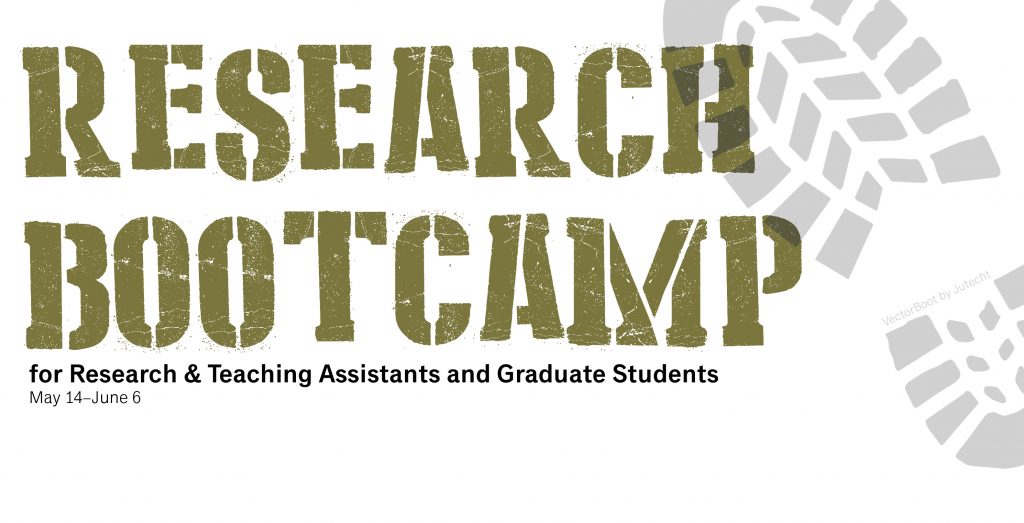
Sessions will run from May 14–June 6 and will cover: library basics; literature reviews (searching and writing); citation tools; writing abstracts & grant proposals; copyright, open access & predatory publishers; legal resources; business and competitive intelligence resources, PubMed and other health sciences databases; humanities resources; Canadian data and stats; grey literature; research data management; Excel; data visualization; and conference posters. Complete session list and descriptions are available at http://dal.ca.libguides.com/ResearchBootcamp/2018/Schedule
Faculty can recommend the workshops to their RAs/TAs or register on their behalf. Participants can attend most sessions in-person in Halifax (various Halifax campus locations) or via video conferencing at the Agricultural Campus or DMNB.
Event website, including schedule, session descriptions, FAQs http://dal.ca.libguides.com/ResearchBootcamp
 Exam season will soon be upon us! Extended hours and Night Owls* have begun at the Dalhousie Libraries. Consult the hours widget on the landing page of libraries.dal.ca to get the hours of Dal Libraries location of your choice.
*Night Owls is available Sundays–Thursdays in the Killam and CHEB locations. All Dalhousie & King’s students are welcome, but after midnight you’ll need your DalCard for access.
Please note: Hours in the W.K. Kellogg Health Sciences Library (Tupper location) and the Wallace McCain Learning Commons will not be extended during exams.
 Due to circumstances beyond the control of the publisher (fibre-optic problems in Scotland) Rock’s Backpages is currently down. Their hosting company is working on the problem and they hope to return to normal service as soon as possible. Rock’s Backpages apologize for the inconvenience.
Dalhousie Libraries is pleased to offer an institutional subscription to Covidence systematic review management software.
Covidence is a productivity tool developed with the aim of making the conduct of systematic reviews faster, easier, and more enjoyable! Covidence is a not-for-profit service that started in Australia and is now partnering with the Cochrane Collaboration to assist reviewers around the world.
This review productivity tool is now available for all Dalhousie affiliates and can be used for knowledge synthesis projects in any discipline, such as systematic or scoping reviews, or less formal reviews such as those for assignments or other projects. Citation lists can be easily imported from citation databases, such as PubMed, Scopus, etc., or from citation management software, such as RefWorks or EndNote. More information about using this tool can be found on the Covidence Knowledge Base. 
Dalhousie’s subscription permits unlimited reviews for any Dalhousie-affiliated user. Any reviews created or migrated to the Dalhousie University Library account will have access to the full functionality of the software, including unlimited reviewers, and online support from Covidence’s technical support. If you have existing reviews under a personal Dalhousie or non-Dalhousie account and you would like information on migration to the Dalhousie site license, go to our Covidence page or contact systrev.help@dal.ca.
The software is secure and fully online, so there is no need to download anything and it is accessible from mobile devices through the browser function.
A good place to start with instructions on joining the Dalhousie University Libraries account, in addition to the Dalhousie’s Knowledge Base page, is the Covidence page of the Systematic Review: A How-To Guide.
For more information or support in using Covidence, contact systrev.help@dal.ca to be put in touch with the librarians at the Kellogg Health Sciences Library.