LibGuides are currently experiencing technical difficulties. @springshare is working to resolve the issues. Watch their Twitter feed for updates. We apologize for the inconvenience.
Update, March 1, 7:44 a.m.: Problem should be resolved.
LibGuides are currently experiencing technical difficulties. @springshare is working to resolve the issues. Watch their Twitter feed for updates. We apologize for the inconvenience.
Update, March 1, 7:44 a.m.: Problem should be resolved.
This is the fourth and final entry in our series celebrating Fair Dealing Week.
The copyright landscape in Canada has undergone significant changes recently. To ensure a fair and reasonable approach to the use of copyright protected materials on campus, Dalhousie has sought to balance the rights of users with those of creators. To help accomplish this, the University has established a Copyright Office and has most recently adopted updated Fair Dealing Guidelines.
As students of Dalhousie University, you may copy materials for which the university (e.g. the Library) has negotiated licenses, according to the terms of the individual license agreements. In addition to license agreements, fair dealing allows you to make use of a work for yourself for the purposes of private study, research, criticism or review, news reporting, education, parody or satire. For example, this means you can copy one article from a journal, or one chapter from a book for the purpose of your studies and research.
Without fair dealing, any time you wished to make use of a copyrighted work in your course, you would need permission from the copyright holder, perhaps even paying a licensing fee. This short presentation (click on the image) illustrates how many basic use of works that we might take for granted would not be legal without fair dealing:
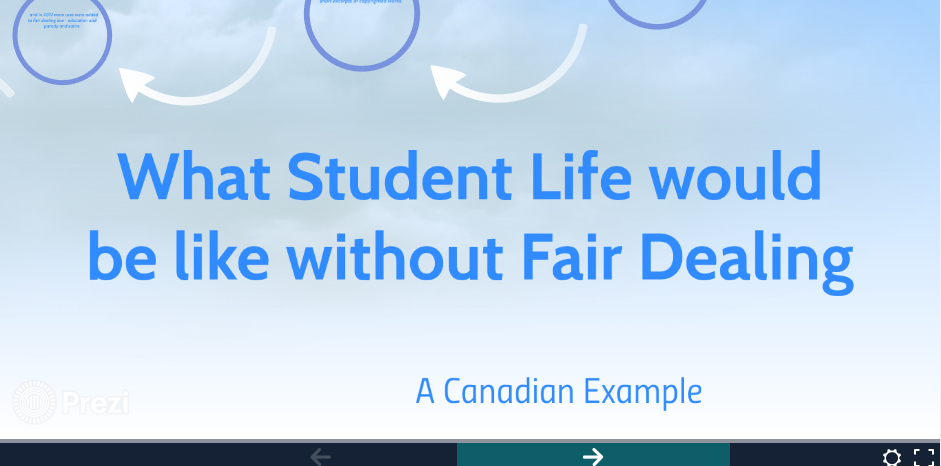
For more information on how fair dealing affects students, please take some time to read about fair dealing for students, and consult our fair dealing guidelines. Please feel free to contact the Copyright Office with any questions or comments at copyright.office@dal.ca
This is part three in our series to celebrate Fair Dealing Week. Part four (Students and Fair Dealing) will appear on Friday.
Fair dealing is a powerful tool for using copyrighted works in the classroom. It allows instructors to use photos and videos in class lectures, reduce the cost of materials for students, and facilitate access and accommodation for students. Faculty can also benefit from Fair Dealing in the context of research, allowing academics to build upon existing research, and facilitating access to scholarly works.
Fair dealing is available in the contexts of education and research, but it is important to remember that copyright in Canada is a balance between users’ rights and creators’ rights. While instructors can engage in copying for their classes, it must be done in a fair and ethical manner.
One of the best resources to make sure your class readings fall under fair dealing is to make use of the Dalhousie Libraries course reserves service. By using the course reserves service, you’re taking the guesswork out of applying fair dealing guidelines for every work that is used as part of class readings, and reducing the cost of material for your students. The Dal Libraries’ course reserves service can upload material to Brightspace for you, or create stable links to course readings.
For more information on how fair dealing affects faculty, please take some time to read about fair dealing for faculty, and consult our Fair Dealing Guidelines. Please feel free to contact the Copyright Office with questions or comments at copyright.office@dal.ca
This is part two in a four-part series of blog posts celebrating Fair Dealing Week (February 20–24, 2017).
Fair Dealing permits the limited use of copyright-protected material without the permission of copyright owners, and without the risk of infringement. It is intended to provide a balance between the rights of creators and the rights of users. Copyright protects the expression of ideas, and fair dealing provides the space for new ideas to flourish. Prior to the current allowances of fair dealing, it was much more difficult to navigate copyright rules to find material for teaching and research. Students, faculty, and staff can now benefit from fair dealing to improve their classes, work, and studies.
Two Dalhousie professors, Dr. Sasha Kondrashov and Dr. Mike Smit discuss the importance of fair dealing in the videos below:
For more information, you can read about fair dealing on the Dalhousie Libraries’ Copyright Office’s Fair Dealing Basics page, and consult the Fair Dealing Guidelines. Please feel free to contact the Copyright Office with any questions or comments at copyright.office@dal.ca
 This is part one in a four-part series of blog posts celebrating Fair Dealing Week (February 20–24, 2017).
Fair Dealing Week (Fair Use Week in the United States) is the Association of Research Libraries (ARL)’s annual celebration of fair dealing. To mark Fair Dealing Week, we’ll be blogging about it all week. These posts will outline why fair dealing is important, what fair dealing means to instructors, and how fair dealing applies to students.
Fair dealing is a right in the Copyright Act (Section 29) which allows the copying and communicating of copyrighted works without permission from or payment to the copyright holder. The Supreme Court of Canada has established a two-part, six-factor test for determining fair dealing:
Step One: Determine if your use of a copyrighted work is covered by any of the purposes enumerated in the Copyright Act: research, private study, criticism, news reporting, education, parody, or satire.
Step Two: If your use does fall under one of these purposes, then you can proceed to applying each of the six factors the Supreme Court identified. The six factors are: purpose (different from the purpose in the first step), character, amount, alternatives, nature, and effect.
If your use of a copyrighted work passes both of these steps, it can be deemed fair dealing. To clarify the determination of fair dealing, Dalhousie has developed a set of Fair Dealing Guidelines, in cooperation with the Association of Universities and Colleges of Canada. These guidelines apply to all members of the Dalhousie University community — faculty, staff and students.
For more information, consult the Dalhousie Libraries Copyright Office’s Fair Dealing Basics page, and the Fair Dealing Guidelines. Contact the Copyright Office with any questions or comments at copyright.office@dal.ca

The CHEB has just doubled the amount of silent study space available at night.
Starting February 6, classroom C268 is reserved every night from 8:30–11:30 p.m. for silent study. From March 6–May 31, that time will be expanded to 7–11:30 p.m. nightly (including weekends).
This room is a complement to the existing silent room in the corner by the main stairs, C223.
Happy studying!
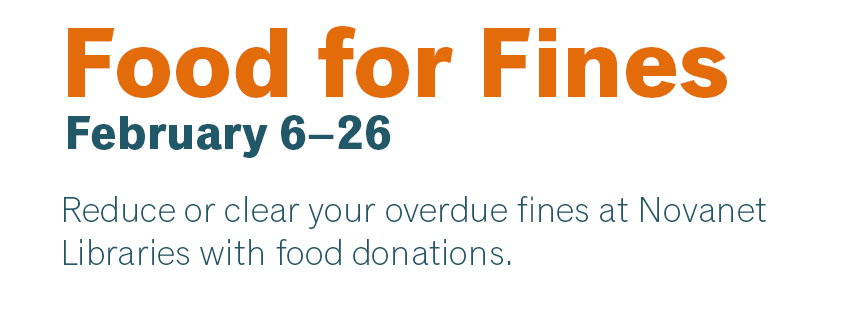
Reduce or clear your Novanet library fines by paying with food donations. Each food donation reduces your fines by $3.
Food donations will be given to the Dalhousie Student Union Food Bank, Feed Nova Scotia and the Colchester Food Bank (for donations made at the MacRae Library on the Agricultural Campus).
Donations of canned goods or other non-perishable foods can be brought to the front desk at any of the five Dalhousie Libraries during regular hours. Recommended donations include cereal, pasta, pasta sauce, canned vegetables and fruits, canned meat and fish, peanut butter, soups, and stews. Cash donations are also accepted. We also welcome donations if you don’t have overdue fines.
Munro Day is a Dalhousie holiday, observed this year on Friday, February 3. The libraries and libraries’ learning commons will be open that day, but running on holiday hours. Consult this list before you head to the library.
Kellogg Health Sciences Library (Tupper)
1–4 p.m.
Kellogg Library Learning Commons (CHEB)
10 a.m.–6:30 p.m.
Killam Memorial Library
1–9 p.m.
MacRae Library
1–6 p.m.
Sexton Design & Technology Library
10 a.m.–6 p.m.
Sir James Dunn Law Library
9 a.m.–4 p.m.
Wallace McCain Learning Commons
1:30 p.m.–8:30 p.m.
Launched on January 15, the #1Lib1Ref campaign is uniting libraries around the world. Supported by Wikipedia Library and a number of Wikimedia Affiliates, the campaign aims to make Wikipedia better for all by encouraging information professionals to add citations to Wikipedia entries.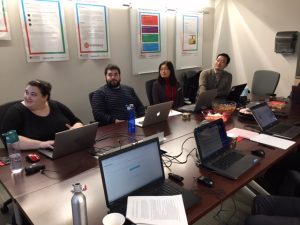
Libraries of all types and sizes are hosting activities and the Dalhousie Libraries is no exception. Lindsay McNiff and Margaret Vail hosted a ninety minute Wikipedia Edit-a-thon for the Dal Libraries on January 24.
“We put out a call to Dal librarians, Libraries’ staff whose work involves reference shifts, and Libraries’ staff who have or are working on a Master in Library and Information Studies degree to join us in improving the mighty but flawed Wikipedia,” said Lindsay. “Many people use Wikipedia, but if the entry they’re using isn’t backed up by a reliable source, that’s reason enough to question the information.”
“Despite the stormy weathe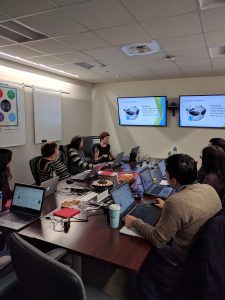 r, we had nine participants and we edited 28 different citations during our edit-a-thon,” said Margaret.
Wikipedia aims to be the “sum of all human knowledge.” On English Wikipedia alone, more than 380,000 articles are in need of citations and another 210,000 have no references at all. (Source: The Wikipedia Library/1Lib1Ref)
“In this post-truth era, the ability of information professionals to provide access to reliable, verified sources of information, and when possible to contribute to the development of these impartial, accurate sources, is more important than ever,” said Donna Bourne-Tyson, University Librarian.
The #1Lib1Ref campaign runs until February 3.
There have been reports of problems accessing journal articles that appear in EBSCO databases when the Get it @ Dal link is clicked. You may get an error message on a white screen that says, “No results were found” in red at the top.
UPDATE FROM EBSCO: There is an intermittent problem with OpenURL linking. Our engineers are working on it and we will provide updates.
We apologize for any inconvenience.