“The fishermen know that the sea is dangerous and the storm terrible, but they have never found these dangers sufficient reason for remaining ashore.”
Vincent Van Gogh

Peggy’s Cove, Nova Scotia
Share.Learn.Inspire.Transform
“The fishermen know that the sea is dangerous and the storm terrible, but they have never found these dangers sufficient reason for remaining ashore.”
Vincent Van Gogh
Peggy’s Cove, Nova Scotia

Conor Falvey
Research Assistant
Celnet – Collaborative eLearning and Networks Lab
Conor Falvey is a Dalhousie Master of Library and Information Studies (MLIS) student at Dalhousie University. She aspires to be an information professional with a passion for digital health, health librarianship, information policy, and research data management. Over 10 years of working in diverse fields, she cultivated a passion for solving information-related problems, especially the challenge of communicating about complex topics like healthcare in more accessible ways.
Community service is paramount in her work, research, and personal life. Her current focus is on ways to improve public health, optimize the health care system, and prepare health professionals for the digital future.
CEGE Connection reached out to Conor Falvey to discuss her recent involvement in the Public Service Commission’s leadership development program
Conor Falvey:
As governments in Canada join the movement towards remote work, the next generation of public service leaders will need effective training to face the unique challenges of virtual teams.

Dr. Joyline Makani, Dr. Martine Durier-Copp, Conor Falvey
On March 4-5, 2019, I had the opportunity to join Faculty of Management professors Dr. Martine Durier-Copp and Dr. Joyline Makani, in delivering an intensive workshop for students in the Public Service Commission’s leadership development program. Over two snowy days, students received an evidence-based introduction to virtual teamwork and e-leadership. Lessons were drawn from the ConnecT Framework, a tool developed by Dr. Durier-Copp and Dr. Binod Sundararajan based on cutting-edge research on virtual teams. The framework is currently the subject of a SSHRC-funded research project to test its effectiveness for the federal public service.

Dr. Joyline Makani
For many participants, the use of training simulations was a particular highlight of the workshop. Students were challenged to work together to reach the summit of Mount Everest – virtually, that is. Completing the Harvard Business School’s renowned Everest teamwork simulation underlined the importance of trust and communication in virtual teams (not to mention the perils of high-altitude climbing!).
Another round of ConnecT Framework training will take place at the Public Service Commission’s Learning Centre on May 29-30.

Dr. Martine Durier-Copp

Dr. Moataz Soliman
Dr. Moataz Soliman is an Assistant Professor in the Rowe School of Business, with interests in the individual acceptance and adoption of information technology and in the impact of the use of these technologies on job performance. His current research focuses on user motivations, and on perceptions of fit between user needs and system functions. His research topics include IT adoption, IT user behaviour, social media and augmented reality.
CEGE Connection reached out to Dr. Moataz to discuss his research and his experience as a Dalhousie professor with the CEGE Connection community.
Dr. Moataz Soliman:
I am pleased to share my thoughts on CEGE Connection. I am a limited time appointee (LTA) assistant professor and my main mandate is teaching. Over the past year, I have had the privilege of teaching six courses and working with enthusiastic and dedicated students. Academic journeys are life- long. They continually challenge us to realize our full potential. There is always a delicate balance between creating a positive teaching experience for students and ensuring that my research is ever fresh and continues at an accelerated pace.
This past year offered wonderful opportunities for exploration. I have had success in grant applications, published conference papers and had journal papers under review. I have also been an external examiner for a PhD student dissertation defense at McGill University. In addition to all this, there was a dream SSHRC IDG grant proposal that I was leading with a team of able researchers from Rowe, the Faculty of Computer Science, and the Faculty of Science.
Armed with six HoloLens devices (an advanced augmented reality tool), our goal was to develop apps that could enhance a student’s learning experience, and then conduct experiments to test the effectiveness of those apps, along with the HoloLens, in improving learning. For example, rather than viewing a static diagram, a student can visualize and interact with a 3D holographic model showing the effect of climate warming on the increased melting of the Greenland Ice Sheet and the resulting increase in the freshwater inflow to the North Atlantic and the subsequent reduction in its salinity.
With opportunities come time constraints, deadlines and demanding schedules. I was focused on teaching and committed to the SSHRC IDG grant proposal. My wife and daughters were amazing during this turbulent time. They were proud of my work and encouraged me to persevere, recognizing that this was important research. On February 4, 2019, our team submitted a good, complete and coherent application. The results are only due in June, but to all of us we have already succeeded!
I have enjoyed and value my time at Dalhousie and the Rowe School of Business. In July, I will be exploring new adventures and possibilities. As I look back over my busy three years at Dalhousie, I am grateful for the opportunity to teach, to work with like-minded academics and pursue meaningful research. Most of all, I am thankful for my family’s trust in me. It has been good years.
“We are not interested in the possibilities of defeat. They do not exist.”
Queen Victoria (24 May 1819 – 22 January 1901)

“To move, to breathe, to fly, to float,
To gain all while you give,
To roam the roads of lands remote,
To travel is to live.”
Hans Christian Andersen, The Fairy Tale of My Life: An Autobiography

Venice, Italy

Dr. Louise Spiteri
School of Information Management
This article by Laurel Sampson, was republished from our sister blog INFORM
Please join the School of Information Management (SIM) in congratulating Dr. Louise Spiteri on her promotion to Full Professor. The rank of Full Professor is awarded to faculty members who have demonstrated a high level of effectiveness in teaching and who have gained wide recognition as a contributor to their discipline or profession.
Throughout her time with SIM, Dr. Spiteri has demonstrated excellence in teaching, research and service. Dr. Spiteri has consistently received high SRI scores, as well as extensive praise and recognition from students for the quality of her teaching, her strong organization, preparation, and planning, and her ability to engage and excite students.
Dr. Spiteri is known for her comprehensive and relevant feedback to students, as well as her responsiveness. Her assignments provide a mix of theoretical and practical elements, and students comment on the utility of her courses in the workplace, and throughout their careers. Dr. Spiteri’s research involving knowledge organization, social tagging, and linked data has expanded with the changes in the field and has helped shape scholarship within the discipline. Most recently Dr. Spiteri has co-edited and contributed to two books that have moved forward the research agenda in her field.
Dr. Spiteri has been a generous and active contributor to SIM, and the Faculty of Management, including her time as Director of SIM. Dr. Spiteri has also had a significant impact in key information associations, in particular, the Association for Library and Information Science Education (ALISE), where she has had numerous roles included President. ALISE recognized Dr. Spiteri’s contributions, awarding her a Service Award.

Sundari Pashupathinathan, Dr. James Barker, Dr. Vivian Howard, Photo Credit Nick Pierce
Dr. James Barker was a recipient the 2018 Dalhousie Faculty of Management Teaching Excellence Award, which celebrates teachers who, per the award’s guidelines, “display the qualities of superior teaching, excellent understanding of the subject area and interest in the needs of the students.”
Just recently, Dr. Barker was presented with the A. Gordon Archibald Teaching Excellence Award for the 2018 – 2019 academic year. The Archibald Award celebrates the art of teaching, of embracing a deep and profound commitment to knowledge, exploration, research and excellence. In his congratulatory announcement, Dr. Benoit Aubert, Director of the Rowe School of Business, Dalhousie University, stated that the A. Gordon Archibald Award committee was especially impressed by Dr. Barker’s variety of approaches, strategies, and the diversity of knowledge sources used to create an exceptional learning experience for Dalhousie students.
CEGE Connection reached out to Dr. Barker for his thoughts on receiving these two teaching awards.

Dr. James Barker, Photo Credit Nick Pierce
Dr. James Barker:
First off, I am deeply honoured to have received both awards, The Management Teaching Excellent Award and the A. Gordon Archibald Teaching Excellence Award from the Rowe School of Business. To receive the recognition of both peers and students is truly gratifying and a profound validation of my philosophy of teaching.
Whenever you put together a package to be reviewed for one of these awards, you are asked for your philosophy of teaching. My philosophy is to be the teacher my students need me to be, right now. While this may appear to be quite simple, it is a difficult proposition to implement. My philosophy challenges me to keep moving forward and continually incorporate newness and adaptability into my classes. So, to be the teacher my students need me to be, right now requires me to work, not just in the present moment, but also to think about where, in the future, my students need to go and what they need to do.
At Dalhousie, I have the privilege of teaching four different types of students: our undergraduate Bachelor of Commerce students; our Corporate Residency MBA students, the direct entry from a Bachelor program into the MBA program; our traditional MBA students, those who have been in management for several years; and our Executive Education students.
A key way that I can be relevant to these students is to adapt to what those students need across a timeline. Each program requires that I work within different time horizon. For example, I work with a five-year timeline for the undergraduate Bachelor of Commerce students. My goal is to offer knowledge and training that can be useful to them for the next five years, as well as position them to pursue advanced studies, in the future, such as an MBA. The five-year timeline works well for them. And again, I base this on feedback from students. There is a lot of calibration that goes into this ongoing dialogue.
The Corporate Residency students – those direct entry students – require a longer timeline because they will attain their MBA, but will not have a depth of experience. My goal is to offer appropriate experience opportunities and the training to position them to take the greatest advantage of this experience. For these students, I work on a five to seven-year time horizon.
The traditional MBA students, those who have substantial management experience, are generally preparing themselves for more senior management roles. They require positioning and leveraging skills required for them to thrive within a more complex work environment. I work with a two-year time horizon because these students will move into senior positions that will mandate their continual change and adaptation.
The Executive Education students – their time horizon is the next business day. They need something with immediacy, something that I can give them that they can take and put to work the next time they go to work, whether that be the next business day or the same evening after class.
Consequently, to be the teacher my students need me to be, right now, I must, not only adapt to those needs of where the students are right now, but where they are going out into the future. My mission is to position students for the future so they can leverage and apply the knowledge that they need to succeed within an evolving work environment.
I started out by saying that my philosophy is challenging for me because it calls for me to adapt, both in the present moment, which we all do as teachers, but also to adapt to what those students need in longer term. As I prepare for classes and gather materials and examples, I am cognizant of the two timeframes. It is imperative that I stay current, both knowledge-wise and technology-wise. To be the teacher my students need me to be, pushes me to keep myself on top of where the pedagogy is for the areas in which I teach. Most importantly, I must be fully committed to practice what I teach in my classes.
A focus point for my leadership and management programs, an element that I build my classes around is to encourage my students to be the leader that their organizations need them to be, right now. Be the leader that your organization needs you to be, in this present moment. It is a different way to think about leadership or management than how we are usually taught to think. When you focus on the organization, on the collectivity, you change dramatically the tactics, the strategies and various elements that you use in leadership and management.
Now, I wish that I had coined the term, be the leader that your organization needs you to be. That came from a mentor of mine, Jim Parco, who introduced me to complexity thinking. I think that Jim would be quite honoured to see what I have done with his idea.
These two awards are very important to me. I appreciate the honour for they are a validation of my philosophy of teaching, of being the teacher that my students need me to be. When I embody my philosophy, I will be a better teacher. And if I am a better teacher, then my students will do better in those time horizons for which I prepare them. That is what teaching is all about.
Students that graduate from the Dalhousie Rowe School of Business will take their place on the world’s stage and make a difference at the appropriate time. That is what my colleagues and I, as teachers, are all trying to do. Preparing our students for the work they will undertake in the years ahead – that is our motivation and focus.

Dr. James Barker, Sundari Pashupathinathan, Photo Credit Nick Pierce
“We leave something of ourselves behind when we leave a place, we stay there, even though we go away. And there are things in us that we can find again only by going back there.”
Pascal Mercier, Night Train to Lisbon

Empress Hotel, Victoria, British Columbia

Michelle Hunter, Dr. James Barker, Deepika Mathur, Derek Tay
The CEGE Team was able to join me in celebrating my receipt of the 2019 A. Gordon Archibald Teaching Excellence Award from the Rowe School of Business. The annual award recognizes outstanding teaching contributions in the school with many past awardees participating in our CEGE MBA programs. I want to say thanks to all the blended learning MBA students who supported my award nomination and who also sent kind words on their work with me. I also want to thank the CEGE team, Derek, Deepika, and Michelle, who do the essential behind the scenes work that enables me to be effective in our classrooms. I am incredibly honoured to receive this year’s Archibald Award, and I look forward our continuing work together to advance our CEGE programs.
Dr. James Barker
May 9, 2019

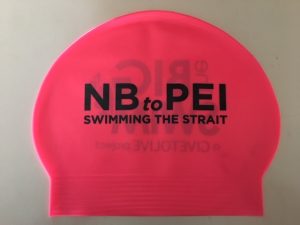
Have you ever considered swimming across the Northumberland Strait? Most haven’t. But for those who have there is the BIG SWIM, your chance to do something truly epic. The BIG SWIM is a supported event held in August each year that combines an epic feat of endurance with the opportunity to raise funds for an awesome charity. The BIG SWIM is not a race and supports swimmers of all abilities to get out into the Northumberland Strait and achieve the unimaginable.” The Big Swim
Stephen Boyd is taking on the challenge of the Big Swim to be held August 18, 2019. In the coming months, Stephen will be focused on training for this “epic” swim. CEGE Connection is pleased to advise that we will be covering this event over the months, following Stephen on his journey. This is the first in the series of The Big Swim – A Give to Live Project.
Stephen J. Boyd (Class of 2018):
Life has so many wonderful opportunities to offer
As mentioned in a previous post, I am recovering from an injury that will prevent me from competing this summer in my first 100-mile ultramarathon. During my period of self-pity, Sarah (my best support and spouse), suggested I consider the BIG SWIM event, where athletes of all abilities swim from New Brunswick to Prince-Edward-Island. For normal people who cross the Northumberland Strait by bridge or ferry, the distance is roughly 13 Kms. Due to currents, and other unknowns, I am told that the average swimmer will cover 15+ Kms.
The Big Swim – Give to Live gives participants the opportunity to accomplish a feat that few have, while raising funds for a charity that supports children. It is a great opportunity to give back to my community. Without any hesitation, or putting any thought into logistics, I registered the moment the portal opened.
For the last month or so, I have been swimming at Dalhousie’s recreation and athletic center, where I log miles in the pool. Since there are not too many of us who show up for 5:45 am (other than the varsity teams), I have had the opportunity to speak with one of the “regulars”. One on occasion, he asked me if I was training for anything in particular; I went on to explain that I was intending on swimming across the Northumberland Strait. As is the case with most people, his question to me was: “why?”
My immediate response was: “why not?” I further elaborated on the importance of my two kids embracing that life is about going beyond the ordinary, and welcoming the unknown.
Recently, during an exchange of correspondence, Rebecca Budd (CEGE Editor) reminded me that on occasion we have re-evaluate our priorities, and that success in life goes further beyond our careers. Don’t misunderstand me; I appreciate my professional career, but it is only a small part of who I am. Later in the spring, Sarah will be competing with her synchronized swimming team in Quebec City. Despite working full-time and being an exemplary mother of two, she has the tenacity to train hard during the week; that is success I admire.
Some years ago, I had the opportunity to speak with someone that had reached the summit of the world’s highest mountains. His advice to me was to never forget that we really only compete against ourselves, and to keep winning; perhaps, that was some of the best advice I’ve ever received. Besides, ordinary is exactly as it sounds. As Mark Twain once wrote:
“Whenever you find yourself on the side of the majority, it is time to pause and reflect.”
I look forward to sharing my thoughts as I embark on the exciting journey.