“The most regretful people on earth are those who felt the call to creative work, who felt their own creative power restive and uprising, and gave to it neither power nor time.”
Mary Oliver

Halifax Public Gardens, Halifax, Nova Scotia
Share.Learn.Inspire.Transform
“The most regretful people on earth are those who felt the call to creative work, who felt their own creative power restive and uprising, and gave to it neither power nor time.”
Mary Oliver
Halifax Public Gardens, Halifax, Nova Scotia
Republished from Faculty of Management News
Posted by Nicole Maunsell on March 22, 2019

MTEA recipients Scott Comber, Oksana Shkurska and James Barker with donor Bill Black.
The 2018–2019 Management Teaching Excellence Awards (MTEAs) were presented in December to three professors in the Faculty of Management.
James Barker is known for being flexible and adaptive in the online classroom environment, where he teaches leadership courses for the Blended Online MBA programs. He had an integral role in developing the newest of these programs, the MBA Leadership. He is the Herbert S. Lamb Chair in Business Education and brings his expertise in organizational complexity to his courses.
Dr. Barker’s award was presented by MBA Leadership student Sundari Pashupathi, who took his Leading in Complexity course. “Jim was very knowledgeable and approachable right from the beginning,” she says. “He made the online learning seamless and was always available to answer any question. He has an excellent understanding of his subject area, and a genuine interest in the needs of the students.”
Oksana Shkurska teaches first-year business communications classes and is a faculty advisor for the Rowe Women in Business Association. She is the communication support specialist for international students in the Rowe School of Business, offering writing help and mentorship to students through the International Student Success Program (ISSP). Her research aims to address the issues of intercultural communication as well as to find more effective methods of communication in academia and business organizations.
Bachelor of Commerce student Julia Penney presented her award. “Not only is her classroom a place where students like me can work through concepts in a safe and engaging environment,” says Penney, “but also Dr. Shkurska brings a zeal for student success outside the classroom as well – whether that is through work with ISSP or when judging case competitions. She connects with students on a personal level and has genuine enthusiasm for their success in a sincere and meaningful way.”
Scott Comber teaches Management Skills Development, Personal and Professional Effectiveness, and is an instructor in the Management Without Borders class, which is taken by all graduate students in the Faculty of Management. He is known for integrating his professional experience as a consultant with academic research in management education to create a unique classroom environment, where he sets high standards for both himself and his students. He has been a case competition coach and the faculty advisor for Enactus Dalhousie.
Sagar Sahota, a Bachelor of Management student, presented the award. “Scott challenged my thinking, how I viewed the world, and how I viewed myself,” he says. “By taking his class, I gained a friend and a mentor, and became a better person.”
Given annually, the MTEAs celebrate teachers who, per the award’s guidelines, “display the qualities of superior teaching, excellent understanding of the subject area and interest in the needs of the students.” Student ratings are integral to the selection process, and the selection committee includes student members.
First awarded in 2010, the MTEAs are made possible by a donation from alumnus Bill Black. At the presentation, the Faculty of Management thanked Mr. Black for his renewed commitments to the award and presented him with a framed reproduction of a profile honouring him in Giving Power, Dalhousie’s print-only donor recognition publication, to honour his longstanding contribution to the Faculty.

John Waldron, MBA (FS) Class of ‘08
Unlike most countries, Canada’s securities industry is provincially and territorially regulated – not federally regulated. This means that instead of having one national regulator governed by one Securities Act, there are 13 regulators governed by 13 Securities Acts. This might have made sense many years ago, before the steam engine, but in an age of information there are no benefits for maintaining such a fragmented system.
Having 13 securities regulatory authorities is not only archaic and extremely inefficient, but it actually conflicts with their common mandate of protecting investors.
Take financial literacy, for example. Many Canadians feel there is a lack of financial literacy resources available to them. And yet, all 13 regulators offer their own version of a financial literacy resource. Imagine how much better a financial resource would be if they all collaborated together, pooling their resources and created one definitive financial literacy resource instead.
To be clear, Canada does not lack financial literacy resources. There are a lot of available resources. So many, in fact, that a Canadian Financial Literacy Database was created, which currently lists 1,362 available resources for Canadians. And there is the Financial Consumer Agency of Canada (FCAC), which is the closest we have to a national financial literacy resource. So why then do we have so many competing resources? If the goal is to protect investors, the better option is for all Canadian securities regulators to work together and maintain one definitive financial literacy resource for all Canadians.
Discussions to create a national securities regulator have been going on for years decades. We may not see a national regulator in our lifetime, but that does not mean they cannot work together to create a unified approach to financial literacy. It not only supports their mandate to protect investors, it is also the right thing to do.
Having 13 financial literacy resource from each of Canada’s securities regulators is not nearly as good for investors as having one resource supported by all 13 regulators. This is how we can make meaningful change for Canadian investors, even if we cannot agree on modernizing the securities industry.
John Waldron MBA (FS) Class of 2008
Founder of Learnedly and purveyor of accessible education for financial professionals
John is a repeat contributor on CEGE Connection. We invite you to read John’s posts on CEGE Connection.
“Lighthouses are endlessly suggestive signifiers of both human isolation and our ultimate connectedness to each other.”
Virginia Woolf

Peggy’s Cove, Nova Scotia
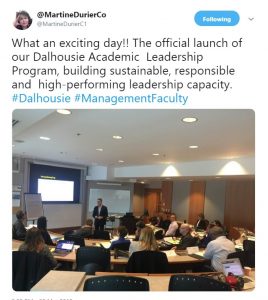
“What an exciting day!! The official launch of our Dalhousie Academic leadership Program, building sustainable, responsible and high-performing leadership capacity.”
Dr. Martine Durier-Copp
Director, Centre for Executive and Graduate Education, Faculty of Management
New program for newly appointed and continuing
Dalhousie Academic Heads, Chairs and Directors
Great work starts with great leaders
Gain the skills and capabilities to lead, collaborate and innovate in academia.
Six full-day sessions with action challenge projects to apply your learning. Course days are scheduled at 2-3-week intervals starting March 29th, 2019 and ending June 21st, 2019.
Program is sponsored by the Provost & VP Academic and designed and offered by the Faculty of Management and the College of Continuing Education.
Courses are delivered by senior Dalhousie Executive Education instructors.
Courses include:
Program starts March 29, 2019. All courses will be delivered in the Centre for Executive and Graduate Education,
Kenneth C. Rowe Management Bldg., Dalhousie University.
To apply to the Academic Leadership Certificate program visit: dal.ca/ExecEd

Rebecca Spencer, Dalhousie University and Sara FL Kirk, Dalhousie University
Supporting girls and women in their efforts to be physically active must become a global public health priority. Preliminary results from our research at Dalhousie University suggests that access to nature may be key to achieving this.
A recent study in The Lancet Global Health pooled global data from the past 15 years and showed persistent and worrying trends: Women continue to get insufficient physical activity, and the gap between activity levels of women and men is widening.
Similar trends are seen in girls aged 12 to 17. Only two per cent meet the requirements of the Canadian 24-Hour Movement Guidelines — which include adequate sleep and at least 60 minutes of moderate-to-vigorous physical activity.
Our own review of the evidence also found that girls have complex relationships with physical activity, requiring an ongoing negotiation of gender roles and stereotypes. They have to navigate cultural narratives focused on the “body” in many parts of their lives every day. They are expected to be pretty but to appear natural, to be thin but not too skinny, to be fit but not too muscular.
We are currently engaged in research to explore the health of adolescent girls and young women through a technique called photovoice, in which participants take photographs to represent their own experiences.
In this study we asked seven research participants to take photos to explore their health, nutrition, and physical activity experiences and to bring them back to discuss in a group, and look for themes or trends.

They found themes relating to challenging norms and stereotypes and to the importance of social support and confidence. They discussed their perceptions that “everything is gendered” and that there are activities girls are “supposed to do.” They talked about sometimes feeling excluded from sports dominated by boys, and expectations around what girls should wear while being active.
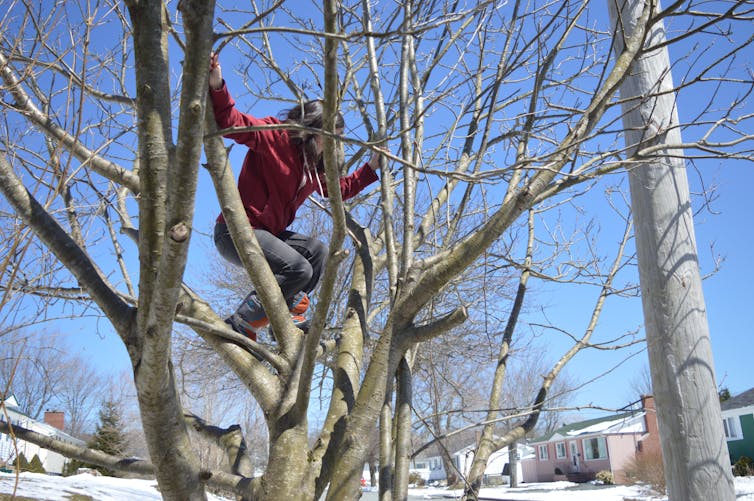
They also discussed how they challenge those norms. The girls, for example, took photos engaging in non-traditional physical activities like aerial circus silks and climbing trees in skirts. They also stressed the importance of support from friends and family to feel safe in challenging norms. There was also a surprising finding: the emphasis they placed on being outside in nature.
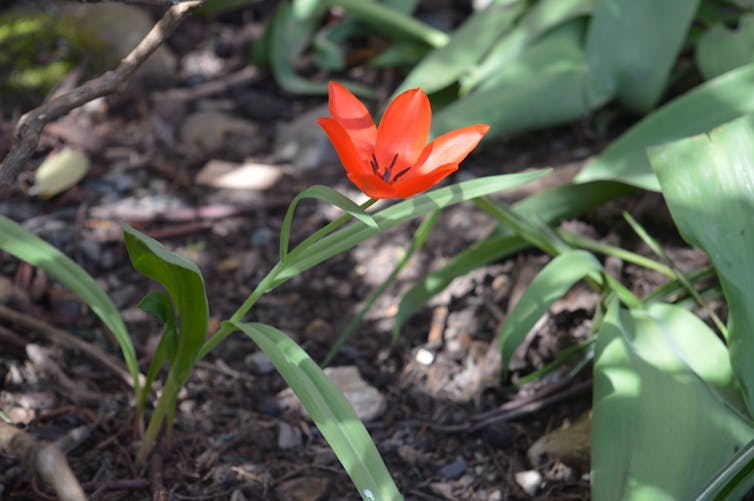
Although nature and the environment were not part of the intended research purpose, being outside emerged as important. Many of the girls and young women shared photos of natural elements, like flowers, trees and water.
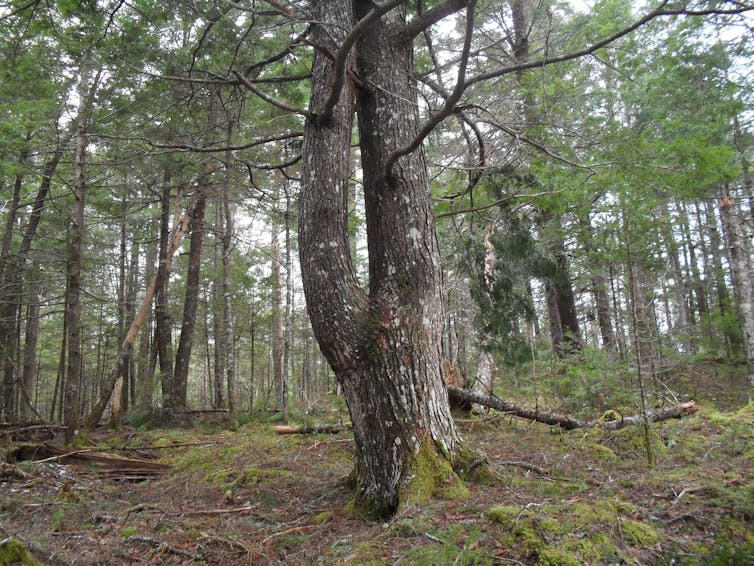
They also took photos of themselves, their friends and families engaging in physical activity outside. This most often included general active outdoor play, but also, more specifically, activities like hiking and camping.
We learned that nature provided important context for these girls and young women to feel comfortable, safe and confident to navigate the complex gender norms around physical activity.
A recent review shows that, due to urbanization and parental fears, youth are less connected to nature than ever before and are missing out on health benefits as a result.
This trend is duplicated in popular culture, with books, songs and films depicting nature less and less over time.
Similarly, a large-scale survey in the United States shows youth spend more time with technology than nature but also indicates they value their time with nature and need more opportunity for that connection.
With the United Nations’ recent warning that we have only about a decade to alter climate change without devastating consequences, engagement with nature has never been more urgent. This can be done through encouraging outdoor play, supporting active transportation and providing safe spaces for women and girls to participate.
Interestingly, the evidence indicates that women face barriers to experiencing nature.
Gendered expectations, fear for their safety and feelings of objectification and vulnerability mean girls and women have to negotiate these feelings in order to participate in outdoor recreation.
Achieving gender equity is a key challenge for the 21st century, reinforced by the United Nations Sustainable Development Goals, which also highlight the importance of nature, environments, sustainability and health.
The benefits of physical activity to mental and physical health are extensive but are not being realized by half the population. Studies are starting to explore gender and the outdoors, while the importance of nature to women is gaining momentum.
But there’s more to do to determine how this finding can support gender equity. The importance of nature for health promotion is an emergent trend in research, and the focus of the upcoming International Union for Health Promotion and Education Conference.
Can nature be the key to promote physical activity among girls and women? More research is needed to know for sure, but it certainly shows promise.
Rebecca Spencer, Interdisciplinary PhD Candidate & Instructor, Health Promotion, Dalhousie University and Sara FL Kirk, Professor of Health Promotion; Scientific Director of the Healthy Populations Institute, Dalhousie University
This article is republished from The Conversation under a Creative Commons license. Read the original article.

Grand-Pré, Nova Scotia
Why is Earth Day Important?
As we celebrate Earth Day on 22 April each year, it should serve up two reminders. One has to do with the past, like a birthday. We need to celebrate all the ecosystem services provided by the Earth to make our lives on this planet livable, indeed even glorious. Fresh air, clean water, diverse natural landscapes, productive soils for food production, minerals to support our technologies, plants and animals to enrich our lives in myriad ways. Earth is a wonderfully hospitable place to live, despite the ravages of natural disasters like earthquakes and volcanoes. In fact, it’s the only place we have to live, and it will remain so for considerable time.
The other reminder has to do with the future. Humans can be really nasty to their earthly habitat. One aspect of this is the global human population, which many believe is too large for Earth’s resources to support adequately over the long term. But another, perhaps more important, is the “footprint” of each individual alive today. The more of Earth’s resources each of us consumes, and the more we dump our unwanted materials into the environment, the less and less hospitable for life Earth becomes. Earth Day should remind us to live gently on our planet and to reflect deeply on what each consumptive decision we make means for environmental sustainability.
Are we handing to our children and grandchildren a world we can be proud for them to inherit?
Earth Day is an annual reminder of our responsibility to engage in daily stewardship of our spaceship Earth. We would not need an annual Earth Day if EVERY day were a celebration of Earth’s bounty!
Dr. Peter Duinker and David Foster, Dalhousie University, April 2019

Grand-Pré, Nova Scotia
“People from a planet without flowers would think we must be mad with joy the whole time to have such things about us.”
Iris Murdoch

Halifax Public Gardens, Halifax, Nova Scotia
Dr. Spiteri’s personal blog, Vegan Footprints, has been a source of information and inspiration for me ever since I started following her blog several years ago. I highly recommend a visit. She covers a wide range of subjects from animal welfare, recipes, to research and libraries. Her articles respond to the rapidly evolving necessity to embrace low-impact living. Her thoughtful discussions allow readers to recognize that everyone can make a difference simply by implementing small changes within our daily living. Dr. Spiteri has generously agreed to share her insights on CEGE Connection.
With special thanks to Dr. Spiteri for encouraging me to embark on my personal “zero-waste living” journey.
Rebecca Budd

Rebecca Budd graciously invited me to discuss a non-work related aspect of my life as part of the blog’s Creative Lives series. My personal interests focus on these areas: Ethical veganism; animal rights; minimalism; zero-waste living; and films. Of these interests, films have been with me since childhood, where I developed an early love of classic Hollywood films, and especially those of the 1930s and 1940s.
Today, however, I would like to focus on my environmental interests and its subsets of minimalism and zero-waste living. I still remember the experience I had as a child of twelve watching a documentary – whose name I cannot recall – that discussed the environmental impact of fossil fuels. Without giving away too much, suffice it to say that this was many, many years ago, and at a time when predictions about climate change and global warming were very few and far between. Thus started my lifelong pursuit of reducing my carbon footprint, even if this term was unknown to me when I started this journey. As a child, I had much less control over my environment, but I remember following family members around to turn off the lights, making sure that taps were not left running, ensuring that windows were firmly closed during the winter, and so forth. I’m sure I annoyed everyone around me, but I was a young woman with a mission, which I was happy to share with anyone who asked.
My interest in what is commonly referred to today as “zero-waste living” has grown over the years. I acknowledge, of course, that there is no such thing as “zero-waste”; the goal, rather, is to reduce as much as possible the waste that one produces on a daily basis. To many, this has focused almost exclusively on single-use plastics, which is also fine, but I have tried to apply this principle of low-impact living – which is perhaps a better term – to all aspects of my life. I maintain a personal blog, Vegan Footprints, in which I document this journey. My veganism is an important part of my low-impact lifestyle, although it was motivated by my love for animals and my desire to do them no harm. The impact of a plant-based diet on the environment has been documented in many places, and perhaps could be the subject of another blog post.
Low-impact living varies with the individual. There is a growing community of like-minded people around the world; it delights me to see so many young people taking up this banner, especially in the face of the dire predictions for the health of our planet. Steps can vary in degree and diversity. Here are examples of how I have created my own low-impact lifestyle:

Dr. Louise Spiteri
School of Information Management
The list can go on, but for the sake of brevity, I will stop here. My personal blog provides more information for those who are interested in exploring how to embrace a low-impact lifestyle. I know that many feel discouraged because of the weight of the environmental predicament in which we find ourselves. Many ask “what possible difference can I make?” I’ve always believed that I can control only my own environment and that I have a responsibility to do what I can to reduce my impact. For many years, I was quite isolated in my low-impact living, but I now know that I’m far from alone and that the movement is growing. We can, in fact, make a difference.
“You may delay, but time will not.”
Benjamin Franklin

Halifax Town Clock, Halifax, Nova Scotia