After Norman Horrocks died last fall, Megan Fitzgibbons collected links to many of the tributes that appeared. It seemed that putting these links together in a web page might be a good project for the E-text class (INFO 6620) that I teach. For a number of reasons, this project did not happen—partly because it did not seem a task to assign as a requirement. So, today I put together a page setting out these links—Norman Horrocks: Tributes and Memories.
Anatoliy Gruzd: Sharing enthusiasm online
Anatoliy Gruzd is in the news again! Check out the Dal News article published yesterday.
You can also listen to his CBC Radio broadcast: Spreading joy, 140 characters at a time!
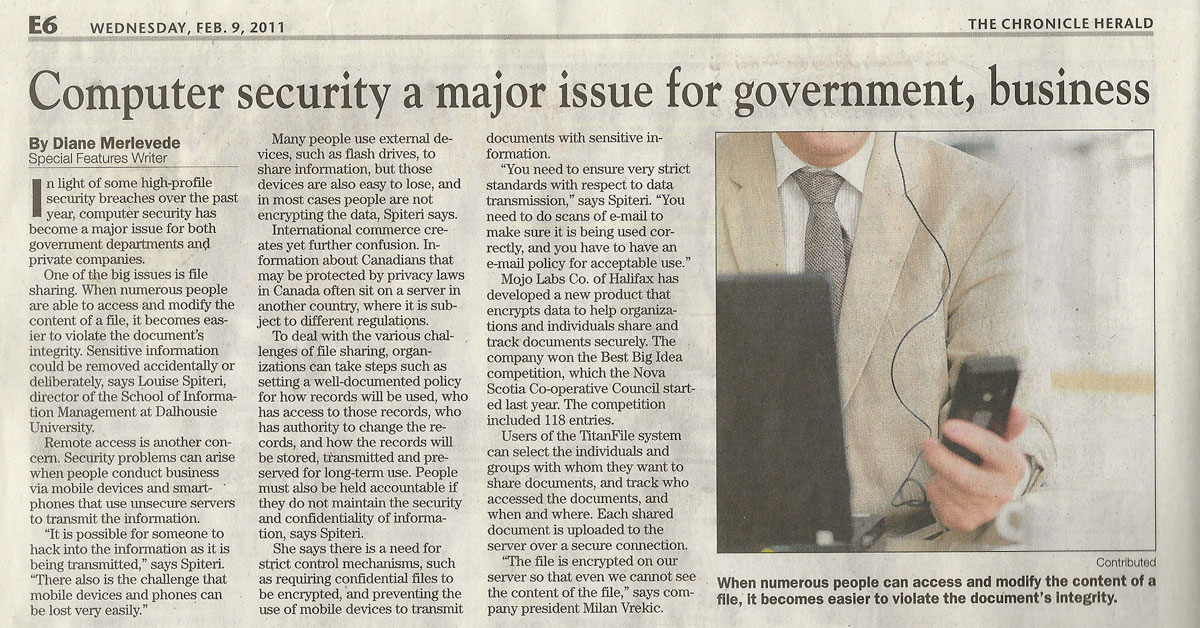
Louise Spiteri interview in the Chronicle Herald
Dr. Anatoliy Gruzd Canada Games research featured in uNews.ca
Further to the Chronicle Herald article featuring Dr. Gruzd’s social media research, his more recent work on the use and impact of Twitter at the Canada Winter Games has now been featured in uNews.ca. “Testing tweets at the Canada Games” (http://unews.ca/story/item/testing-tweets-at-the-canada-games/) gives insight into the work done by his team of students in the Social Media Lab. Also tune in to CBC Nova Scotia Information Morning program on Monday, Feb 14 at around 7:15 am for more updated information about this study.
Paul McKenna interview on CBC Radio
I encourage you to listen to the radio interview given by Paul McKenna, our valued part-time instructor at SIM, about the departure of William Elliot as commissioner of the RCMP. Congratulations, Paul.
How to Be a More Efficient Online Social Networker
A recent NY Times piece about tools that can help companies to manage their online social media better inspired me to start a new series of bi-weekly blog posts at http://SocialMediaLab.ca about different “support” tools that can help individual users to manage and control the content of their ever-changing and ever-growing social media and networking accounts. This week’s focus will be on Social Archiving tools.
Books and the future of reading
I spent yesterday, September 26th, at the Word on the Street Festival, the annual celebration of books and publishing. As always, I saw people crowding around the library, bookstore and publisher displays, pitching their book ideas in the Pitch the Publisher event, listening to authors read from their latest books on the various festival stages, and carrying away shopping bags full of…books. Book culture appears to be alive and flourishing in Halifax, but is traditional book culture fundamentally changing? In his 2007 book provocatively titled The Book is Dead (Long Live the Book), Sherman Young writes:
“For anyone brought up with a 21st C digital mindset, the printed book is an anachronism; books are everything that the new media technologies are not. There is no motion, there is no noise. There is no way to interact with the characters or the story. There is no-one else involved. Reading is a solitary experience. You can’t talk back. It’s just you and the words on the page. And all you can do with those words is read them; apparently there is no other way to engage. For a generation raised on newer media forms, the apparent one-sided conversation of a book defies logic.” (p. 66). He concludes his book with the statement that “the immediate future of the book can be assured (long live the book) by disconnecting the ideas from the object, removing the physical constraints of dead trees and building a future without the codex.” (p. 166).
With the growing popularity of e-books, are we moving into a new book ecosystem…and what will this new ecosystem look like? These are questions we will be discussing in INFO 6070 (Reading and Reading Practices) next term, but I’d welcome your comments now.
Feeling lost in this busy universe of social networking sites? Social Media Lab (SMiLey) rating system can help!
Last week we unveiled a new Social Media Lab (SMiLey) rating system for our ongoing weekly reviews of various social networking sites and tools for scholars like Academia.edu and ResearchGate.net . The reviews are available at http://socialmedialab.ca. Our hope is that this new rating system will make the reviews easier to read and more useful to our readers.
The SMiLey rating system is built around a set of 5 different characteristics: Site Purpose, Findability, Usability, Sociability and Popularity. Each characteristic is rated on a 5-point scale. Each point is represented by a smiley face. One smiley face  represents a site that has major deficiencies and five smiley faces indicate a site that has little or no deficiency.
Read more about SMiLey at http://socialmedialab.ca/?p=422
Exploring Information Interaction ‘Context’ with Tefko Saracevic at IIiX2010
I just came back from the ‘Information Interaction in Context Symposium‘ in New Brunswick (the one in New Jersey, not the one in Canada), the home of Rutgers University. And I would like to share some of the highlights from the keynote speaker while it’s still fresh in my mind.
This year the keynote speaker is Dr. Tefko Saracevic from the School of Communication & Information at Rutgers University. Dr. Saracevic is a well-known figure in the field of Information Behaviour. He was one of the first scholars in the field to recognize the importance and influence of context (e.g., social, cultural, cognitive, etc.) on user’s information seeking and searching behaviour (see Saracevic’s 1996/97 stratified model of Information Retrieval interaction).
Dr. Saracevic started with a great overview of the field from the theoretical perspective. He then outlined some of the shortcomings within current Human-Computer Interaction theories, specifically how HCI theories are not strong on ‘context’ and criticized that the majority of Information Retrieval (IR) tests rely too heavily on the ‘traditional’ recall/precision model (including TREC). As a solution, he proposed five axioms related to ‘context’ in information interaction. I especially like the first axiom “One cannot not have a context in information interaction” which was inspired by Paul Watzlawick ‘s axiom in the Communication field – “One Cannot Not Communicate”. You can find the other four axioms (which are also very insightful) on Saracevic’s website (in the abtract of the talk or presentation slides).
In sum, I agree with Dr. Saracevic that the understanding of ‘context’ is crucial; especially for designing effective IR systems. But understanding the importance of ‘context’ and actually capturing & being able to make use of the information is two different things. Nowadays it is very easy and cheap to capture different kinds of contextual information such as user’s geographic location (via GPS-enabled phones) or user’s social ‘location’ (via online social networking sites); the harder question is how to take full advantage of this information without actually overwhelming the user with a tsunami of data and/or compromising user’s privacy. Going forward, these are some of the concerns that the IR field will have to address.
[Cross-posted at http://anatoliygruzd.com]
SIM faculty members win awards
Each year during its strategic Retreat, the Faculty of Management announces a series of awards to colleagues. These awards relate to achievements in teaching, research and administration. This year, two members of the School of Information Management were honoured with awards, Drs Anatoliy Gruzd and Fiona Black. Read more on SIM’s News & Events.