The Dalhousie University Libraries are seeking a creative, collaborative, enthusiastic Professional Librarian/Archivist for the position of Digital Archivist. The deadline for applications is April 12, 2013. For details, please visit library job vacancies

Free Software Downloads
Did you know that students, as well as faculty and staff members at Dalhousie, can download certain software for free?
Some of the free software available includes: antivirus (Windows), antivirus for Mac, ArcGIS, Minitab, Solid Edge and more.
Go to: https://software.library.dal.ca A log in box will open, prompting you to enter your net ID and password.
This is the page that will open, listing the various software available to students:
Need assistance with software installation? Contact the Help Desk.
Don’t see the software you need? Check out what’s available at reduced rates through PCPC, who sell software at special educational prices, available only to the post-secondary community.
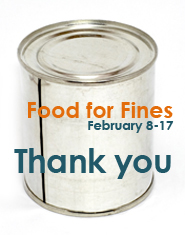
Food for Fines 2013 – Thank you!
Thank you to everyone who participated in Food for Fines at the Dalhousie Libraries between February 8-17. Across our five Dalhousie Libraries, we collected 339 food items and $155.25 in cash donations.
A total of $528.36 in fines were waived in exchange for your food donations. Food items were divided between the Dalhousie Student Union Food Bank, Feed Nova Scotia and the Colchester Food Bank.
Across Novanet (all university and college libraries in Nova Scotia), a total of 1,113 food items were collected, as well as $308.25 in cash donations.
Thank you again for taking part in Food for Fines.
Michael Groenendyk wins national business competition
Michael Groenendyk, the School of Information Management student who helped bring 3D printing to the Dalhousie Libraries, recently won the grand $5,000 prize at a national business competition.
Michael’s proposal was for a 3D design service called Final Frontiers 3-D Design, creating designs for science fiction and fantasy products such as custom-made rings and detailed home decorations.
Michael credits having worked at the Killam Library’s Help Desk with giving him an edge to win the competition. Over the past year, he has spent many hours at the Help Desk, assisting people using the 3D printer, giving him both a solid knowledge of the technology and seeing the ways in which people use the 3D printer.
Congratulations on this fantastic accomplishment Michael! Read more about Michael’s win in Dal News.
UPDATE: Dalhousie Libraries’ statement of support for Dale Askey and McMaster University
Dale Askey is a librarian at McMaster University. In 2010, while working as a librarian at a university in Kansas, he published a blog post called The Curious Case of Edwin Mellen Press.
The blog post contained Mr. Askey’s professional opinion, as an academic librarian, of Edwin Mellen Press, an independent scholarly press established in 1972. According to the Edwin Mellen Press website, their sole criterion for publication is that a manuscript must make a contribution to scholarship.
In the blog post, which has since been removed, Mr. Askey said the publisher was a purveyor of “second-class scholarship.” Due to this statement and other content in the blog post, Mr. Askey and McMaster University are now facing a lawsuit launched by Edwin Mellen Press claiming a total of $4.5 million in damages. The publisher claims that Mr. Askey’s comments were false and defamatory. The claims have yet to be proven in court.
The Dalhousie University Libraries support Dale Askey and McMaster University in their defence against the Edwin Mellen Press libel suit, which is an affront to academic freedom. Librarians must be able to exercise and express professional judgment knowing the principles of intellectual freedom will be respected and upheld. The Dalhousie Libraries join our CARL, ARL and CLA colleagues in urging Edwin Mellen Press to drop the suit.
For more information about this lawsuit, read the CBC story.
UPDATE — March 4, 2013
Edwin Mellen Press is dropping at least one of its lawsuits against McMaster librarian Dale Askey. Read the CBC story here.
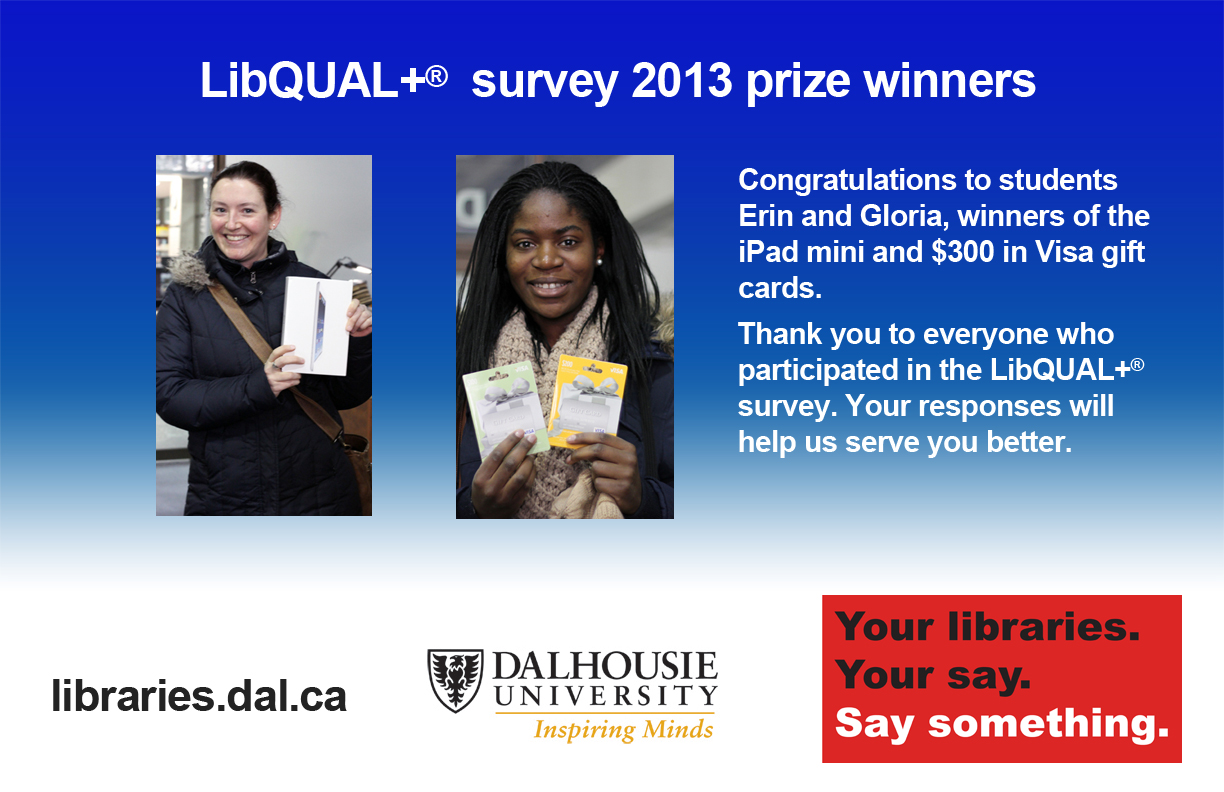
LibQUAL+ Survey Prize Winners
Freedom to Read Week
February 24-March 2 marks Freedom to Read Week in Canada.
Freedom to Read Week is an annual event that encourages Canadians to think about and reaffirm their commitment to intellectual freedom, which is guaranteed under the Charter of Rights and Freedoms.
Organized by the Freedom of Expression Committee of the Book and Periodical Council, Freedom to Read Week is good reminder to not to take this freedom for granted.
The Freedom to Read website has a challenged works section of books and magazines that have been challenged in Canada and the stories behind why a particular work was challenged. Maybe you’ll celebrate Freedom to Read Week today by exercising that freedom and reading a challenged title.
CRC Press: CRCnetBASE trial
The Dalhousie Libraries is offering a trial of the CRCnetBASE until March 26th, 2013!
Explore CRCnetBASE, a premier science, technology and medical ebook collection. The trial includes the following collections:
- SCI-TECHnetBASE,
- BUSINESSnetBASE,
- ECONOMICSnetBASE,
- MILITARYnetBASE,
- ProjectMANAGEMENTnetBASE,
- PublicADMINISTRATIONnetBASE.
To get full access to the trial products, enable the “Full access content only – Access provided by Dalhousie University” search option.
Browse all content on CRCnetBASE .
Let us know what you think – post a comment here, or email us at macrae.library@dal.ca
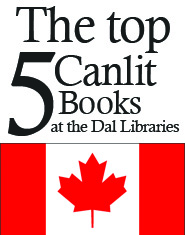
Top Five Canlit Books Borrowed from the Dal Libraries
Today’s Dal News featured the top five Canlit titles borrowed from our five Dal libraries. Here’s in its entirety, is the Dal News piece:
Each year, thousands of books are checked out from Dalhousie’s five libraries: Killam, Kellogg, Sexton, Dunn and MacRae. It probably doesn’t come as a surprise that the most borrowed of these are textbooks, particularly medical ones. So we decided to dig deeper into the Novanet numbers and pull out something a bit more interesting: the five most popular works of Canadian literature, checked out from Dal Libraries over the past year.

1. Life of Pi, by Yann Martel
When Pi Patel is sixteen, his family emigrates from India to North America aboard a Japanese cargo ship, along with zoo animals bound for new homes. When the ship sinks, Pi finds himself alone in a lifeboat, his only companions a hyena, an orangutan, a wounded zebra and a Bengal tiger. Martel’s acclaimed novel became a feature film last year, directed by Ang Lee, which is nominated for 11 Oscars at this Sunday’s Academy Awards.

2. Twenty-Six, by Leo McKay Jr.
A family is forever changed after a devastating mining accident claims the lives of twenty-six men, one of them their son. Written in spare, hard-hitting prose and inspired in part by the Westray mining disaster, Twenty-Six is a novel of human struggle and a community transformed by tragedy. Twenty-Six was also the One Book Nova Scotia selection for 2012 as well as the most recent Dal Reads selection.

3. The English Patient, by Michael Ondaatje
Three damaged people — Hana, the exhausted nurse; Caravaggio, the maimed thief; and Kip, the wary sapper — are each haunted by the riddle of the English patient, the nameless, burned man who lies in an upstairs room. Set in an Italian villa at the end of World War II, the mysterious man’s memories of passion, betrayal and rescue illuminate the novel like flashes of heat lightning.

4. The Mulgrave Road, by Charles Bruce
This collection of poetry was first published in 1951 and won a Governor General’s Award in 1952. The poems are alive with details of Maritime culture and the motifs of ancestors and the connection between past and present are explored.

5. Three Day Road, by Joseph Boyden
Niska, the last Oji-Cree medicine woman to live off the land, has received word that her sole living relation Xavier has been gravely wounded in the war. As she paddles him home on a three-day journey, she realizes that all she can offer in her attempt to keep him alive are the stories of her life. In turn, Xavier relates the horrifying years he spent in Europe as a skilled sniper. Three Day Road is inspired in part by the World War I Canadian hero Francis Pegahmagabow.
Touch a Piece of History: 3D Scanning
We’ve talked a lot about 3D printing on this blog, but we haven’t talked as much about 3D scanning. In addition to the 3D printer, we also have a 3D scanner, which can scan physical objects (historical artifacts, for example) and turn them into a digital file that you can examine from all angles on your computer. You can then take that one step further and print that digital file to make your own 3D model of the object.
University of King’s College journalism student Chris Putnam recently interviewed SIM student and Dalhousie Libraries’ employee, Michael Groenendyk, about the 3D scanning he’s done at Dalhousie and for the Nova Scotia Museum. Chris’s story in Unews.ca, along with a short video, show Michael scanning a red abalone shell. His story and video do a great job of illustrating how 3D scanning works. Chris also included a digital file of a scanned 3D object so you can interact with the finished product yourself.