Congratulations to the two students who won the LibQUAL+ prize incentives, Erin and Gloria.
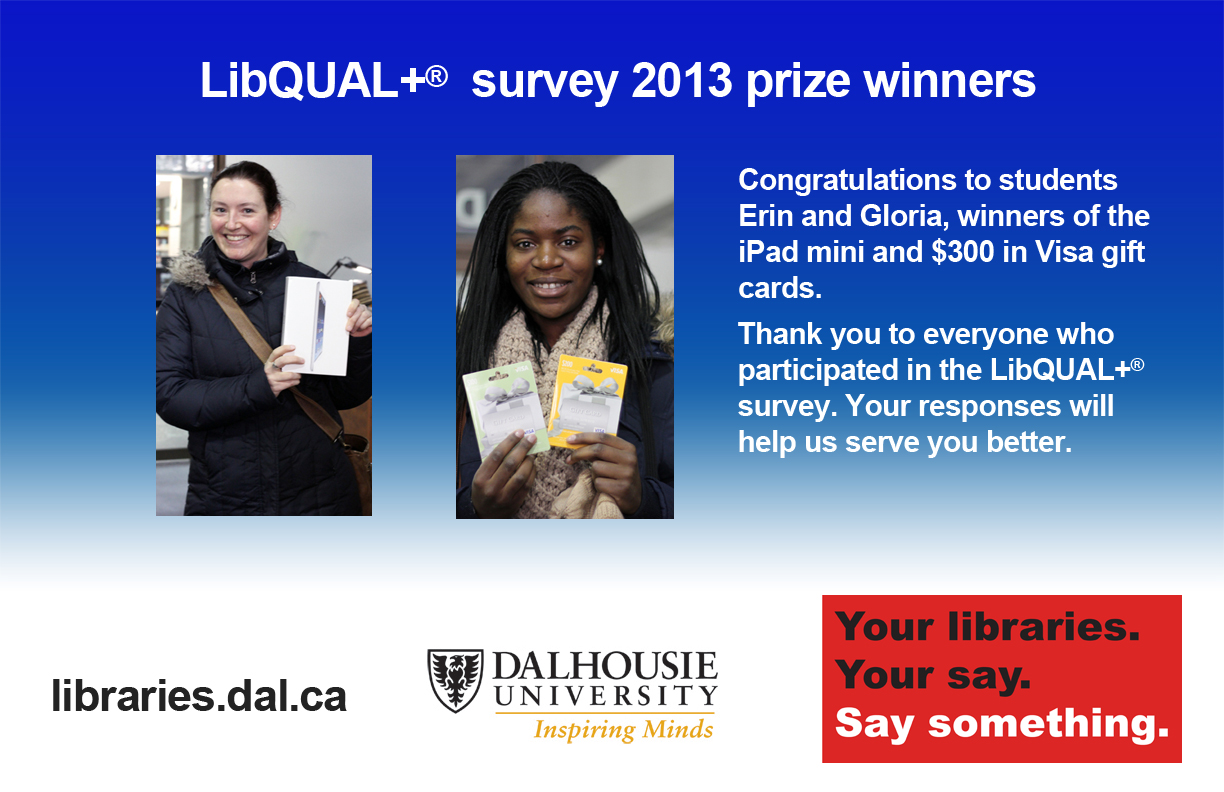
Thank you to everyone who completed a LibQUAL+ survey, your comments and feedback will help us serve you better.
Congratulations to the two students who won the LibQUAL+ prize incentives, Erin and Gloria.
Thank you to everyone who completed a LibQUAL+ survey, your comments and feedback will help us serve you better.

February 24-March 2 marks Freedom to Read Week in Canada.
Freedom to Read Week is an annual event that encourages Canadians to think about and reaffirm their commitment to intellectual freedom, which is guaranteed under the Charter of Rights and Freedoms.
Organized by the Freedom of Expression Committee of the Book and Periodical Council, Freedom to Read Week is good reminder to not to take this freedom for granted.
The Freedom to Read website has a challenged works section of books and magazines that have been challenged in Canada and the stories behind why a particular work was challenged. Maybe you’ll celebrate Freedom to Read Week today by exercising that freedom and reading a challenged title.
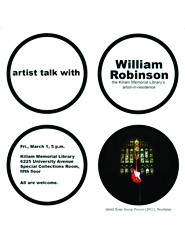
Artist talk with William Robinson, second of two
Fri., March 1/5 p.m.
Special Collections Room, fifth floor,
Killam Memorial Library
William Robinson, the inaugural artist-in-residence at the Killam Memorial Library, is a Halifax-based interdisciplinary artist and graduate of NSCAD (2004).
In this talk, William will discuss his past work and the concept he developed during his residency for a work titled Brutalist Song.
William’s residency at the Killam Library is presented in partnership with the Dalhousie Art Gallery. The residency began on January 28 and ends on March 1.
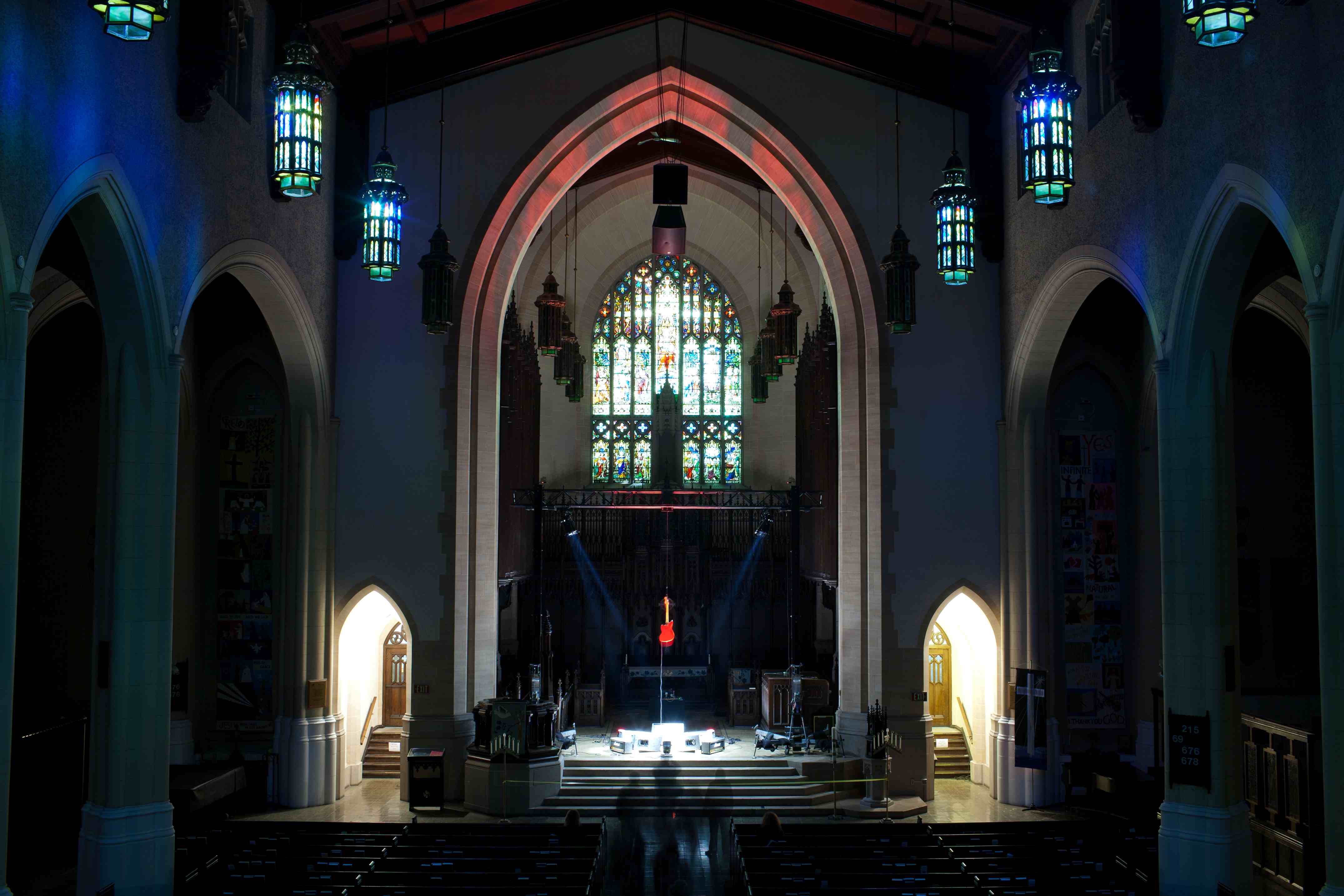
William’s piece Young Prayer (2012), an electronic based kinetic sculpture that functions as a guitar smashing feedback machine. Shown in the Metropolitan United Church during Toronto’s Scotiabank Nuit Blanche, Young Prayer strives to reflect on the sprigging of rock culture from religious practices as well as the repurposed use of architecture (church) from its original context. Young Prayer also aims to reveal the cliché and predictable nature the action of guitar smashing has assumed over its relatively brief history as well as commemorate its lineage and celebrate its unique auditory effects.
The residency is funded through HRM’s residency initiative, which benefits artists by providing them with resources including space, time, critical discourse and financial support to deepen their practices, create works, investigate ideas and experiment with materials.
William employs video, performance, sculpture, drawing and other media to investigate the culture of sound and social architecture. He has exhibited nationally and internationally, having shown in New York, Bergen and Berlin, as well as in Toronto at Nuit Blanche and in Halifax at Nocturne. His practice is conceptually based, often rooted in intimate encounters and immediate experiences.
How many have you read?
Today’s Dal News featured the top five Canlit titles borrowed from our five Dal libraries. Here’s in its entirety, is the Dal News piece:
Each year, thousands of books are checked out from Dalhousie’s five libraries: Killam, Kellogg, Sexton, Dunn and MacRae. It probably doesn’t come as a surprise that the most borrowed of these are textbooks, particularly medical ones. So we decided to dig deeper into the Novanet numbers and pull out something a bit more interesting: the five most popular works of Canadian literature, checked out from Dal Libraries over the past year.

1. Life of Pi, by Yann Martel
When Pi Patel is sixteen, his family emigrates from India to North America aboard a Japanese cargo ship, along with zoo animals bound for new homes. When the ship sinks, Pi finds himself alone in a lifeboat, his only companions a hyena, an orangutan, a wounded zebra and a Bengal tiger. Martel’s acclaimed novel became a feature film last year, directed by Ang Lee, which is nominated for 11 Oscars at this Sunday’s Academy Awards.

2. Twenty-Six, by Leo McKay Jr.
A family is forever changed after a devastating mining accident claims the lives of twenty-six men, one of them their son. Written in spare, hard-hitting prose and inspired in part by the Westray mining disaster, Twenty-Six is a novel of human struggle and a community transformed by tragedy. Twenty-Six was also the One Book Nova Scotia selection for 2012 as well as the most recent Dal Reads selection.

3. The English Patient, by Michael Ondaatje
Three damaged people — Hana, the exhausted nurse; Caravaggio, the maimed thief; and Kip, the wary sapper — are each haunted by the riddle of the English patient, the nameless, burned man who lies in an upstairs room. Set in an Italian villa at the end of World War II, the mysterious man’s memories of passion, betrayal and rescue illuminate the novel like flashes of heat lightning.

4. The Mulgrave Road, by Charles Bruce
This collection of poetry was first published in 1951 and won a Governor General’s Award in 1952. The poems are alive with details of Maritime culture and the motifs of ancestors and the connection between past and present are explored.

5. Three Day Road, by Joseph Boyden
Niska, the last Oji-Cree medicine woman to live off the land, has received word that her sole living relation Xavier has been gravely wounded in the war. As she paddles him home on a three-day journey, she realizes that all she can offer in her attempt to keep him alive are the stories of her life. In turn, Xavier relates the horrifying years he spent in Europe as a skilled sniper. Three Day Road is inspired in part by the World War I Canadian hero Francis Pegahmagabow.
Between Monday, February 25 and Friday, March 1, power conduits and hangers will be installed in the Killam Library basement and connecting service tunnels. This work is required to allow for installation of power and communications lines to service the new LeMarchant Street Mixed Use Building.
This work is expected to have minimal impact on the staff or students in the library, with the exception of noise associated with drilling anchors to support the new services. This work will be scheduled between 7 a.m. and 10 a.m. daily, when the library is less busy.

3D scan of a horseshoe crab.
We’ve talked a lot about 3D printing on this blog, but we haven’t talked as much about 3D scanning. In addition to the 3D printer, we also have a 3D scanner, which can scan physical objects (historical artifacts, for example) and turn them into a digital file that you can examine from all angles on your computer. You can then take that one step further and print that digital file to make your own 3D model of the object.
University of King’s College journalism student Chris Putnam recently interviewed SIM student and Dalhousie Libraries’ employee, Michael Groenendyk, about the 3D scanning he’s done at Dalhousie and for the Nova Scotia Museum. Chris’s story in Unews.ca, along with a short video, show Michael scanning a red abalone shell. His story and video do a great job of illustrating how 3D scanning works. Chris also included a digital file of a scanned 3D object so you can interact with the finished product yourself.

Could your research skills use some honing? The Dal Libraries are presenting two workshop sessions about being an efficient user of library databases and one about RefWorks, a tool that helps you sort your sources and creates a bibliography for you. Work smarter, not harder.
Becoming an effective & efficient user of library databases
Monday, February 18/2-3:30 p.m.
Friday, February 22/11 a.m.-12:30 p.m.
Location: Room G70, ground floor, North Learning Commons, Killam Library
Finding journal articles and books can be a confusing process. In this session, we’ll help you find your way through the research databases and journals available at Dalhousie Libraries. Topics include: choosing and refining your topic, choosing which library database is right for your research paper, understanding why “peer-reviewed” articles are so important and getting articles delivered right to your desktop (or laptop). This session will help you find your path to research success and become efficient library researcher. To register, contact: clrichar@dal.ca
Managing & organizing your literature (RefWorks)
Wednesday, February 20/10-11:30 a.m.
Location: Room G70, ground floor, North Learning Commons, Killam Library
Do you need a system for managing and organizing your literature? This session will teach you how to use RefWorks, an online tool designed to help you easily gather, manage, store and share all types of information, as well as generate citations and bibliographies. Never lose a page number or source name again. To register, contact: clrichar@dal.ca

Update: Dal’s Halifax campuses will resume normal operations effective Sunday morning. Check here for more detailed information: http://www.dal.ca/storm-information.html
Join the School of Information Management for their Master of Library & Information Studies (MLIS) Open House on Wednesday, February 13, 5-6:30 p.m. (Atlantic Standard Time).
Meet with current students in the MLIS and combined degree programs, as well as SIM alumni who are now professionals in the Information Management field. SIM’s instructors will also be on hand to answer your questions.


February 8 – February 17, 2013
Reduce or clear your library fines with food.
For every non-perishable food item donated, participating Novanet libraries* will reduce your library fine by $2, to a maximum of $20. All food donations will be given to Feed Nova Scotia (recommended items), the Dalhousie Student Union Food Bank and the Colchester Food Bank (for food items brought to the MacRae Library on the Agricultural Campus).
Bring your donations of canned goods or other non-perishable foods to the Circulation Desk at any of the five Dalhousie Libraries during regular hours. We accept cash as well, and you can make contributions even if you don’t owe book fines.
Last year, the Novanet libraries waived $3,140.95 in fines, collected 2,076 food items and took in $709.75 in cash donations.
Good for the libraries, good for the food bank — good for you!
*Food For Fines is an initiative of the libraries at Mount St. Vincent University, Dalhousie University, University of King’s College, Cape Breton University, Atlantic School of Theology, St. Francis Xavier University, Saint Mary’s University, NSCAD University, Université Sainte Anne and the Nova Scotia Community College.