Saturday, November 10
- 12-5 p.m.
Sunday, November 11
- 1-10:30 p.m.
Monday, November 12
- 10 a.m.-10:30 p.m.
Saturday, November 10
Sunday, November 11
Monday, November 12
Saturday, November 10
Sunday, November 11
Monday, November 12
Want to catch up on some old memories from the Nova Scotia Agricultural College? You’re in luck! The MacRae Library has digitized back issues of the Agricola News (formerly called Alumni News) to 1979. Here is the complete list of Agricola News (56 issues so far) currently available in DalSpace.
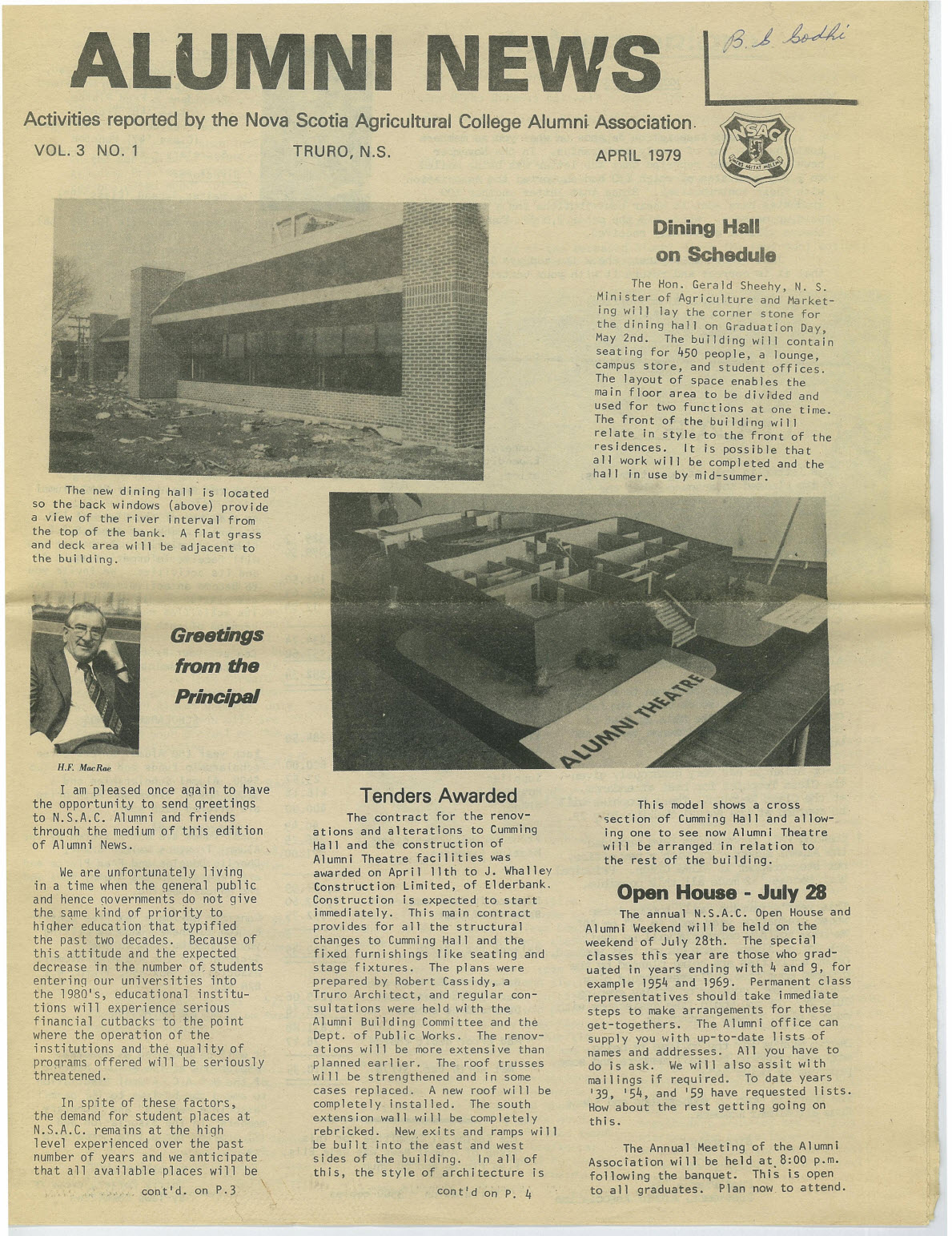
One of the oldest issues of Alumni News that the MacRae currently has, from April 1979. Do you have older issues we could scan?
Some interesting tidbits from early publications include:
The MacRae Library is looking for issues of Alumni News prior to 1979. If you have any issues that you wish to donate to the library for digitization, please contact erin.macpherson@dal.ca
Staff at the MacRae Library are working on other digitization projects, including the NSAC calendars, that we hope to share with alumni in the near future. Stay tuned.
Judith Coughlan-Lambly, head of technical services at the W K Kellogg Health Sciences Library, is retiring today.
“I will greatly miss all of my Dal library colleagues, as well as those I’ve worked with in other Novanet libraries. I wish them all the best!” says Judith.
During her career, Judith provided leadership for technical services and other agendas, both for Dalhousie Libraries and in the broader Novanet and national communities. Her knowledge and experience have been crucial to providing and maintaining user access to Dalhousie collections.
“She is a respected colleague and friend and we will miss her,” says Patrick Ellis, head of the Kellogg Library.
Judith, congratulations on a successful career and all the best in your retirement.
The Dalhousie Libraries have recently obtained a subscription to The Churchill Archive. This remarkable resource about Winston Churchill provides the Dalhousie community with instant access to high-quality digital copies of Churchill’s entire collection of personal papers.
This is a virtual treasure trove for historians. The Churchill Archive contains nearly 800,000 documents, including private letters, speeches, telegrams, manuscripts, and a wide variety of government papers. Every scrap of paper that Churchill kept in his lifetime is there.

Dr. Christopher Bell, pictured with his new book, Churchill & Sea Power (Oxford University Press, 2012).
Dr. Christopher Bell, an associate professor of history at Dal, teaches courses on British and global history and he finds this collection an indispensable tool for his research. The original documents, he notes, are housed at the Churchill College Archives Centre in Cambridge, England. “Over the last twenty years I have made numerous journeys to Cambridge and spent countless hours searching through the original documents and microfilm copies. Churchill has always been a major figure in my own work, and he is the focal point of my latest book, Churchill & Sea Power (Oxford University Press, 2012). I am also embarking on a new Churchill project, which will look at the 1915 Dardanelles campaign, and this subscription will save me a huge amount of time and trouble,” says Dr. Bell.
The Churchill Archive is also a fantastic resource for students. “Every year I teach a seminar on Winston Churchill for upper-level undergraduate and graduate students. This year I will be able to give these students hands-on experience with archival research – something that is virtually impossible when the archives are located (as they usually are for the subjects I teach) on the other side of theAtlantic. Students in the seminar will now have to navigate through this massive collection to find documents relevant to their research topics,” says Dr. Bell.
If you have an interest specifically in Winston Churchill or in twentieth century history in general, make sure you check out The Churchill Archive. You’re sure to uncover something fascinating.
Even though Erin works at the MacRae Library, the newest library in the Dalhousie Libraries group, she is already well acquainted with the Dalhousie Libraries.

Erin Winchcombe, based at the MacRae Library on the Agricultural Campus.
While Erin was a student in the Library and Information Technology program at the Nova Scotia Community College, she worked in acquisitions and serials at the Kellogg Health Sciences Library. From 2006-2009, after graduating from NSCC, she then worked at the Sexton Design & Technology Library as a library assistant. Erin worked in acquisitions and serials, cataloguing, access services, and the Digital Initiatives Group, as well as being the IT contact for the Sexton Library.
Erin started working at the MacRae Library in January 2010 as a library assistant, primarily in acquisitions and serials, where her duties include receiving and processing all journals, claiming, binding, and maintaining the current periodicals, bound periodicals, and storage collections. She also catalogues new journals and government documents, both print and electronic.
Welcome back to the Dalhousie Libraries, Erin!
Jennifer MacIsaac is the cataloguer and acting archivist at the MacRae Library. She catalogues and processes all purchased and donated books and the Agricultural campus’ master’s theses for our collections. Jennifer’s duties also include inventory, weeding, shelf reading, shelf management, and shifting of the MacRae’s book collections. She has also worked in interlibrary loans/ document delivery.

Jennifer MacIsaac, based at the MacRae Library on the Agricultural Campus.
Jennifer also acts a supervisor in the government documents and serials cataloguing department; assists in training and supervising the library student assistants in their shelving and shelf reading; and lends a hand in circulation, interlibrary loan/document delivery, and reference when needed. She is also the occupational health and safety representative for the MacRae Library.
A graduate of the Library and Information Technology program at the Nova Scotia Community College, Jennifer is currently furthering her education by taking workshops to acquire a certificate in the archives core curriculum of the Council of Nova Scotia Archives.
Jennifer has also been involved in the campus United Way campaigns by organizing book sales. One of her favourite quotes is a Zen proverb,”Knowledge is learning something new every day. Wisdom is letting go of something every day.”
Welcome to the Dalhousie Library team, Jennifer!
Need a hand organizing your bibliography? Learn how to use RefWorks, a tool that compiles, edits and formats bibliographies by importing references directly from online databases that you’re using. You can also use RefWorks to enter your references manually and insert them into your finished paper in the citation style of your choice (eg. APA, MLA).

Make bibliographies easier with RefWorks.
The MacRae Library (Agricultural Campus) is offering tutoring sessions that explain how to create a RefWorks account, export article citations, create a bibliography and more. This session is open to faculty, staff and students.
Those attending a session are encouraged to bring their laptops and follow along; however, a laptop is not required. Each session will be held in the Writing Centre corner on the main floor of the MacRae Library (see the Circulation Desk for directions).
Sessions are limited to 15 participants. To register, please email erin.macpherson@dal.ca or sign up at the Circulation Desk and state which session you’d like to attend:
Friday, November 2/1-2 p.m.
or
Tuesday, November 6/9:30-10:30 a.m.
Erin MacPherson has worked at the MacRae Library since 2008. She’s a graduate of the Nova Scotia Agricultural College, holding a Bachelor of Science (Agr) in plant science and a plant science technician diploma. She is currently doing her masters in library science (MLIS) part-time at Dalhousie.
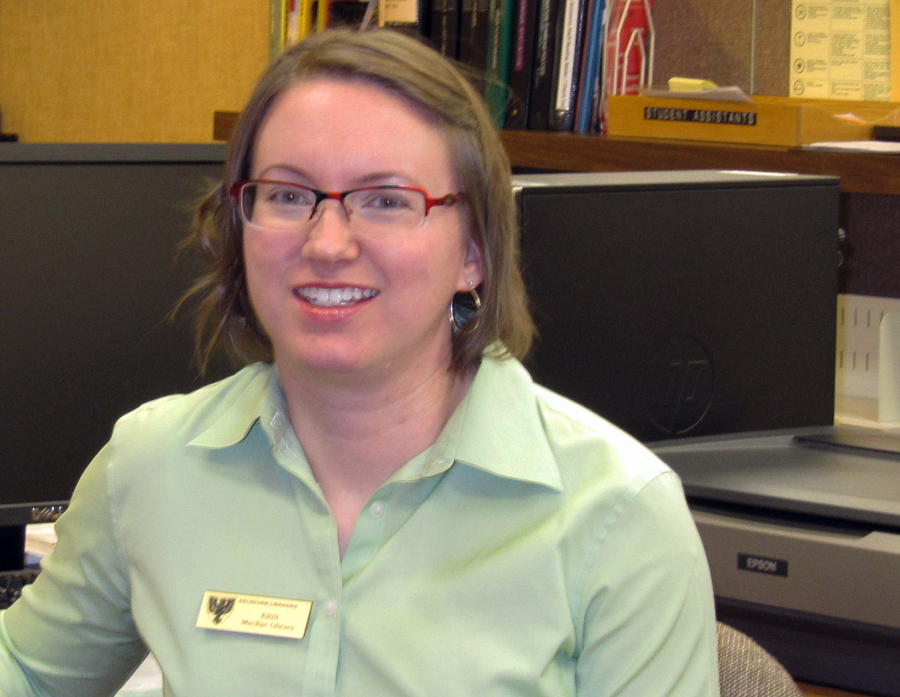
Erin MacPherson, based at the MacRae Library on Dalhousie's Agricultural Campus.
At the Faculty of Agriculture, Erin teaches information literacy classes. She is also responsible for electronic resources (databases), the library website and copyright queries. Erin created and maintains the MacRae Library’s agriculture subject guides, she works on the reference desk, and has done many projects related to the merger.
“I’m really excited to be part Dalhousie team and to work in part of a large library system. I feel like there are many opportunities to make a positive impact,” says Erin. “Working with my colleagues at Dalhousie during the merger has been a great experience!”
Erin, welcome to the Dalhousie Libraries team!

The open access logo.
In today’s installation for International Open Access Week, we’re taking a closer look at the Open Access rainbow. Green, blue, yellow, white and gold make up the open access rainbow, with each colour relating to a different option or model in the open access journal world.
Before we dive into what each colour means, we first have to understand the concepts of pre-print, author’s final version and post-print. Pre-prints are the draft, uncorrected version of an article. The author’s final version is the article written exactly as it will appear in a journal. Post-prints are how the article looks in a journal—this includes the typeface and layout as it appears on the pages of the publication. Usually this is a PDF of the article from the publication.
Each colour in the open access rainbow refers to different levels of open access allowed by publishers.
Green
When a publisher allows both the pre-print and the post-print to be archived, they are considered a green publisher producing green journals. Many publishers will allow the author’s final version to be archived but not the post-print. Such publishers are still considered green as they allow a version to be archived that has the same content as the published version.
Blue
Blue publishers will not allow pre-prints to be archived but will allow post-prints or the author’s final version to be archived.
Yellow
If a publisher allows their authors to archive their pre-prints but not their post-prints, then they are considered a yellow publisher.
White
Publishers that refuse to grant their authors any rights to archive their work online are called white publishers. Their journals are known as white journals.
Gold
Gold refers to open access journals that are available to readers free of charge. Usually, these are electronic journals and the material is openly accessible on the Internet. These journals are financed by payments for the article to be published, as opposed to being financed through reader subscriptions. Sometimes referred to as “author-pays publishing,” when generally the publishing fee is paid from a research grant as part of the cost of doing research.
We hope that the blog posts featured on the LibVine throughout Open Access Week have shed light on some of the issues facing the academic world. In recognition of Open Access Week, the School of Information Management is launching the latest issue of their journal, the Dalhousie Journal of Interdisciplinary Management, as an open access edition. The launch will take place today (Fri., Oct. 26) from 12-1 p.m. in room 3089 of the Rowe Building.
Source: Green, Blue, Yellow, White & Gold: a brief guide to the open access rainbow, by Bill Hubbard. http://www.sherpa.ac.uk/documents/sherpaplusdocs/Nottingham-colour-guide.pdf