“Have patience with everything that remains unsolved in your heart. …live in the question.”
Rainer Maria Rilke, Letters to a Young Poet

Share.Learn.Inspire.Transform
“Have patience with everything that remains unsolved in your heart. …live in the question.”
Rainer Maria Rilke, Letters to a Young Poet
“The MacEachen Institute’s purpose is to engage with the community – public sector, private sector, not-for-profit, students, academics – bringing people together to work on the big policy problems of our time and providing sensible, empirically based research in a non-partisan environment”
Dr. Kevin Quigley, Scholarly Director
The MacEachen Institute for Public Policy’s 2019 event schedule promises dynamic discussions. CEGE Connection reached out to Warren McDougald, Communications Officer and member of the dedicated team at the MacEachen Institute, for a virtual interview.
Warren McDougald:
The MacEachen Institute had a stellar 2018 line-up of events, with more coming in 2019 that will encourage active involvement.
January 31, 2019 the MacEachen Institute will host a grad student round table on “The Canadian Climate Policy and the Turnover problem.” Award winning historian, Dr. Jerry Bannister will moderate the event, which will offer the opportunity for a cross-disciplinary platform for ‘graduate climate researchers’ to collaborate, pool ideas and resources, and engage with knotty climate change issues.
This grad student round table builds on the MacEachen Institute for Public Policy’s October panel discussion, Science and Policy: Should Scientific Information Have Pre-eminence in Public Decision-making?
When politicians debate big issues like reducing greenhouse gas emissions, protecting marine environments, or granting permits for clearcutting, should scientific evidence always take priority in the decision-making? Not always, according to speakers at October panel discussion.
Former MP Megan Leslie joined a panel alongside UK journalist Daniel Cressey, St. FX professor Richard Isnor, and Dalhousie Professor Jeffery Hutchings, at the MacEachen Institute for a discussion about the importance of scientific evidence for government policy. The talk was a part of the MacEachen Institute’s Policy Matters speaker series, a weekly fall series that is open to the public and aims to encourage public engagement with local, national and international policy issues.
The central question up for discussion at this talk was “if evidence supports development of a policy, shouldn’t the evidence be given priority in policy decisions?” In practice, however, the model faces many challenges. Even though governments broadly state that their decisions will be based on research evidence, researchers frequently wonder why evidence seems to be ignored. Evidence to resolve serious environmental and societal problems is available, but solutions seem to be elusive.
“Scientific evidence is one kind of evidence and there are lots of different kinds of evidence,” says Megan Leslie, “Policy making is messy business . . . people are involved, economies are involved, communities are involved, countries are involved, and I do think science is just one factor.”
Leslie’s opinion was at odds with some of the scientists in the room, who spoke about the need to use academic research as a basis for finding solutions to policy problems. UK science journalist Daniel Cressey emphasized the demand for “evidence-based policy” in government but acknowledged that it’s difficult to present complex academic findings to politicians.
“Academic evidence is not cutting through to parliamentary decision-making and that’s because it arrives late, if it arrives at all, it comes laden with technical jargon, and it’s massively long,” says Daniel Cressey, Deputy Editor of Research Fortnight, London.
If you’re interested in learning more about whether scientific evidence should have pre-eminence in public decision making, a video of the full talk is on the MacEachen Institute’s website and their YouTube Channel.
“Did you just groan at the thought of opening another book on risk management? Like election cycles, media talk about celebrity hairdos and cute cat videos trending on social media; perhaps, the least interesting thing might be another book on risk management. However, you got past the first two sentences, so possibly you believe there is something still needed in risk management thinking that is keeping your going”
Dr. Rick Nason: Rethinking Risk Management: Critically Examining Old Ideas and New Concepts
(Kindle loc 66 of 2238)

Dr. Rick Nason: Rethinking Risk Management: Critically Examining Old Ideas and New Concepts
CEGE Connection is excited to launch Dr. Rick Nason’s latest book, Rethinking Risk Management: Critically Examining Old Ideas and New Concepts, which is available in Kindle and paperback format. The Introduction is concise and to the point: Another Book on Risk Management! Those words alone prompt an innate curiosity to read a few more sentences, then a page and before long readers find they are captured by Dr. Nason’s insightful discussion that challenges them to revisit their current understanding of risk management.
The book is structured as a series of questions, the first one being “What is Risk?” The running theme throughout the book’s 150 pages is that risk management is essential and adds value to all organizations, whether public, private or not-for profit.
While “Rethinking Risk Management” is intended for senior managers, directors, risk managers, and students of risk management, I found strategies and insights that were relevant in my personal daily interactions. We live in a world of complexity where risk is ever-present and must be understood as well as managed.
Rebecca Budd
CEGE Connection Editor & Blog Coordinator
The following excerpt is taken from Rethinking Risk Management: Critically Examining Old Ideas and New Concepts, Kindle Edition, Location 96 Location 102 Location 110 of 2238
What is risk? Perhaps, the question is trivial, but in workshops I have conducted, I get a wide variety of responses, and often, a passionate debate will break out among the participants. Apparently, the answer to the simple question of “what is risk?” is not so simple. Of course, this leads to a follow-up question of what is risk management? Another simple question that proves to have a not-so-simple answer—or at least not simple when you hear managers try to explain what risk management is. The physicist Richard Feynman supposedly once claimed that if you cannot explain what you do to someone in grade six, then you do not know what you are talking about. How much of risk management can be explained to a preteenager in grade six much less the managers or even the board of directors of an organization?
It is often only by going back to first principles, or a clean sheet of paper, that one can again make things simple again, and provide the clarity that is needed to develop more productive and effective paths forward. Asking two simple questions of what risk is and what risk management is helps to start us off on that process. How often does someone in your organization question the reasoning behind a certain process? I suspect it is quite often, but they keep their questions to themselves without taking the risk of openly questioning and potentially exposing their lack of knowledge.
Perhaps, you are one of those doing the silent questioning. Generally, if someone actually does verbalize the question, rather than leaving it unspoken, there is frequently no response other than “We’ve always done it this way.” Not a very satisfying response! Progress is not based on always and unquestioningly doing things the way they have always been done. Sometimes, processes are based on assumptions that turn out to be false upon close examination. However, without questioning these assumptions or axioms, the situation will never improve, unless by some fortuitous accident, which is not a high-probability strategy. It becomes very easy to lose the plot of what the main objective is without an occasional pause to ask what the end goal is, and what the best path to get there is.
“Should auld acquaintance be forgot,
and never brought to mind?
Should auld acquaintance be forgot,
and auld lang syne?
For auld lang syne, my jo,
for auld lang syne, we’ll tak’ a cup o’ kindness yet,
for auld lang syne”.
Robert Burns, (January 25, 1759 – July 21, 1796)

Burns Monument Alloway, South Ayrshire, Scotland
Robbie Burns message “Should auld acquaintance be forgot and never brought to mind?” remains ever relevant in a world where friendships have taken on a global perspective. His words, traveling across the centuries, are a call to action. On this Robbie Burns Day 2019, let us celebrate and remember the importance of friendship and camaraderie.
Registration for Information Without Borders 2019 Conference: Information Accessibility, February 12th is now open! To register, please follow this link.
This year, Information Without Borders is exploring the theme of Information Accessibility at the lucky thirteenth annual student-led conference at Dalhousie University. The keynote speaker will be Dr. Teresa Blankmeyer Burke from Gallaudet University in Washington, D.C. She is the only signing deaf philosopher in the world with a doctorate in philosophy. Her publications cover a wide range of genres, including peer-reviewed scholarship in philosophy and bioethics, journalism, creative nonfiction, as well as poetry in American Sign Language and English.
A panel of health librarians will discuss information access differences from consumers to clinicians, and solutions for libraries. We will hear from Bianca Mercer, a prison abolishment activist and first voice narrative expert, as well as Dr. Patti Doyle-Bedwell, an Aboriginal Women’s rights advocate and professor at Dalhousie University who will discuss Indigenous Knowledge. To cap things off, Daniel Rotsztain, Toronto’s urban geographer, writer and cartographer will be discussing how people can reinterpret everyday information in an urban environment.
For more information about the speakers and updates visit iwbconference.ca and follow @iwbconference on social media.
We invite you to join the conversation!
“Scholars have been researching politeness for decades in order to understand its role in communication and its effect on people’s relationships. As human beings, we communicate not only to exchange information, but also to satisfy our basic social needs, including a sense of connection and inclusion that accompanies belonging to a particular group. We need to love and be loved, build and sustain relationships, as well as give and receive empathy.”
Dr. Oksana Shkurska

Dr. Oksana Shkurska Assistant Professor Rowe School of Business
Communication Support Specialist for International Students
CEGE Connection is thrilled to launch “Politeness, Power & Conflict Management”, a column by Dr. Oksana Shkurska, Assistant Professor Rowe School of Business. Dr. Shkurska’s research interests include politeness and power in corporate communication, barriers to effective communication, conflict management in intercultural communication, and successful academic and business writing. Her research is interdisciplinary and aims to address the issues of intercultural communication as well as to find more effective methods of internal and external communication in organizations.
Dr. Shkurska was a recipient of the prestigious 2018 Dalhousie Faculty of Management Teaching Excellence Award, which celebrates teachers who, per the award’s guidelines, “display the qualities of superior teaching, excellent understanding of the subject area and interest in the needs of the students.”
Dr. Shkurska has graciously agreed to share her knowledge and experience on CEGE Connection. We invite you to join the conversation and gain insights on the advantages of introducing politeness into a communication strategy that responds to our evolving workplaces and organizations.
“To be ignorant of what occurred before you were born is to remain always a child. For what is the worth of human life, unless it is woven into the life of our ancestors by the records of history?”
Marcus Tullius Cicero

The Holy Island of Lindisfarne, Northumberland
With the arrival of the new year, it is important to remind ourselves that hesitation is one of the highest forms of opportunity cost. No matter what we may think our constraints or limitations are, we can generally push ourselves further.”
Stephen Boyd MBA(FS) Class of 2018

Crossing the Finish Line Lake Placid Ironman
“All limits are self imposed.” Icarus
In 2010, I decided to start running, inspired by a family member, who began competing in ultramarathons at age 50. The following year, it was no surprise to family when I casually announced that it was my intention to complete in an Ironman triathlon (4 Km swim, 180 Km bike, and 42.2 Km run- all within a 17-hour time limit). Despite my relative inexperience in running and cycling, I took on the challenge of training 20+ hours a week, which often included waking up at 3:15 AM. I recall that on one occasion, a police officer asked me why I was cycling at such an absurd time of the day. On July 22, 2012, at 11:43 PM, I crossed the finish line at the Lake Placid Ironman. It was an affirmation to continue striving for goals that seemed beyond my limits. The honours of that day belonged to a 75-year old triathlete, who successfully completed the race.
I went on to pursue the Ironman Muskoka in 2015, welcoming the challenges and obstacles of training for an endurance event. Mission accomplished! My personal circumstances during this time period changed; my son was born, my career became more demanding, and I was now studying for an MBA at Dalhousie University. I set some onerous goals for my studies, since I have in mind to some day pursue a PhD. Despite personal challenges and the time restrictions that accompany a robust academic journey, I graduated with distinction as the 2018 Director’s Award recipient for highest academic achievement.
To be clear, I have never been a gifted athlete (average at best), nor do I claim to have above-average intelligence. However, I am a firm believer that our personal frame of mind is often the largest obstacle in achieving personal objectives. Many years ago, I was involved a bad car accident. It was a pivotal moment. It was then that I resolved that I would no longer hesitate to pursue ambitious goals, no matter what life chose to throw at me. For instance, at present I am working through an injury which will prevent me from competing in a 100-mile ultramarathon this summer. Admittedly, I found myself expressing negativity about my injury; but I have since shifted my frame of mind and re-directed my energy to other ventures, which may include swimming from New Brunswick to Prince Edward Island in August.
With the arrival of the new year, it is important to remind ourselves that hesitation is one of the highest forms of opportunity cost. No matter what we may think our constraints or limitations are, we can generally push ourselves further. For a little extra motivation, look up the inspiring story of Ironman Team Hoyt.

Stephen J. Boyd MBA(FS) Class of 2018
Stephen J. Boyd, MBA(FS) Class of 2018, was the recipient of the prestigious Rowe School of Business Award for Highest Academic Achievement. CEGE Connection is pleased to advise that Stephen has graciously agreed to be a repeat contributor on CEGE Connection.
“Digital technologies are transforming the structures of society: governments, business, educational institutions, entertainment, travel. Without question, the governance of information and the need for advanced information skills are essential to realize the potential of this field of enquiry.”
Dr. Sandra Toze, Director, School of Information Management, Dalhousie University

Dr. Sandra Toze
Director, School of Information Management
Dalhousie University
The potential of open data is enormous. Much has been accomplished over the past few years, which has encouraged us to look back and reflect upon the knowledge that has been acquired to date. How can we measure and quantify what has been done and how can we use this information to plot the trajectory of open data? There is considerable rhetoric around this dynamic topic, which prompts the need for a deeper and more inclusive dialogue. Open data has the potential to be disruptive even as it offers positive outcomes. We recognize that there will be challenges, setbacks and curves to be experienced along the way. Without question, open data offers an exciting journey that will continue to influence and transform our world and the way we interact within a digital environment.
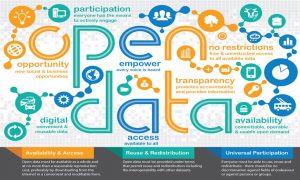
The definition of open data that has been agreed upon within this field in enquiry, is data that can be freely used, shared and employed as a foundation upon which to build, by anyone for any purpose. The definition encompasses many aspects of information management such as quality of data: completeness, timeliness, the ease of electrical transferability, access, and machine readable. It also involves standards. One of the ideas we are looking at within Canada, is making sure that we can incorporate municipal, provincial and federal data seamlessly. The power of data comes with the ability to link data from different places, in different sections, in different ways. Which brings us back to standards, licensing, permissions. Questions like “who owns the data” are critical to our ongoing dialogue.
My goal is to demystify was is currently in place and look at ways in which we can measure and implement ongoing measurement tools to assess our progress so far and prepare for the next stage of the journey. For us to move forward with open data initiatives, we need in increase the overall data literacy, within our profession and within the public. As educators, SIM is creating a data literacy course at the undergraduate level to respond to this need. We need to recognize that this gap must be filled for us to fully enjoy the benefits and influence of open data.
The promise of open data gives us the impetus to continue our research:
We live in a world that has the technological resources and capacity to amass data at an exponential rate. Working together, we have the opportunity to harness the power and potential of open data.
Dr. Sandra Toze
Director, School of Information Management
Dalhousie University
January 2019
“Keep close to Nature’s heart… and break clear away, once in awhile, and climb a mountain or spend a week in the woods. Wash your spirit clean.”
John Muir
