“There are only two ways to live your life. One is as though nothing is a miracle. The other is as though everything is a miracle.”

Venice, Italy
Share.Learn.Inspire.Transform
“There are only two ways to live your life. One is as though nothing is a miracle. The other is as though everything is a miracle.”
Venice, Italy
“The right to be forgotten, also known as the erasure law, has undoubtedly been met with some controversy. There are those who fully support the right of an individual to safeguard anything that is written and searchable about them. If the information no longer fits the person’s lifestyle, beliefs, or is not criminal in nature, does this removal of data and information impact anyone? On the other hand, there are those who believe that once something is written, or made available in the public domain, that this should exist forever, regardless of a person’s current situation.” The Right to be Forgotten – Can this work in Canada?
Chris Donnelly, MIM Class of 2018

Chris Donnelly, MIM Class of 2018
In celebration of the 10th anniversary of the Master of Information Management, Dr. Sandra Toze arranged a virtual interview with Chris Donnelly, Senior Functional Analyst, Business Intelligence at RCMP and the 2018 recipient of the prestigious SIM Director’s Award, given to the MIM grad with the highest overall GPA. Chris focused his research on a question that has significant implications on how individuals, indeed our society, will manage privacy and the right to be forgotten.
Chris has been a student of Dalhousie University for nine of the past 18 years, first graduating from the Faculty of Management’s Bachelor of Commerce Co-op program in 2005, with a major in Finance, which led him to a brief stint in banking, followed by a fulfilling career with the Government of Canada. Since 2008, Chris has been working as a functional systems analyst, specifically with enterprise resource planning and data analytics-based applications. Realizing a gap in his knowledge base, and wanting to enhance his current role, he re-applied to Dalhousie, and was accepted into the MIM program in 2014. He offered this thought to students who feel that their journey may never end, “there really is light at the end of the tunnel. A robust academic program is rewarding and worth the effort. In my experience, the MIM provided insight into strategic and knowledge-based thinking and the opportunity to connect with remarkable peers and mentors.”
CEGE Connection is thrilled that Chris has generously agreed to share his research that provides invaluable insight and a Canadian perspective on the issues surrounding the complex right to be forgotten. We invite you to join the conversation.
Chris Donnelly:
In 2014, the European Union (EU) enacted the concept of the right to be forgotten into law when a ruling against Google was handed down, granting a Spanish citizen’s request to have any links to his financial hardship that occurred 15 years prior. This citizen was successful in de-linking any articles relating to him from a Google search. While the articles may still be available, any direct links via Google were removed. Fast-forward four years later. Since this landmark case, Google has since received requests to remove more than 2.43 million URLs for sites alone since this ruling and has since removed about 43 percent (or 1.05 million) of these URLs (Doubek, 2018).
Google has since received requests to remove more than 2.43 million URLs for sites alone since this ruling and has since removed about 43 percent (or 1.05 million) of these URLs (Doubek, 2018).
So, who is ensuring that companies such as Google are in compliance, and are responsible for processing these requests?
Enter the General Data Protection Regulation (GDPR). The GDPR covers requirements and guidelines regarding the gathering and processing of ‘people data,’ personally identifiable information of individuals and citizens within the EU (Wikipedia, 2018). This regulation is enforced, and applies to all organizations, regardless of location, that has dealings with the EU. Implemented on May 25th, 2018, this regulation aims to further protect citizens by ensuring that their data and information are stored securely, describe how the data is stored and protected, providing greater clarity and transparency on privacy, and how these citizens may be able to access their own data.
Should an individual be able to seek protection from themselves? Meaning, is it important that an individual have the right to have their data erased no matter the circumstances? This ongoing debate may take years to resolve in the EU. Which begs another question, how may Canadians be impacted?
Furthermore, in conjunction with the right to be forgotten legislation, citizens have the right to request their data be erased, based on lawfulness, relevance, or other factors. This legislation protects private citizens when dealing with businesses. Should an individual be able to seek protection from themselves? Meaning, is it important that an individual have the right to have their data erased no matter the circumstances? This ongoing debate may take years to resolve in the EU. Which begs another question, how may Canadians be impacted?
Close to home, no legislation exists within Canada that offers an individual the right to be forgotten, neither through business nor social media. Why is this?
Canadians spend hours a day online, using social media and blogging. Thoughts are shared, and opinions are formed. Debates and dialogues ensue. Many online public forums, including social media are open for everyone to see, despite privacy settings. Should the Canadian government protect us as citizens against ourselves? Or should we be personally accountable for our online content, no matter the age, mental state or background? This may be hard to tell. Indeed, adults should be aware of taking precautions and be mindful as to the perks and pitfalls of the Internet. A general rule of thumb is that if you post or share something online, it will be there forever. Nevertheless, not everyone knows these perks and pitfalls; nor do some even care of the detriment they may be causing themselves.
Should the Canadian government protect us as citizens against ourselves? Or should we be personally accountable for our online content, no matter the age, mental state or background? This may be hard to tell. Indeed, adults should be aware of taking precautions and be mindful as to the perks and pitfalls of the Internet. A general rule of thumb is that if you post or share something online, it will be there forever.
Adults may have to atone for their actions, but what about children and adolescents?
Children and adolescents are undoubtedly impressionable. In many cases, does being naïve or poorly informed the right to request to have links to something that may have been published on social media erased? Or deleted altogether? California has enacted legislation protecting adolescents and children by allowing the ability to wipe the online content that they have posted. A website must disclose what data is being collected and used by the site on behalf of the minor. Based on the information provided, parents then have the right to prohibit the website’s operator from collecting data and information and can request to have this deleted.
All this to say, there may be a disconnect between the right to be forgotten, the right to the freedom of expression, and privacy. In Canada, we are taught at a very young age to express ourselves, and that we are fortunate enough to live in a country where we have the freedom to do so. On the other hand, we also have the right to privacy and protection. Expression vs. privacy, who wins? There may be more at play here, such as what is the limit of expression, but more importantly, the redefinition of what privacy truly means. If someone expresses an opinion that is not directly harmful to the reputation of an individual, nor criminal in nature, is there indeed any undue harm?
All this to say, there may be a disconnect between the right to be forgotten, the right to the freedom of expression, and privacy. In Canada, we are taught at a very young age to express ourselves, and that we are fortunate enough to live in a country where we have the freedom to do so. On the other hand, we also have the right to privacy and protection. Expression vs. privacy, who wins?
Which leads to the redefinition of privacy in the digital age. Almost all millennials grew up as digital natives, and many have had an online presence since they were in grade school. As a result, their social media presence has been years in the making. Therefore, their data and information have not been private in the traditional sense for most of their lives. How does this impact Canadians in the future? A redefinition as to what is considered private versus what may be made available publicly is essential. Granted, specific personal information such as name, gender, beliefs, should be safeguarded and only released by the individual who owns this information. Other information posted in a public setting may be readily available if the information is not detrimental to the individual. Ultimately, we as a society, have to determine how we proceed in handling this.
Almost all millennials grew up as digital natives, and many have had an online presence since they were in grade school. As a result, their social media presence has been years in the making. Therefore, their data and information have not been private in the traditional sense for most of their lives. How does this impact Canadians in the future?
Where the right to be forgotten could become a problem in Canada is if there is a difference in opinion between the private citizen and the online source of information. If the information is factual, and provides protection for other Canadians, specifically in criminal matters, the right to be forgotten is not a vehicle that may be available to those who wish to re-write history. A recent poll suggests that Canadians are not ready for an erasure law within Canada as 58% of respondents feel that links and information about an individual should not be erased (Watson, 2018). Greater sample size may change these results; however, this may indicate that while Canadians are aware of the right to be forgotten, they may not be fully ready to embrace this concept within their borders. Despite these statistics, in nations where democracy is prevalent, more and more citizens are stepping up and voicing their concern over the type of data and information that is being captured. Citizens are becoming increasingly aware of their rights and the type of data retention policies that companies are enacting. It may be only a matter of time before similar legislation is enacted within our borders.
If the information is factual, and provides protection for other Canadians, specifically in criminal matters, the right to be forgotten is not a vehicle that may be available to those who wish to re-write history. A recent poll suggests that Canadians are not ready for an erasure law within Canada as 58% of respondents feel that links and information about an individual should not be erased (Watson, 2018).
The concept of the right to be forgotten and erasure laws are undoubtedly controversial. As Canadians become increasingly more educated as to how our data is used, captured, and what is written about us, we will inevitably become more concerned as to the intended use of our information. As privacy definitions change, and as Canadians become prudent as to what is shared, a demand will surface that will leave Canadian law makers with little choice but to consider similar legislation to the right to be forgotten and the GDPR within our borders.
Whether Canadians fully embrace this remains to be seen. Stay tuned.
Chris Donnelly, 2018
References
Doubek, J. (2018, February 28). Google Has Received 650,000 ‘Right To Be Forgotten’ Requests Since 2014. Retrieved April 28, 2018, from The Two Way: NPR: https://www.npr.org/sections/thetwo-way/2018/02/28/589411543/google-received-650-000-right-to-be-forgotten-requests-since-2014
Watson, H. (2018, April 12). Do Canadians Want the Right to be Forgotten? Retrieved June 23, 2018, from J Source – The Canadian Journalism Project: http://j-source.ca/article/do-canadians-want-the-right-to-be-forgotten/
Wikipedia. (2018, July 21). General Data Protection Regulation. Retrieved July 21, 2018, from Wikipedia, the Free Encyclopedia: https://en.wikipedia.org/wiki/General_Data_Protection_Regulation
“I devoted my final capstone project towards facilitating communication across the various, remotely-located, offices in which I dealt with on a regular basis. It is gratifying to know that many of the findings contained in my capstone presentation continue to greatly benefit the organization.”
Sarah Horrocks, MIM Class of 2011

Sarah Horrocks, MIM Class of 2011
In a recent virtual interview, Sarah joined CEGE Connection in celebrating the 10th anniversary of the MIM program.
Sarah Horrocks:
I was one of the first recipients of the MIM degree from Dalhousie. Being part of the inaugural cohort of students meant being grouped together for every course, which led to many lasting friendships that continue to this day. The MIM program opened a new way of thinking about how to organize documents and materials for the preservation and continuity of business knowledge and information assets.
While I was studying for the degree, I was also working in two different office environments. I found that every aspect of what I was learning was immediately applicable to my work in both of those positions. I developed a deeper understanding of some of the legal underpinnings of information management and privacy legislation and was able to correct several policies that had fallen into non-compliance. I created a document retention/disposition policy and instituted file naming conventions for ease of document retrieval that exist to this day. I devoted my final capstone project towards facilitating communication across the various, remotely-located, offices in which I dealt with on a regular basis. It is gratifying to know that many of the findings contained in my capstone presentation continue to greatly benefit the organization.
Thanks to the flexible MIM blended online model, I was able to complete my degree, despite facing many time constraints. It was not unusual for me to be doing homework during my kids’ football games, paddling practices, even during my son’s bagpipe lessons (THAT was a challenge!). The faculty were extremely helpful in devising options for working around the occasional life events that caused interruptions in studies, such as skyping in to intensives or offering independent studies. Having the course material available online meant you were able to access it at your convenience from any location. The moderated online discussions ensured you were able to exchange your ideas with colleagues and faculty to better understand the material. The “in person” intensive sessions were a two-day whirlwind of knowledge exchange, presentations, papers and most importantly, networking. We worked incredibly hard. Even so, being together as a group made the experience extremely rewarding.
I would (and often do) encourage others to explore this program because there is so much to learn that is interesting and immediately applicable to any organization. In fact, my husband, a career army man, received his MIM degree in 2017. The variety of specialized electives available allow the degree to be tailored to fit a variety of interests. I am continually excited to uncover where my MIM knowledge can next be applied. This fall, after 13 years with the same organization, I am dusting off my CV and embarking on a job search, with my MIM designation at the top of my list of qualifications. I am ever eager to put my hard-earned degree to good use!
“To be yourself in a world that is constantly trying to make you something else is the greatest accomplishment.”
Ralph Waldo Emerson

Vancouver, British Columbia
“Education, like the entrepreneurial process, is a journey rather than a goal fixed in one particular time period. The process of teaching new concepts and helping students discover a new world doesn’t revolve around reading slides and it doesn’t stop after class hours. As instructors, we contribute to building the character that makes students the leaders and experts of tomorrow, which makes the teaching method a critical component of the education process.”
Professor Gregory Adolphe-Nazaire

Professor Gregory Adolphe-Nazaire (Photo Credit: Timothy Richard)
The first time that I encountered Professor Adolphe-Nazaire, was through Nicole Maunsell’s Dalhousie News post announcing that he had received the prestigious A. Gordon Archibald Teaching Excellence Award for the 2017 – 2018 academic year. The Archibald Award celebrates the art of teaching, of embracing a deep and profound commitment to knowledge, exploration, research and excellence.
CEGE Connection reached out to Professor Adolphe-Nazaire in a telephone interview, with one question: Why do you teach? Professor Adolphe-Nazaire’s passion and enthusiasm for teaching was evident throughout our conversation, clearly demonstrating his dedication to his students.
Professor Adolphe-Nazaire’s vision for authentic education is unmistakable. His call to action motivates as well as challenges. “If life is generous enough to give you what you need to succeed, you should be willing to give back to the community.”
A special thank you to Professor Adolphe-Nazaire for his generous willingness to join the CEGE Connection conversation and share his insights into teaching and creating environments that foster a powerful desire to discover and learn.
Rebecca Budd
Editor & Blog Coordinator,
CEGE Connection
Professor Gregory Adolphe-Nazaire:

Professor Gregory Adolphe-Nazaire with members of the Archibald family. (Photo Credit: Timothy Richard)
It is almost a cliché to quote John Dewey: “Education is a social process. Education is growth. Education is not preparation for life; education is life itself.”
However, in that very famous quote, the three definitions lead to one term: a dynamic. Education, like the entrepreneurial process, is a journey rather than a goal fixed in one particular time period. The process of teaching new concepts and helping students discover a new world doesn’t revolve around reading slides and it doesn’t stop after class hours. As instructors, we contribute to building the character that makes students the leaders and experts of tomorrow, which makes the teaching method a critical component of the education process.
We, the instructors, are considered a key part of the process and should strive to create an environment that fosters participation and encourages students’ critical thinking, even when it is sometimes deeply buried. We should also motivate them to go beyond buzzwords, faceless concepts and academic platitudes so they can put whatever they learn in proper context. Therefore, the dynamic should be based essentially on inspiration and mentorship.
However, whether it is in a classroom setting or online, one cannot become inspiring without being truly passionate about a subject. As William Arthur Ward put it so eloquently: “The mediocre teacher tells. The good teacher explains. The superior teacher demonstrates. The great teacher inspires.”
Indeed, an instructor’s passion and enthusiasm for a particular subject never goes unnoticed. That desire to share information and knowledge can create an atmosphere in which students feel they are celebrating learning instead of enduring it. It may also help if students align their personal goals with the material being thought (e.g., personal life and financial planning or home economics) and thus have a sense of purpose rather than just aiming to pass the class.
As for the mentoring aspect of teaching, I believe that interaction with students and continuous feedback are paramount. My teaching approach at its core is dialogic rather than authoritative, horizontal rather than vertical—a philosophy shaped by my own experience with mentors both academic and professional, and where my journey as an apprentice was casual rather than formal.
However, we should bear in mind that setting that conversational and inclusive atmosphere in the classroom is like walking a fine line between making sure we have the necessary rigor for the conceptual framework while having students feeling empowered to participate and not intimidated. For instance, teaching a complex subject like finance requires an open setting where students are actively engaged in class discussions and are empowered to think critically rather than learning how to memorize.
At this point one needs to assess the social and emotional dynamics in the class carefully in order to avoid any misstep. Starting with anecdotes or stories about sporting events is helpful for creating a comfortable and collaborative environment in which to initiate that dialogue.
While for some topics it is easy to shift from one educational paradigm to another, it can be onerous or almost impossible to deviate from the orthodoxy in subjects like hard sciences. This is the case in some schools such as engineering, military or police academies.
Another key point of the mentoring aspect is the importance of feedback. Effective teaching has to be a two-way channel: you don’t just teach, but you learn as well. While I consider the Student Rating of Instructors (SRI) to be of crucial importance, it is essential to have casual and sometimes regular feedback from students, which gives me a much better portrait of the class’s evaluation of my methods. To receive honest and relevant feedback one must build a trusting relationship with students where they feel empowered and confident about expressing their opinion. It can easily be done by showing understanding and compassion while emphasizing a strong work ethic.
Throughout my career I have been very fortunate to meet extraordinary individuals such as my mentors. Their generosity and compassion have taught me one thing: if life is generous enough to give you what you need to succeed, you should be willing to give back to the community. This has profoundly shaped my approach to teaching and mentoring. So, if you show that openness and generosity, students will be comfortable enough to tell you what you need to know to teach them better.
View more photos on the Rowe School of Business Facebook page.
“Within two years of graduating, I successfully advanced my career and became the director of the government-wide program rolling out the standard document and records management solution known as GCdocs. It is my dream job, and I honestly don’t think I would have achieved this goal without the Master of Information Management (MIM) degree.”
Jennifer Woods MIM Class of 2011, Director, GCDOCS EPMO

Jennifer Woods MIM Class of 2011
The Centre for Executive and Graduate Education is celebrating the 10th anniversary of the Master of Information Management (MIM) program. The first of its kind in Canada, MIM builds on an individual’s existing knowledge and experience to develop the skills and best practices in critical information, risk and change management that respond to our ever-changing dynamic work environment.
The MIM is a part-time program delivered primarily online, complemented by onsite intensives. Award-winning teachers, who possess a broad experience in e-learning, research and consulting, create an environment that fosters meaningful learning. The long-term success and strength of the MIM program is found in the collaborative approach that is formed within the cohorts over the duration of the MIM journey.
CEGE Connection reached out to the first cohort of the MIM program for their thoughts on how the MIM program influenced their lives.
Dr. Sandra Toze introduced me to Jennifer Woods at the 2018 ARMA Conference held in Vancouver this past spring. Over lunch, Jennifer highlighted how technology is transforming the way information is managed for the betterment of society. Today, she looks back on how the MIM degree provided a pathway to greater career opportunities.
Jennifer Woods:
I was very fortunate to be part of the first cohort of the Dalhousie Master of Information Management (MIM) program, and I loved it!
At the time, I was a manager in the federal government, and I believed my career would benefit from furthering my education. The mid-career professionals’ approach to the curriculum was brilliant. It not only helped me apply my learning to solve practical issues at the office, and made the learning more meaningful and interesting, but it also provided a great reason for my employer to invest in my tuition.
Within two years of graduating, I successfully advanced my career and became the director of the government-wide program rolling out the standard document and records management solution known as GCdocs. It is my dream job, and I honestly don’t think I would have achieved this goal without the Master of Information Management (MIM).
One of the best things about the program is going to Halifax for the onsite intensives, doing things like boat tours, eating at the Split Crow and touring the Keith’s Brewery. It is such a great city, now one of my favorite places to visit. And I’m so thankful for the great relationships I gained with my cohorts, many of whom stay in touch ten years later.
Congratulations on the 10th Anniversary!
“Everyone discusses my art and pretends to understand, as if it were necessary to understand, when it is simply necessary to love.”
Claude Monet

Claude Monet’s Garden, Giverny
“The basic message in the report is that GHG emissions come at a high cost in terms of human health, future economic growth, human security, and our ability to meet our basic needs of food and water. The cost at 1.5 °C may be manageable, but the cost increases significantly if temperatures are allowed to go higher, and may quickly become unmanageable. The time delay between emissions and impacts means that by the time we know for sure the impacts will be unmanageable, it will be too late to prevent them from becoming unmanageable.”
Dr. Meinhard Doelle, Professor of Law, Schulich School of Law, Dalhousie University

Dr. Meinhard Doelle, Professor of Law, Schulich School of Law, Dalhousie University
Dr. Meinhard Doelle, Professor of Law, Schulich School of Law, Dalhousie University
Dr. Meinhard Doelle, Professor of Law, Schulich School of Law, Dalhousie University, has graciously agreed to join the CEGE Connection conversation and share his insights on climate change and environment law. We highly recommend a visit to Professor Doelle’s Blog: Environment Law News, which provides vital information that speaks to the complexities of environmental and energy law, climate change, GHG emissions, and the role of human rights in these areas of enquiry.
“Reflections on the IPCC’s Report on 1.5 °C has been republished from Professor Doelle’s blog, Environment Law News.
On October 6th, 2018, the Intergovernmental Panel on Climate Change (IPCC) released its much anticipated report on the implications of the 2015 Paris Climate Agreement’s goal of keeping global average temperature increases to 1.5 °C. This IPCC Report was commissioned by the Parties to the Paris Agreement because when they agreed to the 1.5 °C goal, only limited analysis on 1.5 °C had been done by the scientific community, and none by the IPCC. Until then, the IPCC’s scenarios had been based on 2 °C and higher, pointing to the increasingly disastrous consequences of these higher temperature scenarios. It is through this higher temperature scenario work that it gradually became clear that 2 °C was not an adequate goal to ensure a stable climate.
The 1.5 °C Report offers a first opportunity for Parties to the Paris Agreement to assess how their current “Nationally Determined Commitments” (NDCs) and their national efforts (such as the Pan Canadian Framework) stack up against the 1.5 °C goal they all accepted in Paris in 2015. In this post, I will offer highlights of the key conclusions of the IPCC Report (http://www.ipcc.ch) and consider its implications for Canada.
What the IPCC Report Says
The report starts by providing important context for the consideration of the 1.5 °C goal. It points out that the Earth is already experiencing over 1 degree of warming, will reach 1.5 °C between 2030 and 2050 at the current rate of increase ( ~0.2 °C per decade). It also points out that global average temperature increases are not distributed evenly. They tend to be higher over land than over oceans, higher inland, and higher in polar regions. Regions at disproportionately higher risk from the effects of climate change include northern regions, inland dryland regions, small-island developing states at risk from sea level rise, and least developed countries because they lack resilience. Many of these regions are already experiencing significant impacts and losses from crop failures, erosion, storm damage, water shortage, and loss of biodiversity.
The Report offers the following key conclusions on its assessment of the 1.5°C goal:
What the IPCC Report Means for Canada
First, I think it is important to recognize that the IPCC Report would have important implications for Canada even if we decided not to change our GHG emission reduction targets or increase our domestic effort to decarbonize. I say that because the Report makes it clear that regardless of our actions, somehow preserving the status quo is a practical impossibility. Even if we don’t decarbonize, the world around us will change in significant ways. If we don’t act, and in the process discourage others from acting, climate change will accelerate, causing economic, social and environmental hardship for all.
Even if we were to free ride, meaning we decided not to act on climate change while other countries do act, we would lose export markets for the GHG intensive products we currently rely on for our economic wellbeing. Even in that scenario, we would need to transition our economy, something that will not happen without domestic markets for the solutions to climate change. Domestic markets for these products and services in turn depend on investor friendly policy and regulatory environment for decarbonization solutions.
The basic message in the report is that GHG emissions come at a high cost in terms of human health, future economic growth, human security, and our ability to meet our basic needs of food and water. The cost at 1.5 °C may be manageable, but the cost increases significantly if temperatures are allowed to go higher, and may quickly become unmanageable. The time delay between emissions and impacts means that by the time we know for sure the impacts will be unmanageable, it will be too late to prevent them from becoming unmanageable.
It is clear that a significant part of the global community is committed to the transition that is needed, though we are at a critical time to ensure the global action will be at the scale needed to avoid worst-case scenarios. The transition is well under way in many countries. A key message from the IPCC is that it needs to be accelerated, and that there are global economic (among many other) advantages to accelerating the transition. All Parties to the Paris Agreement will be challenged, starting in Poland this December, to increase their targets, and to match the more ambitious targets with more ambitious action at home and internationally. This means that industries dependent on fossil fuels and other sources of significant GHG emissions are increasingly at high risk of becoming unprofitable. It also means that there are huge economic opportunities for those who find ways to accelerate the decarbonization of societies around the world.
For Canada, the message of the IPCC Report, therefore, is that we need to decarbonize from a domestic consumption perspective, and we need to prepare for export markets drying up for our fossil fuel based (and other GHG intensive) products. We should, over the next year, set new targets for 2030 and 2050 that are in line with the IPCC report and with our commitment under the Paris Agreement to make a fair contribution to the global effort to keep global temperature increases to 1.5 °C. We should increase our domestic efforts to decarbonize in line with our revised targets. We should continue to diversify our economy by supporting industries that are part of the solution, and stop investing public resources or otherwise subsidizing industries that are not part of the solution. Finally, we should make every effort to ensure the transition of our society from a fossil fuel based one to a carbon neutral one is fair. A priority in this regard is to ensure a transition of the workforces that are currently working in sectors that we will lose (such as the production of fossil fuels), and to help other sectors to thrive through the transition (by doing everything we can to support a shift to carbon neutral agriculture, manufacturing, and buildings, for example).
As importantly, the IPCC report means that we have to change the nature of the discourse on climate change in Canada. We have to change from trying to protect the status quo to accepting the need for the transition. Rather than continue to fight or delay the inevitable, we need to ensure that the transition that we need to make is fair, and that we thrive economically and socially through the transition. This is not accomplished by trying to hang on to what “we have” for as long as possible, and then face the collapse of our economy along with the collapse of the climate system. Rather, it is accomplished by taking seriously both the climate threat and the challenges and opportunities associated with the transition that is now so clearly inevitable.
Priority Actions for Canada
The following are priority actions the IPCC Report demands of Canada:
Continuing to fight this inevitable transition will exhaust us as a country, and leave us ill prepared for the challenges ahead. It is time to put our energy into embracing the transition, and thriving through it. Swimming upstream in the hope that the current will weaken (when we know better) is not the way to avoid the waterfall downstream. It is time instead to stand up and get out of the water while we still can make it to shore, and before we are swept downstream by the growing current. Perhaps, in the process, we will learn that living on dry land is not so bad after-all.
Dr. Meinhard Doelle, Professor of Law, Schulich School of Law, Dalhousie University
Professor Doelle specializes in environmental and energy law, with a focus on climate change and environmental assessment processes. He has been involved in the practice of environmental law in Nova Scotia since 1990 and in that capacity served as drafter of the NS Environment Act and as policy advisor on the Canadian Environmental Assessment Act (1992). Professor Doelle was a non-governmental member of the Canadian delegation to the UN climate change negotiations, 2000 – 2006. He continues to follow the negotiations as an official observer. Professor Doelle was a visiting scholar at the Environmental Law Center of the IUCN in Bonn, Germany, 2008. He co-chaired a strategic environmental assessment on tidal energy in the Bay of Fundy from 2007 to 2008, served on the Lower Churchill Joint Federal-Provincial Review Panel from 2009 to 2011, and co-chaired a provincial panel on aquaculture from 2013 to 2014.
Teaching
Professor Doelle’s teaching within the law school has involved courses in environmental law, energy law, climate change and contract law. He has also been involved in interdisciplinary teaching outside the law school, most notably at the College of Sustainability, where he co-taught a course on Humanity in the Natural World from 2009 to 2012.
“The MacEachen Institute’s purpose is to engage with the community – public sector, private sector, not-for-profit, students, academics – bringing people together to work on the big policy problems of our time and providing sensible, empirically based research in a non-partisan environment”
Dr. Kevin Quigley, Scholarly Director
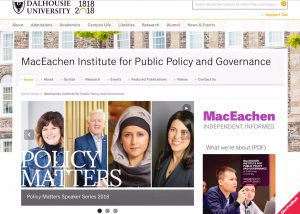
The MacEachen Institute for Public Policy and Governance at Dalhousie University is a nationally focused, non-partisan, interdisciplinary institute designed to support the development of progressive public policy and to encourage greater citizen engagement. The Institute is supported by three faculties at Dalhousie University: Faculty of Law, Faculty of Arts and Social Sciences, and Faculty of Management.
We invite you to listen to Dr. Kevin Quigley’s “welcome video” which highlights the vision and mission of the MacEachen Institute for Public Policy and Governance.
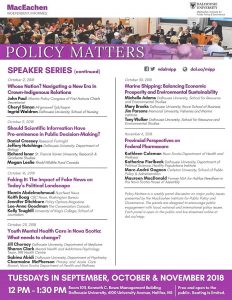
Policy Matters is a weekly panel discussion on major policy issues presented by the MacEachen Institute. These robust dialogues speak to a wide range of topics from the impact of fake news to Provincial perspectives on Federal Pharmacare. We encourage you to subscribe to the MacEachen Institute’s mailing list to receive invitations, activities and updates.
“The woods call to us with a hundred voices, but the sea has one only — a mighty voice that drowns our souls in its majestic music. The woods are human, but the sea is of the company of the archangels.”
L.M. Montgomery, Anne’s House of Dreams

Peggy’s Cove, Nova Scotia