“The secret of leadership is simple: Do what you believe in. Paint a picture of the future. Go there. People will follow.”
Seth Godin

Peggy’s Cove, Nova Scotia
Share.Learn.Inspire.Transform
“The secret of leadership is simple: Do what you believe in. Paint a picture of the future. Go there. People will follow.”
Seth Godin
Peggy’s Cove, Nova Scotia

Business measures performance and overall success based on benchmarks that have a financial outcome. Embedded within a corporation’s financial statements, are the results of customer satisfaction, employment engagement, risk management, R&D investments, and corporate responsibility. Compensation and bonuses are calculated using the profitability and sustainability of a business entity. Recently, Allison Rockwell MBA(FS) Class of 2015 and I conversed on how we may inadvertently find ourselves measuring personal success using business metrics.
In the second installment of striving for success in 2019, Dr. Rick Nason discusses the question: What benchmarks, besides financial, should be used to measure a successful career?
Dr. Rick Nason:
Two knee jerk reactions to this question. First is that a financial benchmark for a successful career (implied in the question) is a horrifically awful benchmark. The second knee-jerk reaction is that whatever I, or anyone else provides as an answer for this question will be both misleading and sad for anyone who mindlessly takes our answer(s) as the truth.
To the first point: I believe the goal of life, and of a career, is to maximize utility. Merriam-Webster online dictionary defines utility as “fitness for some purpose or worth to some end”.[1] Happiness is an end of worth to me. In fact, I generally equate utility with happiness, but I see the linguists starting to compose angry tweets against me, so I will move forward quickly. Love and friendship are also ends of worth to me. Laughter is an end of great worth to me. Having good food (which may or may not be fancy and expensive) with friends is an end of great worth to me. Having shelter, clothing, food and financial flexibility is also of worth to me, but not great worth. Being able to provide shelter, clothing, food and financial flexibility for my family is of much greater worth and utility to me than those things are to me personally.
To continue with this thought you need to realize one fact: economists (and by extension finance profs) are extremely lazy intellectually. We build our theories on maximization of “utility”, but immediately take an intellectual shortcut to state the aim is to maximize “utility of wealth”. We then go to second order laziness and shorten “maximize utility of wealth” and think we are becoming efficient by simply eliminating two words: “of wealth”. To those students, lay people, media, and political pundits who are lazy and do not bother to actually read and understand the concept of utility it is all the same. (Sadly, to most economists and finance profs it is also all the same.)
The important point is that “utility” is not fungible with “utility of wealth”. If you give me $20MM dollars but take away my ability to see and hear my children laugh, then I will have “utility of wealth”, but I will be bankrupt of “utility”. Trading $20MM for never seeing and hearing my girls laugh again is a trade I will never make (and neither should anyone else although I am afraid that a lot of people implicitly and unconsciously do make that sad trade).
Success, like utility, is a function of the individual. You should celebrate the fact that what gives you utility (happiness) is as unique to you as your thumbprint or your DNA. This unnerves economists as the uniqueness of everyone’s utility function means that economists cannot create a general theory of economic maximization (and thus formulaically answer your question). This uniqueness, and inability to mathematically deal with this uniqueness, is one of the excuses that economists give for focusing on “utility of wealth” rather than the more appropriate “utility”.
Unfortunately, we spend a lot of time focusing on some arbitrary (and sometimes downright silly) relative measures of success as we have been trained to think in terms of objective scorecards. If only the world was so simply complicated, instead of having all of this wonderful complexity that we humans bring to it, then we would have a giant formula we could operate by, and soon, some company would be offering us a personal robot and algorithm and there would be no need for us to individually exist at all.
The benchmarks for success are what you as an individual determine them to be. They should not be my benchmarks, nor should they be anyone else’s. They should not be adapted from a tweeted blog titled something like “9 Factors of Success”, nor should they be based on subliminal elements from advertising. They should be developed by you though careful and thoughtful consideration. By the way, it is quite likely that your benchmarks for success will change dramatically through time and through your experience.
I believe that success is a journey. Sadly (or fortunately) we can never consider ourselves a success and then call it a day. If we do, then entropy will quickly kick in. We will be unable to recognize the many opportunities that are available to those who continue to strive in a complex environment.
Whatever measure(s) of success you come up with you, comparison should not be part of the process. Regardless of the measure (unless it is laughably low), you may fall short compared to someone else. However, success is not a zero-sum game; or a game at all for that matter. Success is relative, and you need to make the difficult calculations of the most useful level of relativeness to you.
As for me, every day when I set off into the world, I say a little prayer that the world will be a “little better place because I existed”. Some days I clearly fail in that goal. I may say something politically incorrect, my hair gets in someone’s face, my exam questions are too long or too difficult etc. etc. etc. However, success for me is in the trying. Failure is still success if you are trying to increase your utility (and for me, the utility of others).
Are you still actually reading this!? Get out there and be successful!
“Life’s short. Live passionately.”
Marc A. Pitman

Nymphenburg Palace
Adebayo Majekolagbe, Dalhousie University
The latter half of 2018 saw the release of a flurry of climate change reports, from the special report on global warming of 1.5℃ to the Emissions Gap Report (EGR). The conclusions are the same: current global commitments under the Paris Agreement fall far short of the 1.5℃ target, and a 2℃ (or more) increase in temperature will trigger adverse consequences for humans and nature.
The EGR also reaffirmed Canada’s front seat in the laggards’ zone. It confirmed that Canada is neither on track to meet its Cancun pledge for 2020 to achieve a 17 per cent decrease in emissions, nor its unconditional commitment under the Paris Agreement to reduce its emissions by 30 per cent relative to 2005 levels by 2030.
Canada has generally taken a top-down approach in the design of its climate policy. This approach is not only detached from the political reality of the Canadian federal system, it also fails to capture the communicative demand of climate policy making.
But it is possible to reboot Canada’s climate policy by taking into account local peculiarities and making it more resilient to government turnover.
One might contend that Canada’s current backwardness is not for want of trying.
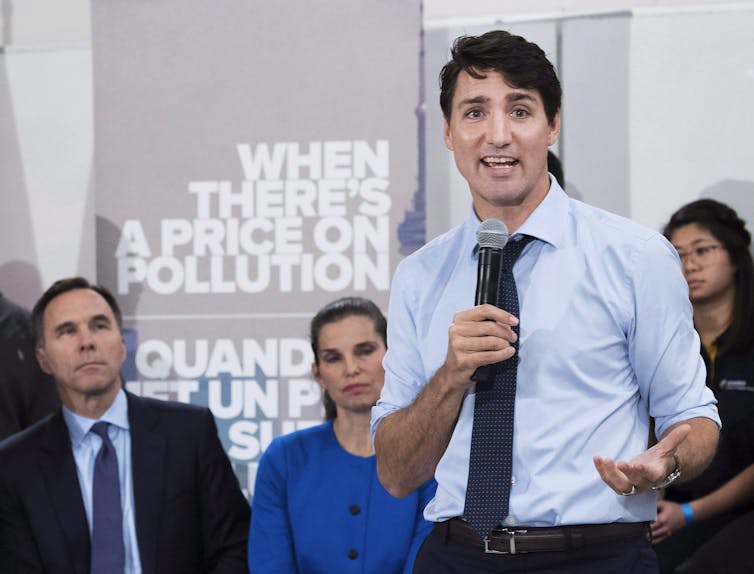
In December 2016, shortly after Canada made its Paris commitments, Prime Minister Justin Trudeau corralled premiers to create the Pan-Canadian Framework on Clean Growth and Climate Change (PCF). The framework, which centres on carbon pricing, is designed to help Canada meet its commitment under the Paris Agreement. With the exception of Saskatchewan and Manitoba, the provinces and territories endorsed the PCF.
But within two years of signing the historic agreement, the newly elected governments in Ontario and New Brunswick also rejected the PCF, and the United Conservative Party in Alberta has indicated that it will renege, if elected in the province’s 2019 general election.

The PCF is dogged by questions of effectiveness, equity and flexibility. Saskatchewan and Ontario, for instance, argue that carbon tax would not significantly reduce emissions, will kill jobs and make it difficult to play to the comparative advantages of the provinces.
Two central sub-themes of these questions are burden sharing, through which climate burdens can be allocated by identifying the peculiarities of provinces, and political acceptability, which speaks to the electoral phobia of political office holders.
At the First Ministers’ meeting in Vancouver in 2016, the idea of assigning specific climate obligations for each province and territory was considered to be too sensitive a subject. Rather, a working group did a nationwide sectoral scan of specific mitigation opportunities.
The caution was not without justification. The issue, in part, had sounded the death knell of the previous National Climate Change Process (NCCP) negotiation, when the provinces and territories had failed to agree on a formula to allocate climate burden. But falling once is no reason not to walk again.
It is often assumed that Canada’s 30 per cent emission reduction target simply translates into a 30 per cent emission reduction obligation for each province. This presumption and the commitments it induces, however, leads to an aggregate that is less than Canada’s national goal under the Paris Agreement. Yet the flaw can be addressed by a burden sharing approach.
Read more:
More than carbon taxes, we need wholescale energy transitions
The 2016 Vancouver meeting was a missed opportunity to design a burden-sharing formula for Canada. Burden sharing is not just a tool for allocation, nor does it impose implementation pathways. Rather, it is an instrument of reassurance of the possible and the equitable distribution of costs.
This lesson is powerfully taught by the European Triptych burden-sharing approach developed in 1997. The approach identified emissions-intensive sectors in each European Union member state, calculated the emission allowances for each sector considering particular circumstances and derived state-by-state targets by adding up the sectoral allowances.

This gave a clear picture to each state of how their obligations were reached, and their capacity to achieve such targets. It also made provisions for states that will incur the highest cost or those without the capacity to implement prescribed responsibilities.
Cohesion fund countries like Portugal, Greece and Croatia, for example, with GDPs less than 75 per cent of the EU GDP average, were allowed to grow their electricity consumption by 1.9 per cent, compared to 0.9 per cent growth allowance for more developed EU states. Triptych even led to emissions-reduction targets that were higher than what the states had been prepared to accept.
To be clear, designing a Canadian burden-sharing formula will not be easy. It will be fought by some provinces, while others will embrace it. But, as the PCF has shown, any Canada-wide climate policy will be contentious. Taking the burden-sharing route is a worthwhile fight that will not only put Canada on a path to meeting immediate climate commitments, but can also help provinces forge an enduring cooperation based on the principles of equity and flexibility.
The provinces protesting the PCF refer to its adverse effects on their constituents. If the people are central to the opposition of provinces, one wonders if this is not a natural place to begin the design of a pan-Canadian climate policy. To what extent were residents of emissions-intensive provinces like Alberta and Saskatchewan directly engaged prior to creating the PCF?
We can learn from German thinker Jürgen Habermas on the importance of communicative action for the legitimacy of policies. Regardless the “inherent good” of a policy, its effectiveness boils down to acceptance, and acceptance is a function of communication.
But the PCF — both in the lead up and the aftermath — falls short of this requirement, and the research proves it. For instance, a 2018 study found that less than half of Canadians understand what carbon pricing is, despite this being at the core of the PCF. And most people in Québec and British Columbia don’t know that those two provinces have had a carbon tax for at least a decade.
Read more:
Want citizens to care about climate change? Write them a cheque
As important as market mechanisms might be, behavioural change is central to fighting climate change, and this lies with individuals. It is, therefore, imperative that the climate change conversation in Canada leaves the realm of governmental institutions and centralized policies. The conversation must be strategically deregulated.
It is about time we agreed that there are real, even if at times misguided, concerns in carbon-intensive provinces. People fear that they will spend more, lose jobs and their provinces will become unviable. It is not enough to reach these people through their political representatives. Governments must develop a mechanism that allows them to directly engage with individuals. Nothing is more important.
Adebayo Majekolagbe, Junior Fellow, MacEachen Institute of Public Policy and Governance; Doctoral Candidate, Marine and Environmental Law Institute, Schulich School of Law, Dalhousie University
This article is republished from The Conversation under a Creative Commons license. Read the original article.
“The theory of politeness argues that each adult person has a need for independence and autonomy (negative face) as well as a natural desire to have their actions approved and recognized (positive face). “Face” is usually defined as a person’s public self-image, or a reputation. As people in all cultures strive for independence and appreciation, there is an assumption that people in all parts of the world are concerned with maintaining their positive and negative faces and are aware that all the adult members of society have the same concerns.”
Dr. Oksana Shkurska

Dr. Oksana Shkurska Assistant Professor Rowe School of Business
Scholars have been researching politeness for decades in order to understand its role in communication and its effect on people’s relationships. As human beings, we communicate not only to exchange information, but also to satisfy our basic social needs, including a sense of connection and inclusion, which comes with belonging to a particular group. We need to love and be loved, build and sustain relationships, as well as give and receive empathy. It means we all have the need to connect emotionally with others on a personal level. We need to know that other individuals understand us and take our desires into consideration.
This sense of connection, however, cannot be fulfilled without polite communication, but is politeness expressed in the same way around the globe?
The theory of politeness argues that each adult person has a need for independence and autonomy (negative face) as well as a natural desire to have their actions approved and recognized (positive face). “Face” is usually defined as a person’s public self-image, or a reputation. As people in all cultures strive for independence and appreciation, there is an assumption that people in all parts of the world are concerned with maintaining their positive and negative faces and are aware that all the adult members of society have the same concerns. This is the reason why all societies have the rules of expressing politeness that include demonstrating good manners and appropriate behaviour. What is interesting, however, is that in different cultures, these rules vary due to the cultural preferences in communication styles and politeness strategies.
What do I mean by different communication styles, and how are they related to politeness?
All the cultures are traditionally divided into collectivistic and individualistic. As research shows, people in individualistic cultures prefer a low-context communication style and are more concerned with their own ‘face’. It means that they value direct and straightforward communication without being afraid to offend others. This low-context communication style is opposed to a high-context style in collectivistic cultures, where people are concerned with another people’s face more than with their own public self-image. As a result, they avoid direct confrontation and value indirectness in communication. In these societies, what is not said is more important than what is actually said, and nonverbal clues play a crucial role in communication, adding meaning to the conversation.
Communication style is usually learned from a very young age when it becomes an important part of a person’s cultural identity. This is the reason why people can sometimes react negatively to the messages that do not follow conventional communication rules and therefore do not correspond with their cultural expectations.
The next post will discuss the question, are politeness strategies in contrasting cultures different?
“When the best leader’s work is done the people say, ‘We did it ourselves’.”
Lao Tzu

Banff, Alberta
From all of us at CEGE Connection, we send out warm wishes for a Happy Valentine’s Day.
We hope you celebrate it by doing all the things you love.

“The sweetest successes come from adventures which push us past our limits, challenge our strength and test our will. Ultimately, learning to embrace change, thriving within ambiguity, stretching and releasing myself of personal constraints, and having the determination to persevere no matter the challenge were my greatest lessons.
Carrie Morrison MBA(FS) Class of 2018

Carrie Morrison MBA(FS) Class of 2018
With the completion of my MBA(FS), I rewarded myself by taking the trip of a lifetime, cage diving with Great White Sharks off the coast of Guadeloupe. What a thrilling adventure, taking risks and diving into an experience filled with uncertainty! Believe it or not, I leveraged many of the skills I learned to enjoy and embrace throughout my MBA candidacy.
In 2014, I resolved to take ownership over my own success and explore opportunities that would push me outside of my comfort zone. As a mother of two and a dedicated Branch Manager in the financial services sector, my decision to engage in a challenging academic journey was an affirmation and commitment to myself. I recognized that life is measured by our choices and the risks we take to realize our potential. I wanted a life filled with experiences marked by courage and purpose, rather than defined by risks avoided or sidestepped.
My MBA journey provided me with lessons far beyond my expectations. Fast forward four years of balancing multiple priorities and a lot of hard work, graduation became one of the proudest moments of my life. I experienced indescribable feelings of accomplishment, confidence and assuredness, which can only be summarized as personal success!
Upon reflection, the most significant and impactful lessons were not illustrated within the program outline or a course syllabus; rather, it was the unwritten lessons which have left a lasting imprint:
Surprisingly, and in some ways not surprisingly at all, the ultimate learning I have experienced from achieving a MBA is that the sweetest successes come from adventures which push us past our limits, challenge our strength and test our will. Ultimately, learning to embrace change, thriving within ambiguity, stretching and releasing myself of personal constraints, and having the determination to persevere no matter the challenge were my greatest lessons.
Today, and as I move forward in my career with aspirations of becoming an executive of the bank within the year and a senior executive within the next seven years (I always put a time frame on my goals), the textbook learnings, care of Dalhousie University, will guide my judgement and decisioning. Whereas the unwritten, unpublished and unmarketed soft-skill learnings will continue to drive me forward toward my dreams and full potential.
My advice is to have courage to accept a challenge and reach outside of your comfort zone, for within challenge is where personal growth blooms!

Carrie Morrison MBA(FS) Class of 2018
Carrie Morrison MBA(FS) leads an amazing group of colleagues who represent the North American Contact Centre in initiatives, campaigns and projects across the TD enterprise in a business leadership capacity. CEGE Connection is pleased to advise that Carrie has graciously agreed to be a repeat contributor on CEGE Connection.
“He who cannot be a good follower cannot be a good leader.”
Aristotle

Dalhousie School of Architecture and Planning, Halifax, Nova Scotia

Dr. Meinhard Doelle, Professor of Law, Schulich School of Law, Dalhousie University
Dr. Meinhard Doelle, Professor of Law, Schulich School of Law, Dalhousie University, has graciously agreed to join the CEGE Connection conversation and share his insights on climate change and environment law. We highly recommend a visit to Professor Doelle’s Blog: Environment Law News, which provides vital information that speaks to the complexities of environmental and energy law, climate change, GHG emissions, and the role of human rights in these areas of enquiry.
“Negotiating the Paris Rulebook: Compliance in Transition.” has been republished from Professor Doelle’s blog, Environment Law News.
In December, 2018, Parties to the UN Climate Regime are set to negotiate a Rulebook on how to implement the Paris Agreement. The Rulebook will cover a broad range of issues, from market mechanisms, to finance, reporting, and the 5 year review cycles build around the global stocktake. Key among the elements of the Rulebook is the compliance system. In this post, my intention is to briefly highlight some of the issues before negotiators of the compliance system. A more detailed assessment of the draft negotiating text is available in my article entitles “Compliance in Transition: Is Facilitative Compliance Finding Its Place in the Paris Climate Regime?”. It is published in CCLR, and a draft is available at SSRN: https://ssrn.com/abstract=3228766.
In the transition from the Kyoto Protocol to the Paris Agreement, some parties took great lengths to distance themselves from the architecture and institutions of the Kyoto Protocol. Key among this architecture was the Kyoto compliance system, which was seen as a departure from the norm for multilateral environmental agreements (MEAs). The system included an enforcement branch that applied automatic consequences in case of non-compliance with key obligations of developed country parties. It is therefore not surprising to see a focus on facilitation in Article 15 of the Paris Agreement and specific direction that the compliance system is to be non-adversarial and non-punitive.
The differences between the Kyoto compliance system and that to be developed under the Paris Agreement are, of course, also driven by substantive differences between the two agreements. Most notable among these differences is that the Paris Agreement establishes a much broader range of commitments and obligations covering mitigation, adaptation, funding, technology access, education, capacity building, and loss and damage. The commitments, furthermore, have been made by a much broader range of parties, including all developing countries, in particular the least developed countries and small island states. Many of the commitments are self-determined in the form of nationally determined contributions (NDCs) to be updated by parties every five years.
While there are many important differences, some of the core challenges of ensuring compliance are, on closer examination, remarkably similar to the Kyoto Protocol. Both agreements include a range of commitments from voluntary to binding. Both include provisions for market mechanisms, which will be dependent on compliance to be effective. Both include a range of reporting obligations that are fundamental to the functioning of the regime. These parallels suggest parties would be well advised to draw on the compliance experience under the Kyoto Protocol in negotiating the design of the Paris compliance system.
This post assesses the state of play in the negotiations under Article 15 heading into the COP 24 negotiations in Poland from December 2-14, 2018. The negotiations are taking place in the context of the provisions of Article 15 itself as well as provisions 103 and 104 of the Paris COP decision. Before delving into the current state of the negotiations, it is helpful to identify the key relevant elements of the agreement parties reached in Paris.
The overall purpose of the compliance process under Article 15 is to facilitate the implementation and promote compliance with the provisions of the Paris Agreement. It is important to highlight that Article 15 refers to “the provisions”, not just some provisions, and not just obligations. It seems clear, therefore, that the mandate of the compliance committee should be broad in scope, include individual and collective commitments, and include binding obligations as well as non-binding commitments.
Another set of provisions in Article 15 clarify the overall approach to be taken in the design of the compliance system. They refer to the facilitative, non-adversarial and non-punitive nature of the process, and the principle of transparency. These elements offer important guidance to negotiators on the design of the compliance process and the measures the compliance committee should have at its disposal to facilitate implementation and promote compliance.
A key message in Article 15 relates to the “respective national capabilities and circumstances of the Parties”. This reference to the revised principle of common but differentiated responsibilities (CBDR) in the Paris Agreement signals that the process needs to be sensitive to the capacity challenges of the least developed countries in particular. Article 15 is clear that with respect to compliance, differentiation based on capabilities and other relevant circumstances is the job of the compliance committee. This suggests that the compliance modalities and procedures should provide flexibility for the committee to apply certain aspects of the compliance system to parties that have capabilities and circumstances that may warrant either relaxing process requirements or warrant the application of different measures at the conclusion of the compliance proceedings.
The agreement reached in Paris offers considerable direction on the process to be designed. Included is the composition of the compliance committee (12 members, two from each of the 5 UN regions plus one each from a least developed country and a small island developing state), required areas of expertise, and the importance of gender balance on the committee. The committee is to report annually to the Conference serving as the Meeting of the Parties to the Paris Agreement (CMA). This is the context within which parties are now negotiating the modalities and procedures for compliance. Among the key issues are the following:
Purpose, Principles and Nature of Compliance Procedures
Functions of the Compliance Committee
Institutional Arrangements
Scope of Work of the Compliance Committee
Initiation of Proceedings before the Committee
Process to be followed by the Committee
Measures and Outputs at the Committee’s Disposal
Identification of Systemic Issues (ie beyond individual party issues)
Sources of Information for the Committee’s Work
Relationship with and Accountability to the Conference of the Parties (COP)
Who Carries out Reviews of the Modalities and Procedures
Secretariat Support for the Work of the Committee
A particular source of complexity in the negotiations is that the compliance modalities are being negotiated in parallel with the overall Paris Rulebook. Not only is there uncertainty about the nature of substantive rules on mitigation, emissions trading, and finance, but as discussed elsewhere in this special issue, the Paris Agreement contemplates a comprehensive 5 year review cycle that consists of parties reporting on their efforts to implement their NDCs, review of those efforts and reports, a global stocktake of progress against the long term goals, and revised NDCs. Even though the Paris Agreement clearly provides for a compliance system, it seems that some parties would prefer to subsume the compliance effort under the work of the transparency framework and the global stocktake.
To be effective, the compliance process under Article 15 will have to find its place within the Paris Climate Regime, both substantively (i.e. its role with respect to mitigation, emissions trading, finance, adaptation, technology, capacity building, coordination among institutions and connection among commitments) and in relation to the overall institutional structure being developed. The aim must be to complement the bottom up NDC approach with appropriate top down elements to help close the significant ambition gaps that currently exist in all key areas of the Agreement. A key contribution of the compliance process will be its relative independence and its resulting opportunity to impartially assess compliance with individual and collective commitments. This will help inform the broader discussion about the effective implementation of the Paris Agreement.
There is much to be resolved in developing an effective, efficient, and fair compliance process under Article 15. Key among them are effective triggers for the compliance process, an adequately broad mandate to be able to effectively facilitate implementation and promote compliance with all important commitment in the Paris Agreement whether binding or not and whether made by a developed or a developing country Party. The inclusion of “implementation and compliance” and the language of “the provisions” in Article 15(1) clearly enables the process to deal with all important commitments. Any differentiation between binding and non-binding and differentiation among parties should focus on applying appropriate measures in the circumstances. This can be assured through an appropriate combination of general direction to the committee and appropriate discretion. A fair and effective process will depend on the full implementation of the commitment to transparency and on procedural fairness to any Party being investigated.
It will be important to keep the focus of the committee on technical issues and to avoid having it dragged into political issues and equity judgement calls. This seems particularly important and tricky when it comes to the assessment of systemic issues. The committee will be well advised to stick to assessing whether the collective goals are on track and to technical assessments of the causes, without being seen to point fingers at any particular party or group of parties unless they have clearly failed to meet their individual commitments. This means the focus should be on commitments that allow for a technical assessment of compliance or implementation, rather than political consideration or judgements. Committee has the potential to make an important contribution to progress on collective commitments, particularly those that involve all parties or a clearly identified group of parties, as this can be assessed without getting to any assessment of who within the group of parties needs to do more. Having said this, to ensure the committee has the full opportunity to pursue important systemic issues as they arise, the triggers for systemic issues should include the CMA, the Article 13 outcomes, and the committee based on its own assessment of reports generated under the PA.
It will be important to properly integrate the work of the committee with Article 13 and 14. Not much can be said about the details of how to ensure this is done until there is more clarity on the review process under Article 13 and the global stocktake under Article 14. However, it is clear that the compliance committee can benefit greatly from the work proposed under Article 13, and its conclusions and recommendations have the potential to be important for the global stocktake.
For binding commitments, it will be important for the committee to make a finding of compliance/non-compliance and to apply other appropriate consequences including a compliance action plan, and other non-punitive measures. It would be helpful for negotiators to recognize in this regard that compensatory measures are different from punitive measures, and that for markets under Article 6 to function, it may be important to include compensatory measures in the toolbox of the compliance committee. Special access to support should be limited to LDCs and SIDS.
Conclusion
It is too early to say whether the compliance system is finding its place among the many institutions and processes under the Paris Regime. There are still many issues unresolved within the compliance negotiations, and many more issues to be worked out on other key aspects of the Paris rulebook, such as the reporting, transparency and global stocktake provisions. In the absence of significant progress in other areas in advance of COP 24, negotiators may be well advised to develop the modalities and procedures for compliance at a fairly high level, and to leave some of the detail for the compliance committee to work out after there is more clarity on how other aspects of the Paris Agreement, including Articles 6, 13 and 14, will be implemented. As a result, while this year’s COP should be an important milestone in the development of the Paris compliance system, it is unlikely to mark the end, as much of the detail will inevitably have to be finalized later, either by the CMA or by the compliance committee once it is established.
Dr. Meinhard Doelle, Professor of Law, Schulich School of Law, Dalhousie University
Dr. Meinhard Doelle, Professor of Law, Schulich School of Law, Dalhousie University
Professor Doelle specializes in environmental and energy law, with a focus on climate change and environmental assessment processes. He has been involved in the practice of environmental law in Nova Scotia since 1990 and in that capacity served as drafter of the NS Environment Act and as policy advisor on the Canadian Environmental Assessment Act (1992). Professor Doelle was a non-governmental member of the Canadian delegation to the UN climate change negotiations, 2000 – 2006. He continues to follow the negotiations as an official observer. Professor Doelle was a visiting scholar at the Environmental Law Center of the IUCN in Bonn, Germany, 2008. He co-chaired a strategic environmental assessment on tidal energy in the Bay of Fundy from 2007 to 2008, served on the Lower Churchill Joint Federal-Provincial Review Panel from 2009 to 2011, and co-chaired a provincial panel on aquaculture from 2013 to 2014.
Teaching
Professor Doelle’s teaching within the law school has involved courses in environmental law, energy law, climate change and contract law. He has also been involved in interdisciplinary teaching outside the law school, most notably at the College of Sustainability, where he co-taught a course on Humanity in the Natural World from 2009 to 2012.