SIM is excited to share that in 2021-2022 we exceeded $1 million in research funding for the first time in the period covered by records, and possibly ever! Congrats to all of our hardworking researchers.

SIM is excited to share that in 2021-2022 we exceeded $1 million in research funding for the first time in the period covered by records, and possibly ever! Congrats to all of our hardworking researchers.
SIM is hiring a part-time academic to teach the following course in the winter 2023 term:
Please apply through PeopleAdmin, via the link above.
Questions? Email sim@dal.ca
By: Toni Beaton (MI Student)
We are happy to share the following recent research accomplishments by SIM faculty:
As previously announced, Mike Smit started a new role as Deputy Scientific Director for the Ocean Frontier Institute earlier this year. In that role, he helped lead a large, multi-institution proposal to the Canada First Research Excellence Fund, which aims to understand and transform the role of the ocean in assessing, mitigating, and adapting to climate change, and which includes a significant role for ocean data and information. Hopefully there’s good news on that proposal in our next newsletter! Mike has also participated in the Digital Twins of the Ocean Summit, a WMO initiative to better collect and share data on Greenhouse Gas emissions, the Polar Data Workshop, the joint Canada-EU ocean data partnership forum, and many other national and international conferences.
Louise Spiteri is a co-applicant, together with other members of DefaultDal (https://defaultdal.ca/) on a SSHRC Partnership Development Grant for the project Fostering plant-based defaults in Canadian universities and colleges. Louise is continuing to work on another SSHRC-funded project that examines Scaling up trauma and violence: Informed outreach with women affected by violence.
Journal Publications
Conference Proceedings
Datasets
Research Grants
By: Toni Beaton (MI Student)
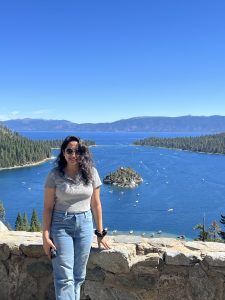
Sakshi Jeswani is a second-year student in the Master of Information program here at SIM. This past summer, Sakshi completed a three-month internship with DeepSense. I had the pleasure of interviewing Sakshi to share more about her internship experience, her roles and responsibilities, and her tips for first-year students contemplating their own internships.
Please tell us a bit about your internship with DeepSense. What drew you to choose an internship with this company? What were your main responsibilities?
I applied for the Data Readiness program offered by DeepSense. They have a student pool in which they invite students to submit their resumes, and they have different companies with different projects which are assigned to students according to their capabilities and interest. I applied in that program, and I went home because I had given up on getting an internship in the summer! When I was at home, I ended up getting a call for the interview, and I gave the interview from my home. I was selected for the AI and Machine Learning intern position and flew back to Halifax to start the internship. I got to see my family, and I also got to do the internship!
It was an internship with a company called Global Spatial Technology Solutions. It was machine-learning work; the project was predicting the estimated time of arrival for the vessels considering weather variables. The vessels coming to the port need to have an assigned place on the port. Some vessels book their port in advance by entering the incorrect time of arrival. The project was an extension to the current ETA model the company has. I used different machine-learning models to predict the time of arrival. Most of the work was exploratory data analysis (EDA). I was new to the ocean sector and didn’t know anything about it! My supervisors were really helpful, and helped me throughout the project. We found many things that needed to be removed from the data sets, so there was a lot of data filtering that needed to happen to make the model more accurate. The models that I used were Linear Regression, GLM, Random Forest, and XGBoost (different machine learning models) to understand which model fits best with the data.
How did the work in your internship connect to what you learned in the first year of your MI degree?
One day, the CEO of the company (Global Spatial Technology Solutions) called me, and I had a meeting with him. I told him about all the courses I’m taking and planning to take at SIM. I think that was a major contributor to getting the part-time work that I have with the company. I also think I got the internship because of the Data Science course that I took with Dr. Philippe Mongeon. There was a final project in that course that I did, and that’s the project that I showed them in the interview. I think they were really impressed, because they were also using R (a programming language), which was what I learned from my course.
INFO5590 was also helpful. I took the Business Analytics course (INFO6513 with Dr. Colin Conrad) and it has a bunch of helpful technologies that we learned throughout the course. I learned Tableau in that course; because of which, I got a practicum with Dal Analytics! In my resume, I added all of technologies I learned in INFO6513, which was very helpful [in gaining my internship].
What would you say was the most rewarding part of your internship?
I cannot describe how helpful the supervisors were, and are now as well! I got to learn a lot from them, because they have been working in the industry for so long. I am getting transferred to a GIS project and it will be very helpful for me to gain practical industry knowledge along with taking the GIS course with Jennifer Grek Martin.
Congratulations on your offer of employment with DeepSense! What will your main roles and responsibilities be?
Right now, I am still completing the project that I started in my internship. The internship time was three months which was less according to the project requirements. It will go until the end of October; in November, they will transfer me to another project. The company deals with spatial data and the project involves building maps. One of my supervisors is a GIS data scientist, so I am learning from the course and then applying it as well.
Looking forward after graduation, are you hoping to stay in Halifax and find full-time work? What would be your ideal job after graduation?
I think I’ll stay in Halifax, but it also depends on the job profile that I get. I might also move, but I’m not sure about it yet. I want to work in the data science field. But, taking the GIS course, I’m building my interest towards GIS! I’d love to do a combination of both.
Lastly, what advice would you offer first-year MI students considering a potential summer internship?
I would suggest starting early and building connections. LinkedIn helps a lot in connecting with people working in the same industry. Janet helps in getting the practicum which could help build connections for your internship. I would like to say to anyone considering an internship: I believe that things fall in place.
SIM sends congratulations to Sakshi on the successful completion of her internship, and subsequent job offer from Global Spatial Technology Solutions!
For immediate release: Dalhousie SIM Welcomes New Tenure Track Professors
Tuesday, October 18th, 2022 (Halifax, NS) – SIM is excited to announce two new tenure track hires: Dr. Stacy Allison-Cassin and Dr. Jamila Ghaddar.
 Dr. Allison-Cassin began her appointment as Assistant Professor on July 1st, 2022. She holds a BMus Honours from Wilfrid Laurier University, MMus from Duquesne University, MMISt from University of Toronto, and a PhD in Humanities from York University. Before coming to SIM, she held a limited-term appointment of Assistant Professor, Teaching Stream in the Faculty of Information at the University of Toronto; and as an Associate Librarian at York University Libraries, as Teaching and Learning Librarian, Digital Humanities Librarian, W.P. Scott Chair in E-Librarianship, and Music Cataloguer at York University Libraries; and the National Librarian at the Canadian Music Centre. She is a Citizen of the Métis Nation of Ontario and Chair of the Indigenous Matters Standing Committee of IFLA. She sits on an a number of advisory roles including Library and Archives Canada’s National Union Catalogue Advisory Committee, the Researcher Council of CKRN, and recently was an advisor on OCLC’s Reimagine Descriptive Workflows project. Her research concerns the ways knowledge structures shape meaning and how we come to know and understand the world, especially as it concerns intangible culture, media, and marginalized communities.
 Dr. Ghaddar will begin her appointment as Assistant Professor on January 1st, 2023, after completing a limited-term appointment. She holds a BA Honours in Anthropology with a Minor in Linguistics from McMaster University, and an MI and PhD (Information Studies) from the University of Toronto. She is currently a SSHRC-funded Postdoctoral Fellow at the University of Manitoba (UofM), where she works with Raymond Frogner at the National Centre for Truth & Reconciliation and Dr. Greg Bak at the History Department. She is also an instructor in the Archival Studies stream of the University of Manitoba and University of Winnipeg Join Master’s Program in History, and a Visiting Fellow at the University’s St. John’s College. Previously she was Project Coordinator of the Diversity of Design Project (PI: Dr. Nadia Caidi) at the University of Toronto; a Library Archival Fellow at the American University of Beirut; and a Senior Doctoral Fellow at the Equity Department at the University of Toronto’s New College. Dr. Ghaddar’s research explores the complex dynamics between race, class, gender, sexuality, and citizenship in archival, library, media, and digital domains.
As highlighted in their bios, Drs. Allison-Cassin and Ghaddar bring valuable experience in decolonizing curricula and collaborative research and will contribute significantly to D (equity, diversity, inclusion, and accessibility, decolonization) initiatives in SIM and in the Faculty of Management. With these new positions, SIM and FOM can continue to build a strong foundation in all programs Faculty-wide that reflects social justice concerns within society.
From Dr. Sandra Toze (Director, School of Information Management): “As the information professions continue to respond and change, it is very exciting to be able to build capacity in the areas of social justice and decolonization. We welcome both Drs. Allison-Cassin and Ghaddar and are looking forward to supporting their important work, and collaborating with them on strengthening our programs, and providing excellent opportunities for our students to learn.”
From Dr. Kim Brooks (Dean, Faculty of Management): “It is exciting to have a new colleague with Stacy’s depth of experience joining us at the Faculty of Management. I’m particularly fascinated by her engagement with ‘wiki’ publications and am confident that her research and teaching will help us expand our Faculty’s footprint in important ways. Jamila has already brought so much to our Faculty. Her work with the National Centre for Truth and Reconciliation has enhanced the experience she brings to her research and teaching. I know that her course on Antiracism and Diversity in the Information Professions was a real inspiration and change-maker and look forward to having her talents within our community.”
When asked about their new appointments, Drs. Ghaddar and Allison-Cassin said the following:
Dr. Stacy Allison-Cassin: “I’m thrilled to join the School of Information Management and excited to build capacity in relation to research on knowledge justice and Indigenous matters in information studies. I’m also excited to have the opportunity to work with students, faculty at SIM and beyond on issues related to social justice. There’s such a need in librarianship, other information professions, and in related domains for substantive change to practice, culture, and technology.”
Dr. Jamila Ghaddar: “SIM is an incubator for new ideas, fresh thinking and critical perspectives on information, its institutions, and infrastructures. It is as exciting and dynamic as it is warm and welcoming. Here, you can aim high and find the support you need to succeed. I look forward to continuing to work with the amazing SIM team as I further expand and deepen my work for equity, decolonization and antiracism through curriculum development, partnership building, research, community engagement, and knowledge mobilization. My work begins from a strongly held belief that within our increasingly information driven and technologically mediated world, information scholars and professionals can play a crucial role in addressing the social justice issues of our time.”
Media contact:
Dr. Sandra Toze
Director, School of Information Management
Dalhousie University
Sandra.toze@dal.ca