
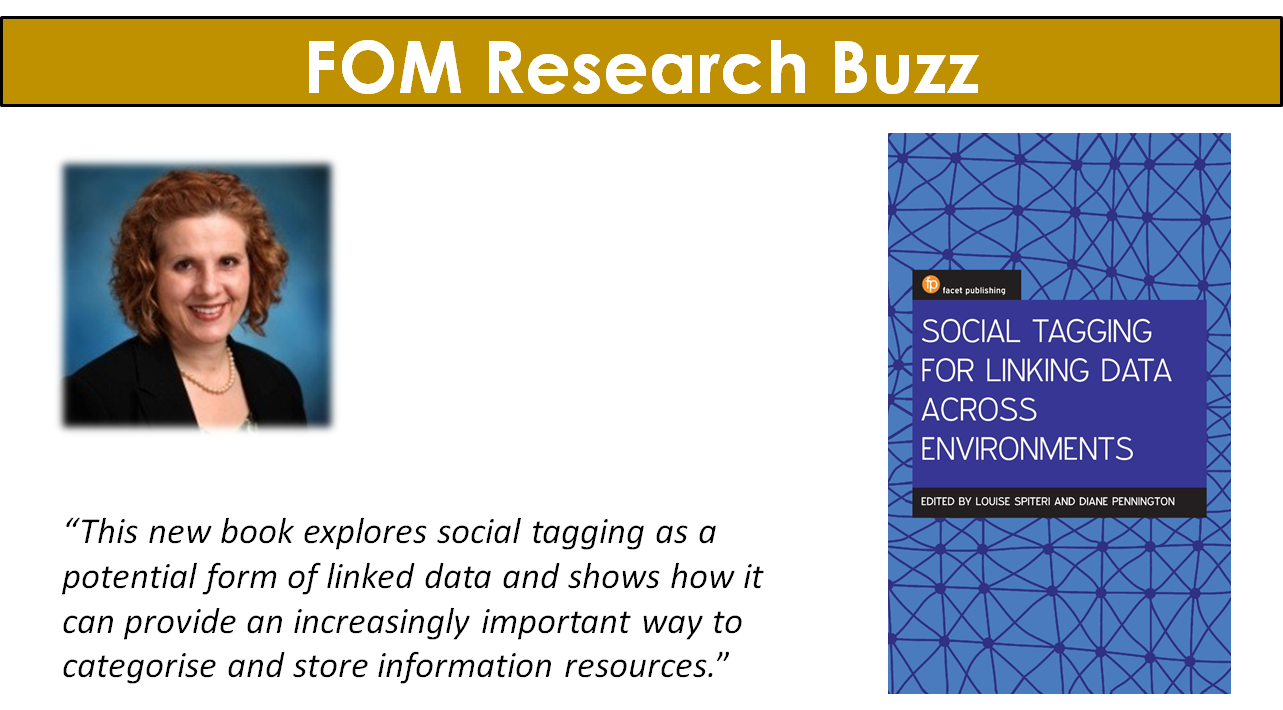
FOM Research Buzz: Louise Spiteri
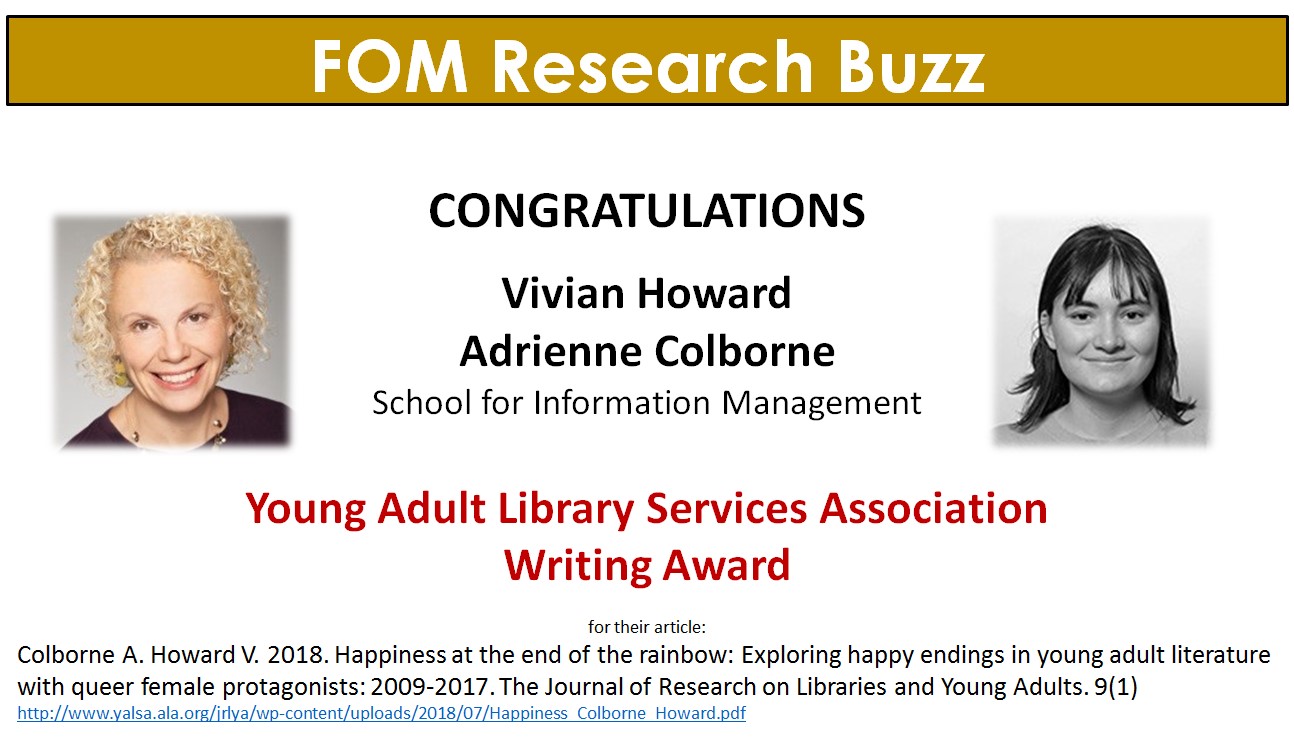
FOM Research Buzz: Vivian Howard & Adrienne Colborne
Dr. Mike Smit to Deliver Keynote Address at ARMA International (November)
Attending the ARMA NCR Fall IM Days (Ottawa) next month? Don’t miss the keynote address from SIM Associate Professor, Dr. Mike Smit. The talk takes place Thursday, November 15th, 2018 from 9:30-10:30am. There is a workshop sale happening this week only, so perhaps a good time to register!

Job Posting: Lecturer, Assistant Professor or Associate Professor (SIM)
School of Information Management
Dalhousie University
Lecturer, Assistant Professor or Associate Professor
The School of Information Management (SIM) invites applications for a probationary tenure-track, tenure-track or tenured position at the rank of Lecturer, Assistant Professor or Associate Professor commencing July 1st 2019 (negotiable).
The Faculty of Management is developing a new Masters program in Digital Innovation jointly with the Faculty of Computer Science. Positions relating to this new program are being advertised in the Faculty of Computer Science, Rowe School of Business, and School of Information Management. It is an occasion to join a strong and diversified team, in an environment where new programs are being introduced. Please see also the Rowe School of Business posting (https://blogs.dal.ca/academiccareers/2018/09/21/rowe-school-of-business-career-stream/) and Computer Science posting (https://blogs.dal.ca/academiccareers/2018/09/21/faculty-of-computer-science-career-stream/) for details on those positions and how to apply. Qualified candidates are encouraged to submit applications to more than one competition.
This position combines teaching, research, and administrative responsibilities. The School seeks candidates with a strong interest in, and capacity for, interdisciplinary research. Candidates will be expected to teach in at least two programs at the graduate or undergraduate levels. Professional information management experience will be an asset.
The successful candidate will have a PhD (or ABD status) in information management or a related discipline, with research expertise and/or teaching experience in one or more of the following areas:
- Data management, including analytics, visualization, curation, and preservation
- Information systems
- Information risk management
- New and emerging media and/or technology, including digital transformation
- Other relevant areas including organizational learning, collaboration, user experience, or knowledge management
The SIM (http://sim.management.dal.ca) offers two graduate programs: the American Library Association-accredited Master of Library and Information Studies (MLIS) program, and the mid-career blended learning Master of Information Management (MIM) program. At the undergraduate level, the School provides core and elective courses in the Bachelor of Management program, delivered collaboratively with the three other schools in the Faculty of Management. The School also participates in Dalhousie’s Interdisciplinary PhD program.
The SIM is part of the interdisciplinary Faculty of Management (http://www.dal.ca/faculty/management.html), which also includes the School of Public Administration, the School for Resource and Environmental Studies, and the Rowe School of Business. The Faculty of Management’s mission is to collaboratively advance management knowledge and practice, and its vision is inspiring managerial solutions to transform lives. We seek an additional colleague who will contribute to, and thrive in, this environment.
Dalhousie University (http://www.dal.ca/) is one of Canada’s leading teaching and research universities, with four professional faculties; a Faculty of Graduate Studies; and a diverse complement of graduate programs. Inter-faculty collaborative and interactive research is encouraged, as is cooperation in teaching. Dalhousie University inspires students, faculty, staff and alumni to make significant contributions regionally, nationally, and to the world.
Dalhousie University is located in Halifax, Nova Scotia, Canada. Halifax is a vibrant capital city and is the business, academic, and medical centre for Canada’s east coast.
All qualified candidates are encouraged to apply; however, Canadians and permanent residents will be given priority. Dalhousie University is committed to fostering a collegial culture grounded in diversity and inclusiveness. The university encourages applications from Aboriginal people, persons with a disability, racially visible persons, women, persons of minority sexual orientations and gender identities, and all candidates who would contribute to the diversity of our community.
Review of applications will begin on October 22, 2018. To receive full consideration, please submit your application by this deadline. Applications received after October 22 may also be considered.
Applicants should submit a cover letter, curriculum vitae, copies of past teaching evaluations, and statements of teaching philosophy and of research interests. (Each statement should be approximately one page.) Applications must also include a completed Self-Identification Questionnaire, which is available at www.dal.ca/becounted/selfid.
Applications should be directed to:
Ms. Kim Humes
School of Information Management
Kenneth C. Rowe Management Building
6100 University Avenue, Suite 4010
PO BOX 15000
Halifax, NS B3H 4R2
sim@dal.ca
Fax: 902-494-2451
Voice: 902-494-3656
Electronic applications are preferred.
FoM Research Buzz: Louise Spiteri

SIMSA “Eat & Learn”: ASL and Deaf Culture (Sept 27th)
SIM faculty, staff, and students:

On Campus With: Sandra Toze (Librarianship.ca)
Dr. Sandra Toze (SIM Director and Assistant Professor) was recently interviewed by Librarianship.ca about her career path, research and the ever-evolving nature of the information professions. A great read to kick off a new academic year!
Full interview re-posted from here:
 Where are you from? What did you do before joining the faculty at Dalhousie University?
I am originally from Ancaster, Ontario. I graduated from Queen’s University with a BAH in History and Politics. My first real job was in a special library in a brokerage firm. My love of this profession grew from there. I complete my MLIS at the University of Toronto and worked in the Financial Services industry as a Director of Information Services for many years. I joined the School of Information Management at Dalhousie in 2003 and completed by PhD while working as a Lecturer. I became Director of the school in 2015.
What are your research and teaching interests?
My entire career has involved examining the evolving relationship between information and information services, people, technology and work. I am motivated to understand the possibilities and risks inherent in the increased impact of technology, and the need for reflection on unintended consequences.
I have centred my research around three evolving and interconnected strands:
- the collaborative information and data processes of groups;
- the shift to digital governance; and
- user specific, social, and mobile information interactions.
These areas of research are interdisciplinary and integrate research from knowledge management, collaboration, organizational learning, sociology, information seeking, and computer supported co-operative work.
Similarly, I have focused my teaching in the areas of knowledge management, human information interaction, information and research services, collaboration, and management without borders.
What advice would you give to a new faculty or staff member?
This field is interdisciplinary by nature, and very much expanding and affected by technology. Find areas that connect with your interests and your past experiences. I also love that people in our field are so collaborative. There are so many opportunities to work with our associations and other disciplines.
Coolest thing in your office?
The view!
As Director I have a corner office, so can see across to our Arts Centre, as well as to the Student Union Building, and up the street to the iconic Henry Hicks building.
I also have a beautiful table cloth from Iran, a fan from Spain, and rocks from the beach near our farmhouse in Malagash Nova Scotia.
If you didn’t teach librarianship, what would you be doing?
Probably being a librarian! I love working with people and researching.
What changes have you seen in the teaching of librarianship since you started teaching?
Especially in terms of research/reference services, the impact of Google and internet has affected our roles.
I am excited by the expansion of what our academic and public libraries do. The need to design and create user centred information and data services has also expanded. These are now becoming core skills.
What do you think is the most important aspect of being an information professional today?
Beyond knowing the core aspects of our profession, adaptability is key. You can connect our skills across all industries. With the growing impact of AI, machine learning, and issues such as fake news, the importance of the values and ethics of our profession are increasingly important.
How do you stay current in your field?
I love to attend conferences, and a wide range of conferences from academic to professional. I read as much as I can, follow experts, and have alerts on topics of interest to me.
What emerging topics do you foresee in the future of LIS research?
In many ways I see us continuing to study what we always have, but in new contexts. Information and data are really the key elements of most organizations, and the consideration of this is increasingly important.
Dr. Bertrum MacDonald: Reflections on SIM50
Did you know that SIM is turning 50 in 2019? This is a time of reflection and celebration. We invite you to accompany us on the journey by following this blog, our website, and the #SIM50 hashtag on Facebook and Twitter.
Re-posted from CEGE Connection (the Centre for Executive & Graduate Education blog):
CEGE Connection reached out to Dr. Bertrum MacDonald, Professor, School of Information Management, to share his thoughts on reaching the 50th year mark, given the ever-increasing influence of information management within our society.
 Dr. Bertrum MacDonald:
Thank you for opportunity to share my thoughts on the evolution of information management. Indeed, we are experiencing exponential leaps in how information is applied within our daily interactions. I agree that INFORM provides invaluable information on current research that is being conducted by Dalhousie.
I have been a faculty member in the School of Information Management for many years – more than half of the 50 that the School will celebrate in 2019! During this period, I have served as Director of the School, then Associate Dean (Research) in the wider Faculty of Management, and recently for a short term as Interim Dean of the Faculty. I have taught courses in the Master of Information Management since it was launched in 2008, beginning with the first course offered in the program: Information, People, and Society.
I head the interdisciplinary Environmental Information: Use and Influence research program (EIUI), based in the School of Information Management. My primary research area focuses on questions about information use and influence in marine management and policy development. The goal is to advance understanding of the many pathways of information (scientific, social science, and local) at the science-policy interface in marine environment contexts.
I look forward to joining the CEGE Conversation and highlighting the strength of the School of Information Management programs. The need to increase literacy in information management has reached a critical juncture.
We have come a far distance in 50 years. We have a solid foundation upon which to build for the future.
Dr. Bertrum MacDonald
Professor
July 2018

SIM Professor Co-Writes Book About Social Tagging
 The book “Social Tagging for Linking Data Across Environments”, co-written by Dr. Louise Spiteri (SIM Associate Professor), will be released by Facet Publishing in September.
From the publisher website: “Social tagging, hashtags, and geotags are used across a variety of platforms (Twitter, Facebook, Tumblr, WordPress, Instagram) in different countries and cultures. This book, representing researchers and practitioners across different information professions, explores how social tags can link content across a variety of environments.
Most studies of social tagging have tended to focus on applications like library catalogues, blogs, and social bookmarking sites. This book, in setting out a theoretical background and the use of a series of case studies, explores the role of hashtags as a form of linked data – without the complex implementation of RDF and other Semantic Web technologies.
Readership: Social Tagging for Linking Data across Environments will be useful reading for practicing library and information professionals who implement electronic access to collections, including cataloguers, systems developers, information architects and web developers. It would also be useful for students taking programmes on Library/Information science, Information Management, Computer Science, and Information Architecture.”
Congrats Dr. Spiteri!