“Trees are poems that the earth writes upon the sky.”
Khalil Gibran, Sand and Foam

A Vancouver Winter Sky
Share.Learn.Inspire.Transform
“Trees are poems that the earth writes upon the sky.”
Khalil Gibran, Sand and Foam
A Vancouver Winter Sky
“I enjoy watching students get to that next level in their personal and professional development, watching them actualize – getting that promotion / that challenging opportunity. I believe in an applied approach to teaching, focusing on building transferable skills for the workplace using hands-on teaching methods such as cases, simulations, role plays and pro-bono student consulting projects.”
Dan Shaw is the Director, MBA Program & Faculty Member (Marketing), Rowe School of Business, Dalhousie University. He teaches in the areas of marketing, marketing strategy, marketing communications, global marketing and personal selling/sales management. His career has included time in marketing, business development, sales and management consulting in the following industries: professional services, telecommunications, software development and consumer packaged goods. Dan is Director of Dalhousie’s Corporate Residency MBA program as well as Acting Director of the MBA Financial Services and MBA Leadership mid career programs and teaches in both the BComm (Co-op), BMgt, Corporate Residency MBA and Executive Education programs at Dalhousie.
CEGE Connection reached out to Dan in a virtual interview to discuss why students should choose Dalhousie’s MBA programs.
Dan Shaw:
Why should students choose to study online/blended with Dalhousie University’s Faculty of Management?
We are the best option for students looking for the alternative to the weekend warrior executive / mid-career MBA. Many prospective students are leery about the impact of giving up every second Friday and Saturday for two years. They worry about the impact on their work life, but also their homelife. They are often at the stage where they have children at home or aging parents to support. Setting aside every second Friday and Saturday can be problematic on both the home and work front. Our online/blended programs give students control and flexibility to carve out the time in their schedule where it fits their needs, whether that is on the commute home from work, evenings or weekends. It allows you to go to your child’s big soccer game, or dance recital.
What do you enjoy most about your work?
I enjoy watching students get to that next level in their personal and professional development, watching them actualize – getting that promotion / that challenging opportunity. I believe in an applied approach to teaching, focusing on building transferable skills for the workplace using hands-on teaching methods such as cases, simulations, role plays and pro-bono student consulting projects.
What book would you recommend?
I just finished reading “The Monk Who Sold His Ferrari.” It was a worthwhile book about personal development, Eastern philosophy and mindfulness. It offers tactics that will make you a better person and a better leader.
What do you do for relaxation?
Ultimately, I like to sail, but I am currently without a sailboat. I hope to rectify that in the next couple of years. Aside from sailing, I love to ski, cook, play basketball with my boys, walk the dog, weekends at the cottage and international travel.
What is your next adventure?
It is the last year that my wife, Fiona, and I have both boys home for the March break before they are off for university, so we are taking advantage of this opportunity to take the family to Hawaii. We are going to the Big Island, staying with friends near the beach and taking the opportunity to enjoy the natural beauty of the area (volcanoes, beaches, surfing, rain forest, waterfalls, etc.). I can’t wait.
Dan Shaw
Editor’s Note: In addition to teaching, Dan is a consultant to several Canadian corporate and non-for-profit organizations, in the areas of marketing, corporate strategy, strategic/business planning, board and organizational development.
Connect with Dan on LinkedIn: https://www.linkedin.com/in/danbshaw/
Connect with Dan on Twitter: @daldanshaw
Connect with Dan on Instagram: daldanshaw
Admission enquiries for the MBA Corporate Residency: crmba@dal.ca
Admission enquiries for MBA Leadership and MBA FS: cege@dal.ca
Check out the most recent edition of the QS Global MBA Rankings – Dalhousie has been ranked for the first time: https://www.topuniversities.com/university-rankings/mba-rankings/global/2019

“We invent the future every day through creativity. Inventing the future takes work and has a momentum of its own. I have learned that there are times to speed up, as well as slow down or, even wait for events to unfold in a natural flow.”
James Christopher Desmoulin MBA (FS) Class of 2019

James Christopher Desmoulin MBA (FS) Class of 2019
James Christopher Desmoulin graduated with the Class of 2019 MBA(FS) and has become involved in our vibrant alumni community. In a recent virtual interview with CEGE Connection, James reflected on how creativity influenced his academic journey and his involvement with reBoot Canada, The Prince’s Trust Canada and IYIL2019 through UNESCO.
James Christopher Desmoulin:
“How are the paintings coming along”, my instructor used to ask at the Ontario College of Art and Design, reminding us that we are all painters even though we may believe otherwise. We have the power of imagination within us, whether it be painting, music, poetry, writing or in the performing arts. We must continue to ask ourselves “How is our artistic outflow coming along”.
When I studied art at the Ontario College of Art and Design this was a technique used to stimulate creativity. While it may not be our focus, even in our busy professional lives we are still the painter, the musician etc.
As I wrapped up my MBA at Dalhousie University in August, I recalled a question asked in one of my classes at the beginning of the program: What made you want to complete your MBA at Dalhousie? My answer was simply that I always wanted to do my MBA and found that Dalhousie’s on-line blended program was optimal. So, these past years my question, “how is the MBA coming along” was an affirmation of my art instructor’s reminder to give voice to my artistic nature. An academic journey allowed me to explore the creative aspect of business and strategic direction, to visualize a dynamic world via the lens of a wider, global community.
We invent the future every day through creativity. Inventing the future takes work and has a momentum of its own. I have learned that there are times to speed up, as well as slow down or, even wait for events to unfold in a natural flow.
I support organizations and proponents in building networks where sharing information connects people and teams to engage in collaborative problem-solving. I actively participate in reBoot Canada’s initiative to mentor and train Indigenous youth in technology inclusion. As well, I work with The Prince’s Trust Canada to revitalize Indigenous languages through their children’s coloring books which are illustrated by Patrick Hunter, Prince’s Trust Canada’s Artist-in-Residence.
This year, I am assisting my mother who is participating in the 2019 International Year of Indigenous Languages – IYIL2019 through UNESCO, the purpose of which is to prevent the loss of Indigenous languages. Once these languages disappear, the world will lose vital knowledge that could be harnessed for human improvement and sustainable development. Our global cultural diversity will be diminished along with unique ways of knowing and experiencing the world, which may disappear forever.
Creativity pulls us into the future. As I come to the end of my MBA academic journey, I look back at the all the beautiful paintings in my memories of my colleagues and professors at Dalhousie. I look forward to inventing the future in my next endeavours.
Editor’s Note: James is a repeat contributor on CEGE Connection. We invite you to read his first article on his work with Indigenous Services Canada and his position as a Union President in the Public Services Alliance of Canada. We wish James the very best as he invents the future in his next endeavours. We look forward to updates on his journey in future CEGE Connection posts.
Links:
IYIL2019 through UNESCO
Twitter: @IYIL2019
Facebook: @indigenouslanguages @IYIL2019
The Prince’s Trust Canada
http://www.princestrust.ca/initiatives/indigenous-languages/
reBoot Canada

@instacege #cegeconnection
On November 1, 2019, CEGE Connection celebrated our third anniversary of bringing together a virtual community that thrives on the exchange of knowledge and experiences. The momentum continues as we head into our fourth year of existence. Over the past three years, CEGE Connection launched dialogues that served as catalysts for deeper conversations. A special thanks to our alumni community for engaging and sharing their insights.

Richard S. Brookfield Media Loft
There are many more discussions waiting for us in the upcoming year. 2020 has special significance as we begin a new decade.
To mark this milestone, CEGE Connection opened an Instagram account to share photo memories and stories. Check us out and share your story!
@instacege
#cegeconnection
We enjoy sharing stories of graduates. We also want to have repeat contributors to discuss current thoughts regarding leadership, communication, governance and information management. Please let us know if you are interested in joining CEGE Connection: Year 4, The Continuing Journey.
With warm appreciation,
Michelle, Rebecca & the CEGE Team

Dalhousie University, Halifax, Nova Scotia
“That’s what I consider true generosity: You give your all, and yet you always feel as if it costs you nothing.”
Simone de Beauvoir

Dalhousie Campus
THE HONOURABLE LOUISE ARBOUR NAMED 2019 RECIPIENT OF THE SCOTIABANK ETHICAL LEADERSHIP AWARD
Erin Elaine Casey – October 1, 2019

The Honourable Louise Arbour (Photo Provided)
The Dalhousie Faculty of Management will honour The Honourable Louise Arbour, former UN High Commissioner for Human Rights and former Justice of the Supreme Court of Canada, with the 2019 Scotiabank Ethical Leadership Award.
Each year, the award is presented to a Canadian who has demonstrated exceptional character, moral courage and commitment to ethical principles. Mme. Arbour will accept the award and speak to Management students, faculty and the public at the Ethics in Action Gala on November 23.
Finding her home, making a difference
Born in Montréal in 1947 and earning a law degree from the Université de Montréal, Mme. Arbour’s career took her from a law clerkship for a Supreme Court justice to a professorship at Osgoode Hall Law School. In 1987, she was appointed to the Supreme Court of Ontario, and in 1989 to the Ontario Court of Appeal.
“What became very clear to me when I went to law school is I found my home,” explains Mme. Arbour. “I was attracted to criminal law, and then to all aspects of public law as it interfaced with democracy and social equality and all kinds of things. That’s what I think has driven me to run toward things that others might run away from.”
From 1996 to 1999, Mme. Arbour was chief prosecutor for two international criminal tribunals. The tribunal for the former Yugoslavia resulted in the first-ever indictment for war crimes of a sitting head of state (Serbian president Slobodan Milošević), and the tribunal for Rwanda in the world’s first conviction for genocide since 1948.
For the next five years, Arbour sat on the Supreme Court of Canada. She returned to the UN as High Commissioner for Human Rights in 2004, then spent five years as president of the International Crisis Group. In December 2018, she finished a 22-month term as Special Representative of the United Nations Secretary-General for International Migration, where she guided the adoption of the Global Compact for Safe, Orderly and Regular Migration (GCM).
A deserving honour
Peggy Cunningham is professor and R.A. Jodrey Chair in Commerce at the Rowe School of Business. She chairs the award’s selection committee, composed of students, faculty and a representative from Scotiabank.
“Student voices are primary in the decision process,” she explains. “From the first when she was called to the bar, Mme. Arbour has taken on controversial and difficult issues. It’s not popularity that drives her, but deep moral conviction. It says a lot about her as a person that she would give her time to come and interact with young people here.”
Student committee member Nivashini Sabeshan just graduated with an MBA and took part in Ethics in Action case competitions in 2017 and 2018.
“It’s important to celebrate the impact Mme. Arbour has made, not just in Canada but worldwide,” she says. “A lot of people ask themselves, ‘What difference can I make?’ But all the people who’ve received this award are people like us — and look at what they’ve been able to accomplish! It’s so inspiring to us as young adults. If one person can make such an impact, what could we do together?”
A special honour
Mme. Arbour has received at least 40 honorary doctorates and many international prizes, but the Ethics in Action award feels special.
“It means a huge amount because I started my career as a law teacher. I want young people to know that I’m extremely confident in them and their capacities. Hard as the challenges are around issues like climate change — and a lot of it is profoundly distressing and depressing — but in all the dark and gloomy things I’ve done, the friendships I’ve developed with like-minded and committed people have been so exhilarating. The rewards are vastly positively disproportionate to the work involved.”
Mme. Arbour’s most important message to students? “They have a lot of choices, and there are a lot of people in this world with zero choices. Don’t turn your choices into a liability because you’re lost. Just go! If you make a mistake, you can go back. As Yogi Berra used to say: If there’s a fork in the road, take it!”
The Faculty of Management established the student-led Ethics in Action case competition and conference with a $1.5 million donation from Scotiabank. The Scotiabank Ethics in Action Ethical Leadership Award recognizes a Canadian leader from a corporate, non-profit or public organization who has demonstrated and maintained outstanding ethical leadership. Past recipients include Sir Graham Day, Richard Pound, Chief Phil Fontaine, Irwin Cotler, Anna Tudela, Justice Rosalie Silberman Abella and Lieutenant-General (Ret’d) Roméo A. Dallaire.
The public is invited to the award presentation at the Ethics in Action Gala at the Canadian Museum of Immigration at Pier 21 in Halifax on November 23. Tickets can be purchased at dal.ca/ethicsinaction.
Jed Levene, MBA(FS) Class of 2013
If you were to ask my wife what the biggest stress in her life is, she would be quick to answer – me. However, if you were the Financial Planners Standards Council working with Leger Research and you surveyed over 1,100 individuals, fortunately (for me) you would get a different answer. Here are some key findings to the research:
Managing our finances can be one of the biggest stresses in our lives. With some basic planning and just a little time each month, this stress could be greatly reduced or even eliminated.
November is Financial Literacy Month; use it as motivation to get a better grasp on your personal finances.
In my opinion, one of the reasons that we like to ignore our finances, aside from the fact that they are easy to ignore, is we think managing our finances is synonymous with sacrifice. It really doesn’t have to be this way.
A better way to look at this is what I call spending with intention. Simply put, you do not have to put limits on your spending, but rather think about how you want to spend your money and whether or not your current spending is in line with your values.
In my next column, I am going to show you how to do this and manage everything in 10-minutes per month. And trust me, it would take a lot longer than that to fix the biggest stress in my wife’s life.
CEGE Connection Editor’s Note: Republished with permission from Simcoe.com
Jed Levene MBA(FS) 2013 is President, Rockwater Wealth Management Limited and Investment Representative of Quadrus Investment Services ltd. He is a Certified Financial Planner® and holds a certificate in Behavioural Finance from Duke University. His articles on financial planning appear regularly on Orillia Today, Simcoe.com, CEGE Connection is pleased to advise that Jed has graciously agreed to be a repeat contributor on CEGE Connection.

Save the Date
CEGE is heading to Vancouver!
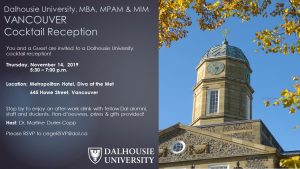
The planning has begun! Martine Durier-Copp will be in Vancouver next month and we welcome all MBA FS, MBA L, MPA(M), MIM students, alumni, friends of Dalhousie and their guest to join her for a cocktail reception on November 14, 2019.
Thursday, November 14, 2019
5:30 – 7:00 p.m.
Location: Metropolitan Hotel, Diva at the Met
645 Howe Street, Vancouver
This is a great opportunity to reconnect with your Dal peers, build new relationships and to catch up with what is happening at Dalhousie, the faculty and the programs.
Are you celebrating an anniversary? When we recognize milestones, we are reminded of the robust ties that bind our alumni community through the years
A special shout out to the Class of 1999 commemorating their 20th Anniversary, the Class of 2004 their 15th Anniversary, the Class of 2009 their 10th Anniversary, the Class of 2014 their 5th anniversary, and the newest member of the Alumni family, the class of 2019 – come celebrate with Dalhousie!!
Let’s stay connected. Follow us on Instagram: @instacege #cegeconnection

“We shall never learn to feel and respect our real calling and destiny, unless we have taught ourselves to consider every thing as moonshine, compared with the education of the heart.”
Sir Walter Scott

Aberdeen, Scotland
“Governments that want to build more sustainable road networks may need to change their administrative processes, shift the work culture of the public service, and even restructure the approval bodies made up of elected officials.”
Christina Bouchard MPA(M) Class of 2019

Christina Bouchard MPA(M) Class of 2019
Christina Bouchard is a Transportation Planner and Project Manager for infrastructure engineering projects. Located in downtown Toronto, she specializes in the delivery of sustainable transportation projects. Her recent projects include transportation master planning, major capital implementation coordination, strategic policy design and infrastructure design for walking and cycling infrastructure. Following 10 years working as a public servant at Toronto City Hall, Christina now works with a variety of Canadian and international jurisdictions as a consultant. Following the completion of a Masters in Public Administration (Management) at Dalhousie, Christina will be pursuing PhD studies at the University of Ottawa. Her doctoral research will center around a comparative analysis of infrastructure delivery by Canadian municipalities.
CEGE Connection reached out to Christina for her insights on building sustainable transportation infrastructure.
Christina Bouchard:
What are the processes to construction of a road design?
As a manager of transportation infrastructure engineering projects, I have seen a lot of variability in how different jurisdictions are planning, designing and building their infrastructure. Some jurisdictions have been rapidly planning, approving and building networks of separated cycle tracks. These types of successes are great from both an environmental and public health perspective for the people living in those Cities. Unfortunately, some other jurisdictions struggle to install modest changes.
How would doing a comparative analysis of infrastructure projects in different Cities help?
No one has compared the political structures, government structures, government processes and stakeholder engagement that affect the implementation of Canada’s sustainable transportation infrastructure. Interviewing practitioners in Canada’s major Cities will help map best practices as well as the pain points that are causing projects to be installed very slowly or not at all.
The professionals that make up Canada’s transportation sector include traffic engineers, civil engineers and transportation planners. I have been fortunate to work with many capable professionals in both the public and private sectors. However, the successful implementation of transformative change goes beyond good planning or good engineering for individual projects.
Why is studying the implementation process that governments use important?
Wherever you go, everyone wants government to be efficient. Unfortunately, it is not always easy for bureaucracies to change their own structure and processes. Bureaucrats often use process and protocol as measurements of transparency and accountability. Studying implementation realities across multiple jurisdictions is a way to better understand how public value is being created.
If best practices are identified, what comes next?
Governments that want to build more sustainable road networks may need to change their administrative processes, shift the work culture of the public service, and even restructure the approval bodies made up of elected officials.
Did undertaking the Masters in Public Administration offered by Dalhousie University’s Faculty of Management influence your thinking about public sector management?
Yes, and there were many program areas that addressed problems I have witnessed in my professional career. Government structures, accounting practices, intergovernmental relations, risk assessment, information management and human resource management all play a role in the actual ability of a public service organization to address a shifting political mandate. It has been my experience that these aspects of program implementation are often inadequately addressed by advocates and reformers working in the Transportation sector.
When studying at Dalhousie, what was the blended program like?
Working all day and then doing schoolwork in the evening requires commitment, but a strength of the program is that you can tie it into your area of expertise. If you’re passionate about your work, Dalhousie’s blended program can help you learn without leaving your workplace. Continuing my work with clients allowed me to remain active and engaged with the industry I care deeply about.
Why do you want governments to succeed at building sustainable transportation infrastructure?
In Canada, there are over 10,000 people killed or seriously injured in traffic each year. Instances of serious property damage during climate change storms is increasing, and there is an obesity epidemic. Sustainable transportation infrastructure addresses all these issues simultaneously – and it’s fun! I have always been passionate about transportation sustainability. As the mother of an energetic child, the need to build infrastructure that makes walking and cycling safe for all ages and abilities has become even more immediate to me.
Editor’s Note: CEGE Connection is pleased to advise that Christina has graciously agreed to be a repeat contributor on CEGE Connection. We wish her the very best as she pursues her PhD studies at the University of Ottawa.