“The capacity to learn is a gift; The ability to learn is a skill; The willingness to learn is a choice.”
Brian Herbert, House Harkonnen

Share.Learn.Inspire.Transform
“The capacity to learn is a gift; The ability to learn is a skill; The willingness to learn is a choice.”
Brian Herbert, House Harkonnen

Interim Director, Rowe School of Business; Associate Professor of Management; Academic/Research Director, CeLNET
Courage is Destiny
May all we learn here in our school
By thought and deed be shown,
Let living truth within us rule,
And seeds of love be sown :
That Men in all our deeds may see
Courage is Destiny!
Courage is Destiny!
We pray for grace, serenity,
To keep a humble mind,
That we may learn true charity
To love all human kind :
That Men in all our deeds may see
Courage is Destiny!
Courage is Destiny!
Undaunted, though alone we stand,
Upholding what is right :
Proud children of our Motherland,
With truth, our stay and might,
That Men in all our deeds may see
Courage is Destiny!
Courage is Destiny!
All that is good may we retain
When scattered far and wide;
May we our destiny attain
With courage as our guide :
To show that by our constancy
Courage is Destiny!
Courage is Destiny!
John Stafford Smith
These were the words of my School Song, Frank Anthony Public School, Bangalore, India. I grew up singing this song every morning during School Assembly, along with my class and school mates. I mouthed the words, the tune was wonderful, but not until later in life, did I realize the true meaning of these words. “Courage is Destiny” and these words are more true now than ever before.
During these current, uncertain times, when it is easy to despair, I urge all our new and returning students to hold true to what brought you to Dalhousie and our programs, what riding these troubled waters with grace and confidence will do for your own evolution and careers, and what amazing stories you will be able to tell the next generation about how you rose to the challenge of navigating online classes and relationships and overcame them with fortitude.
At Dalhousie, we are ready to welcome you back to our classes, with as much preparedness as possible and help you through your fall classes and Dalhousie experience. Even though we maybe scattered far and wide, may we keep a humble mind, show with our thoughts and deeds our love for human kind and with courage, uphold what is right as we attain our destiny!
Dr. Binod Sundararajan
Interim Director
Rowe School of Business
Associate Professor of Management
Academic/Research Director, CeLNET
Dalhousie University
September 2020
“The single greatest lesson the garden teaches is that our relationship to the planet need not be zero-sum, and that as long as the sun still shines and people still can plan and plant, think and do, we can, if we bother to try, find ways to provide for ourselves without diminishing the world. ”
Michael Pollan, The Omnivore’s Dilemma: A Natural History of Four Meals

Cucamelons (Photo Credit Dr. Carolan McLarney)

Kim Brooks
Dean, Faculty of Management
Purdy Crawford Chair in Business Law
Welcome to a new year of academic excellence. Whether you are a new or returning student, we look forward to your contribution within our community. You will be joining other like-minded individuals who share our vision of inspiring transformative solutions for society.
In February 2020, our world changed with the Covid19 pandemic. As a global community, we have come together to face this unprecedented disruption. Dalhousie University has responded by investing in our students and in our student experiences. We are working closely with our public health partners and are diligently monitoring the impact of the pandemic going forward. As with the 2020 Spring/Summer terms, this Fall term will be predominantly online, with limited exceptions. Our commitment to facilitate opportunities for our students is unwavering. Our goal is to foster an environment of teaching and learning excellence, built on innovation, collaboration, and respect.
Dalhousie’s Faculty of Management has a unique approach to education. We integrate four disciplines which encourages and promotes knowledge exchange: the Rowe School of Business, the School of Information Management, the School of Public Administration and the School for Resources and Environmental Studies. We believe that offering transformative solutions demands all of our students to step beyond conventional boundaries.
CEGE Connection outreach modality connects our students, alumni, and stakeholders. These past four years, graduates, students, and professors have discussed themes ranging from virtual teams, and information management to scholarship and deeper learning. This demonstrates a values-based approach to management education and research.
Thank you to our engaged alumni. You make us proud. As the leaders and managers in the business sector, public sector, and civil society, your influence within a complex global environment has been extraordinary.
We look forward to the ongoing conversations on CEGE Connection.
Kim Brooks
Dean, Faculty of Management
Purdy Crawford Chair in Business Law
Dalhousie University
September 2020
“The highest activity a human being can attain is learning for understanding, because to understand is to be free.”
Baruch Spinoza

Kenneth C. Rowe Management Building
6100 University Avenue, Halifax
“The world is not something that is given to us but something we engage in by moving, touching, breathing, eating.”
Francisco Varela (1999)
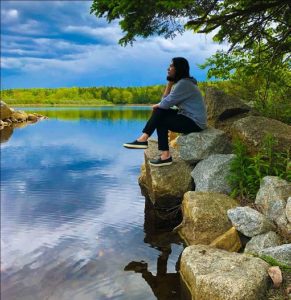
More than ever we are realizing that change and uncertainty are part of being human, especially living with a pandemic and in a rapidly changing world of complexity. In working with students this summer, we have used dialogue to deeply understand each other through a portal of shared meaning-making, to consider how we arise to emerging challenges in uncertain times that affect not just us, but people and communities across the globe. What is bubbling up is it is not so much the patterned and habitual knowledge frameworks and mindsets that guide us into the future, but it is the emergence of new ontological mindsets, or ways of knowing, being, and doing in the world, that are important in enabling resilience and adaptability to dramatic change around us.
This shift in thinking seems new to us in ‘our business as usual’ thinking but according to the Canadian anthropologist, Wade Davis, we have been ‘doing’ adaptive change for over 60,000 years. Historical evidence shares that our ancestors first ventured out Africa’s Rift Valley, spreading out across the planet, and adapting to changing land and seascapes, and new ways of life as they went. Fast forward to today’s modernity we have established knowledge frameworks that have been led by scientific discovery, and capitalistic approaches to learning and doing business. This has enabled us in the Global North to prosper and progress from a human development perspective. However, this approach has also objectified and commodified our world, leading to a binary separation from our natural world of where we come from. Nature1 is seen as a resource to be used (water as drinkable water, animals as livestock, land as real estate, trees as timber); nature is place outside of us and as something ‘out there’ for our taking. It is suggested that this lost connection to Nature, or nature deficit disorder, is what has created the societal grand challenge of climate change that looms before us. This decoupling effect from Nature is not a good thing and moves us far away from the traditional practice of ancients before us, of interdependence to the biosphere. Though it is worth noting, Indigenous knowledge frameworks and practices have persisted in holding onto this reciprocal or ‘two-eyed seeing’ approach of sensing the interconnections with the planet.
1 I capitalize the word ‘Nature’ throughout the text to recognize my perspective of the subjectivity and interconnected relationship humankind has with Nature. For hundreds of years we have placed Nature outside of the human inter-relational domain and have recognized her as an object, and unfortunately, too often as something to exploit. As I capitalize the name of a family member to show honor and respect, I do the same with Nature.
This summer, along with integrating the scientific frameworks of the UN’s sustainable development goals and 2030 Agenda into the business ethics course curriculum, we have introduced an assignment called the Nature Experience (NX). This assignment is grounded in Indigenous knowledge frameworks. In this assignment students are asked to design and spend at least 30-minutes in the sacredness of Nature and to share a report with their cohort on this experience. The student’s reaction to the NX assignment has been surprisingly wonderful and wonder-filled. First, students cannot believe they get a chance to do this type of experiment in a business school environment, and it stands out as a highlight. Second, students carry out diverse and meaningful designs in carrying out the NX, from hikes along shorelines, to writing poetry in the woods, to running or biking actively along a trail, and starring in the cosmos at night. In the student narratives you hear their senses coming alive, and a revived awakening. Feel the sense of connection and learning in the following three shared student NX narratives:
Above students share deep experiences of letting go of stresses and anxiety, to reflexive moments of new insights, to deep feelings of connection to our planet. From an observational perspective, these experiences seem to re-connect students to something once lost and creates a sense of revival of something new but old. Is this a connection to our past, and ancestral ways of being?
This makes me curious. Why has it become so strange for students to have Nature connections in a business school curriculum? This has not always been the way, the ancient Greeks, like Plato, Socrates, and Aristotle, embraced the organic and sacredness of the world. However, since the scientific revolution of Cartesian- Newtonian thinking, humanity has increasingly continued to decouple and estrange us from our origins of Nature; objectifying the world and using the biosphere to create profits and shareholder value. The problem with objectifying and externalizing Nature, we set up a duelist reality that Nature is different from humans…when scientific truth tells us that we are of Nature. Perhaps objectifying Nature makes it easier to exploit. Could this part of the challenge with business and society today, where we only view Nature as a resource to be used––creating an existential vacuum?
One might ask, how is this NX relevant to future business leaders? A whole paper or large volume could be written on this but succinctly in consideration of this short post there are several answers to that question, which included: (1) enabling systems thinking; (2) decreasing stress/anxiety levels and improving mental health; (3) de- coupling ontologies of separation; and, (4) de-centering students from patterned ways of thinking and opening creativity to create the world anew. Enhancing all of these elements has been strongly suggested as enabling leadership capacity and capability for embracing the increasing complexity of our rapidly changing world. I sense there is a real opportunity for a transformation of business school curriculums to include Indigenous knowledge frameworks and practice, that feature reciprocity and deep interconnections to Nature. Moreover, Pratarelli (2014) suggests that nature-based education can be redesigned to inspire the idea that humans are an equal part of the socio-ecological system:
That is to say, citizens, young and old alike, will require re-education to first accept that we are an evolved organism with biological needs that must be met, and afterward raise awareness and understanding of an individual’s personal contribution to the excessive exploitation of the planet’s limited resources. Furthermore, education will need to encourage self-evaluation from a psychological/mental health perspective. (p. 67)
In ending, my hope is that we can continue to innovate and transform school curriculum and develop new economic models and living plans that ultimately promote life on the planet that is held by the pillars of fairness, well-being, and sustainability. Furthermore, we need to explore the radical inter-relationality of our planet through the web of life. In doing so we can learn to re-connect to what it means to be human living on an interconnected planet full of networks of relationships. We have an opportunity to learn with Nature, not to just live and take from her, but to live in harmony. Walking this path will enable us to free our thoughts, our hearts, our agency, our identity, our happiness, our awareness, and our hope for desired futures (Escobar, 2020).

Kent A. Williams, DSocSci (pronouns: he/him)
Assistant Professor, Leadership Studies
Rowe School of Business
Dalhousie University
Kent A. Williams (DSocSci) is an Assistant Professor with the Faculty of Management and facilitates leadership studies for undergraduate and graduate students that focuses on the 2030 Agenda and enabling citizenry ethics and virtue that builds leadership capacity and capacity for action to create desired futures for humanity.
References
Davis, W. (2009). The Wayfinders: Why ancient wisdom matters in the modern world. Toronto: House of Anansi Press Inc.
Escobar, A. (2020). Pluriversal politics: the real and the possible. Duke University Press.
Pratarelli, M. E. (2014). The biopsychosocial model of human unsustainability: a move toward consilience. Global Bioethics, 25(1), 56-70.
Varela, F. J. (1999). Ethical know-how: action, wisdom, and cognition. Stanford, California: Stanford University Press.
“We cannot live only for ourselves. A thousand fibers connect us with our fellow men; and among those fibers, as sympathetic threads, our actions run as causes, and they come back to us as effects.”
Herman Melville

Peggy’s Cove, Nova Scotia

Class of 2005 MBA (FS)

Class of 2005 MBA (FS) BMO
CEGE Connection would like to recognize the contribution of the MBA(FS)Class of 2005 as they commemorate their fifteenth-year anniversary. All our best goes out to these graduates on this very special milestone year. Thank you for your commitment to excellence, life-long learning and the communities in which you live and work.
The CEGE Team
Jed Levene, MBA(FS) Class of 2013
Imagine that you were interviewing contractors to build you the custom home of your dreams. How would you feel if one regaled you with stories about how wonderful his hammer and table saw were? The next, told tales of 2×4 lumber and how strong it was. And finally, the third contractor came in and asked you questions like: When you imagine your dream home, what does it look like? What are your absolute must-haves? How big is it? How many bedrooms, bathrooms? Can you show me pictures of homes, kitchens, etc. that you really like?
My guess is that contractor number three has the best chance of winning your business. The reason? He focused on your goals, needs, and what is important to you; while the others told you about the tools they would use to build your home.
This analogy seems bizarre, however, when it comes to financial planning this is exactly what happens. Advisors pontificate on how one investment is superior to the other. Or how fees are the only factor to consider when investing. Why you would be a fool to purchase one type of insurance over another.
This behaviour is no different than that in the example above. The financial services industry often behaves like the first two contractors – trying to sell you on the tools instead of educating you on the fact that products in the financial services industry are simply a means to an end – to help you achieve your goals.
Like the third contractor in the example above, the process needs to be based on your goals, not the bells and whistles of various products; advisors should seek first to understand your goals. Although it may be true that one type of investment has outperformed another type over the last twenty years, that doesn’t really answer the question of: “How can I retire at age 60 with $7,000/mth after-tax, in today’s dollars, indexed to inflation?”
For example, it is possible to achieve all of your goals while earning a three per cent annual rate of return; and it is also possible to achieve none of your goals while earning a 12 per cent annual rate of return. Knowing this, perhaps it is time to give more focus and energy to financial planning versus products.
If you don’t know where you’re going, it really doesn’t matter if you get on a plane, train, or automobile.
One of the biggest benefits in working to successfully execute a financial plan and tracking its progress regularly is that it will help prevent rash decision making. For example, if you have simply purchased some investments without a plan or a goal attached to them, then all that you have to focus on is the rate of return and the volatility. This results in way too much attention to the ups and downs of the market in the short term. By contrast, if you have a plan and your plan is still on track despite a small downturn in the market, you are more prone to stay with it and not attempt to become a market timing expert.
A good advisor should have a very clear understanding of your goals -create a roadmap showing you how to get there – and regularly review those goals with you to ensure that you are on track. Like any homebuilder, most have access to the same or similar tools. The difference is that a good advisor knows that the are tools, a means to and end, not an end in themselves.
Jed Levene is Managing Director at Rockwater Wealth Management. He is a Certified Financial Planner®, holds an MBA(financial services) from Dalhousie University, and a certificate in Behavioural Finance from Duke University. His articles on financial planning appear regularly on Orillia Today, Simcoe.com, CEGE Connection is pleased to advise that Jed has graciously agreed to be a repeat contributor on CEGE Connection.
“The winds, the sea, and the moving tides are what they are. If there is wonder and beauty and majesty in them, science will discover these qualities… If there is poetry in my book about the sea, it is not because I deliberately put it there, but because no one could write truthfully about the sea and leave out the poetry.”

Martinique Beach, Nova Scotia