“We must begin thinking like a river if we are to leave a legacy of beauty and life for future generations.”
David Brower

Wallaback Lake, Nova Scotia (River view), Photo Credit Michelle Hunter
Share.Learn.Inspire.Transform
“We must begin thinking like a river if we are to leave a legacy of beauty and life for future generations.”
David Brower
Wallaback Lake, Nova Scotia (River view), Photo Credit Michelle Hunter

Sylvain Charlebois, Dalhousie University
In the wake of this year’s large E. coli outbreak, Walmart notified its leafy green suppliers that they must be using blockchain technology to trace their products before the end of 2019.
Walmart, one of the world’s largest retailers, has been piloting blockchain projects with IBM for the past 18 months. It is banking on this relationship to put pressure on the entire sector to give consumers what they want from the food industry: more transparency.
In Europe, Carrefour also recently began using blockchain to track food products on several of its product lines.
Read more:
Everything you need to know about fresh produce and E. coli
The whole idea is to better manage food recalls, farm to fork and back, and also to tackle the intricate issue of food fraud, which is receiving an increasing amount of attention.
Meanwhile, many others are wondering if the investment is worth it. Consumers tend to want many things from the food industry without paying for them.
Blockchain is about data, but it is mostly about accountability through enhanced digitalized transparency. With blockchain everyone knows what’s happening all at once.
To use a simple analogy, think of blockchain as a hockey rink. All the data is on the ice, protected by the boards so that it can’t be altered. Everyone participating in a blockchain is in the stands. The activity on the ice lets everyone else know who is buying from whom, when, at what price and volumes.
As a result, a recalled product can be traced back in seconds instead of taking days. It took investigators days to trace the source of an E. coli outbreak to contaminated romaine lettuce. They had to look through documents to find the source and the potential causes, all the way up the food chain. It would have been managed quite differently with blockchain.
Food safety is an obvious driver for blockchain, but food fraud appears to be what is moving the blockchain agenda much faster these days.
Blockchain technologies have been used in other sectors, but they have only recently entered the food sector.

Food safety was never going to be enough for consumers to embrace blockchain. Consumers expect safety and don’t want to pay more for it. Why pay extra for a safety belt when buying a car? Food safety may have never had market currency, but food authenticity does.
Fraudulent products can compromise brands and the viability of a company in a heartbeat. We have seen many cases already around the world.
Food fraud is difficult to measure, but it has arguably kept food prices lower, allowing some companies to cut costs and offer lower price points.
Economically motivated adulteration is a growth killer, something Walmart and Carrefour both know. To increase sales, companies must eliminate fraudulent food products from their shelves, and blockchain technologies can provide the perfect antidote.
How better to deal with food fraud than by making the whole system more transparent?
Transparency in the context of blockchain, however, is neither absolute nor unconditional. Each solution will offer a different level of transparency depending on how the system is set up. This is likely why grocers are jumping on the blockchain bandwagon, to exercise their power with the supply chain and generate their own rules of engagement.
It is also likely making everyone else less comfortable, including processors and producers.
Read more:
How technology will help fight food fraud
If food fraud is properly addressed, growth in the food sector can be expanded. Over the next decade or so, we should not be surprised to see the disruptive nature of blockchain technologies generate tensions among grocers, processors and producers as they try to cope with grocers’ impositions.
Other sectors made traceability a priority decades ago. Drugs, car parts, minerals and so on can be tracked to their sources in seconds. Consumers know the technology exists and are putting the pressure on grocers. It’s time for the food industry to catch up.
Sylvain Charlebois, Professor in Food Distribution and Policy, Dalhousie University
This article is republished from The Conversation under a Creative Commons license. Read the original article.

John Waldron, MBA (FS) Class of ‘08
Within four years, 42% of your core workplace skills will be obsolete, according to the Future of Jobs Report 2018, recently published by the World Economic Forum. One way to close the skills gap is to retrain existing employees, but among the 313 organizations surveyed worldwide, that solution ranked only third behind automating work tasks and hiring new permanent staff already possessing the relevant skills. This is a wakeup call to all employees for more skills training.
It is no longer necessary to make a case for learning in the workplace. But to be certain, the report estimates that an extra 101 days of training will be required in order for employees to close the skills gap by 2022. Unless organizations begin aggressively replacing staff or fully automating workflows, employers need to support a culture of learning in the workplace. The best way to do that is to make learning frictionless.
Learning in the workplace needs to be a lot of things: relevant, contextual and purposeful; but what often gets neglected is the learning experience, which is every bit as important as the content itself.
Frictionless learning means having learning that is on-demand and available for when employees need it; having content that is quick and easy to access. A learner shouldn’t have to go through extraneous steps or spend excessive amounts of time just to reach the content. This creates an unnecessary cognitive load, which only encourages the individual to look elsewhere for a solution, or not bothering to even look.
People are busy. And there is only so much mental energy to expend on work and life demands each and every day. How can someone embrace learning that creates so much extra friction and unnecessary cognitive demand?
If, instead, workplace learning is more accessible, then it becomes more immersive. Not in the “virtual reality” sense – immersive in that employees will engage more frequently with the content. When you have an immersive learning experience, education is pulled by the employee rather than pushed onto the employee. They will learn because the want to and not because they have to. Create a culture of learning in your workplace. Make it frictionless.
John Waldron, MBA (FS) Class of 2008
Founder of Learnedly and purveyor of accessible education for financial professionals.
CEGE Connection is delighted to advise that John Waldron has graciously agreed to be a repeat contributor on CEGE Connection.
I was thrilled to meet with Minister Diab, a Dalhousie MPA graduate. Minister Diab was a co-panelist at our closing IOG/FOM Inter-Jurisdictional Executive Leadership presentation evening Spring, 2018. She exemplifies the leadership necessary to thrive within a new and evolving inter-jurisdictional, inter-sectoral and interdependent world.” Dr. Martine Durier-Copp.

The Honourable Lena Metlege Diab & Dr. Martine Durier-Copp
Photo Credit Anthony Zibara, Executive Assistant
Dr. Martine Durier-Copp was honoured to be welcomed to the Nova Scotia Legislature by the Minister for Immigration and La Francophonie, Hon. Lena Metlege Diab, MPA.
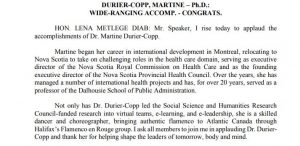
Hon. LENA METLEGE DIAB: Mr. Speaker, I rise today to applaud the accomplishments of Dr. Martine Durier-Copp
Martine began her career in international development in Montreal, relocating to Nova Scotia to take on challenging roles in the health care domain, serving as executive director of the Nova Scotia Royal Commission on Health Care and as the founding executive director of the Nova Scotia Provincial Health Council. Over the years, she has managed a number of international health projects and has, for over 20 years, served as a professor of the Dalhousie School of Public Administration.
Not only has Dr. Durier-Copp led the Social Science and Humanities Research Council-funded research into virtual teams, e-learning, and e-leadership, she is a skilled dancer and choreographer, bringing authentic flamenco to Atlantic Canada through Halifax’s Flamenco en Rouge group. I ask all members to join me in applauding Dr. Durier-Copp and thank her for helping shape the leaders of tomorrow, body, and mind.”
“When you arise in the morning, think of what a precious privilege it is to be alive– to breathe, to think, to enjoy, to love.”
Marcus Aurelius, Meditations

Bellevue, Newfoundland and Labrador, Photo Credit Michelle Hunter

The Great Canadian Baking Show, Season Two returned on September 19, 2018. Ten passionate amateur bakers were selected to participate in a series of daunting challenges, all competing for the enviable title of Great Canadian Baking Show. Congratulations to Dr. Sachin Seth, assistant professor and the Director of Group Practice at the Faculty of Dentistry, Dalhousie University, who is one of the chosen ten contestants.

Sachin Seth Dentist | Educator | Food lover | Contestant on the Great Canadian Baking Show.
Photos from Dalhousie University YouTube Channel – Sachin Seth’s Chocolate Chip Mug Cake Recipe
Dalhousie University’s YouTube channel features Sachin Seth’s Chocolate Chip Mug Cake recipe that promises to be fast, easy and exceptionally delicious. It’s a winning combination.


Our best wishes for a great season on the Great Canadian Baking Show.

Summers at the Centre for Executive and Graduate Education are eventful. It is the “Intensive Season,” a much-anticipated end-of term culmination of the blended/online learning courses offered by Dalhousie’s Centre for Executive and Graduate Education (CEGE).
Blended/online learning has the advantage of asynchronous education resources including readings, videos, discussion posts, blogs and audio files. In the months leading up to the Intensives, students share and connect with colleagues and professors via Live Classroom, tutorials, Collaborate, Adobe Connect and Skype sessions. The high point occurs when students meet for a three-to-five-day intensive review session at the end of each term.
The final course of CEGE programs, the capstone, brings participants to Halifax, Nova Scotia. These courses are held during a week-long summer session on Dalhousie’s historic campus.
In a recent telephone discussion, Michelle Hunter highlighted the excitement generated during the Intensive Season, Summer 2018. Approximately 230 students participated in courses offered through the Centre for Graduate and Executive Education programs: MBA Financial Services / Leadership, Master of Public Administration (Management) and Master of Information Management. Courses ranged from Corporate Social Responsibility, Marketing, Strategic Leadership & Change, Intergovernmental Relations, to Managerial Economics, Human Resources Management, Knowledge Management and Collaboration.
The Centre for Executive and Graduate Education is recognized as a Centre of Excellence for delivering blended/online programs designed to enhance the learning experience for professionals. The ability to learn from wherever you are, flexible program options, and a robust support team have positioned CEGE as an innovator in knowledge transfer and exchange.
Achieving the sought-after MBA(L&FS)/MPB(M)/MIM designations, is not the final destination for CEGE graduates. Their influence, as strategic thinkers in the knowledge economy, is a confirmation that continuous learning leads to success and increased productivity. This is the legacy of Centre for Executive and Graduate Education’s commitment to excellence.

“The big question is whether you are going to be able to say a hearty yes to your adventure.”
Joseph Campbell

Salmonier Nature Park, Newfoundland and Labrador, Photo Credit Michelle Hunter

Sara FL Kirk, Dalhousie University and Amberley T. Ruetz, University of Guelph
As summer winds down and a new school year begins, the conversation about food in schools is once again heating up.
In June, Sen. Art Eggleton tabled a motion calling on the federal government to consult with key stakeholders to develop a cost-shared universal nutrition program across Canada.
He is not the first senator to have made this call. Back in 1997, the House of Commons Standing Committee on Finance made the recommendation “to create a national school nutrition program” but no action was ever taken. In 2015, the Standing Committee on Social Affairs Science and Technology and the Minister of Health advocated “for childcare facility and school programs related to breakfast and lunch programs… and nutrition literacy courses.”
A universal, national school food program would make sure that all students from kindergarten to Grade 12 have the same access to healthy food in school.
The case for such a program in Canada is already strong. So what needs to happen to make this a reality?
Canada is lagging behind other high-income countries in providing nutritious food to children.
In a UNICEF report published last year, Canada ranked 37th out of 41 countries on access to nutritious food for children. That is below the United States.

One reason for this is Canada’s patchwork of programs that serve only a fraction of kids. Funding for programs comes from several different stakeholders, including provincial and territorial governments, municipal governments and charities. This contrasts sharply with school food programs in other countries.
In Brazil for example, food is a constitutional right, which means that a national program feeds 47 million students at 190,000 schools each day.
The benefits are multiple, not only improving student nutrition, health and social development, but providing wider employment. The program supports local food systems and regional economic development, since 30 per cent of food purchased for the program comes from small family farms.
In Italy, school meals are a central part of education about national culture and health. In Rome, 70 per cent of ingredients in school meals are required by law to be organic. These are also local or regional foods, making school meals a local economic growth strategy as well.
In Finland, school lunches, which are free for all students, are the healthiest meal that students eat during the whole day.
These international examples illustrate how healthy food provision is prioritized elsewhere in the world. This pays off through an impressive return on investment for school food programs — of $3 to $10 for every dollar invested.
Because children’s eating habits are more easily influenced than those of adults, interventions aimed at children are also more likely to have the potential to reduce future health-care costs.
Children spend on average six to seven hours or 50 per cent of their time awake at school which makes schools the ideal medium for instilling lifelong eating habits in a non-stigmatizing way.
Public support for a national program is growing. Martha O’Connor, former director general of the now defunct Breakfast for Learning Program affirms that “70 per cent of Canadians believe that child hunger in Canada is more important than national unity or the deficit. Strategic investment in a national school nutrition program is an investment in the future of all Canadians.”
Political will is essential for a national school food program to become a reality. And Eggleton’s motion is catalyzing this important conversation about the state of children’s health in Canada.
Growing rates of diabetes, obesity and heart disease among Canada’s population are unsustainable. The Coalition for Healthy School Food, comprised of 40 organizations across Canada, estimates that a national, universal healthy school food program would cost $1.8 billion per year.
The Coalition is calling on the Government of Canada to initially invest $360 million, through provincial and territorial transfers, in healthy school food programs.

The eventual goal would be universal coverage, through a cost-shared model of joint investments from the federal, provincial, territorial and municipal governments, as well as some investment from not-for-profits and parents where applicable.
The United Kingdom recently implemented a promising strategy of directing the revenue from a national sugary drinks levy to fund school food programs. Diabetes Canada, the Heart and Stroke Foundation and the Childhood Obesity Foundation are making the same recommendation for Canada.
A soda tax could produce $1.7 billion in annual revenue for Canada, just short of the Coalition’s estimate to fund a national school food program.
Given the burden that chronic, diet-related diseases already place on the Canadian health care system — a cost estimated at $190 billion each year — a $1.8 billion investment in the health of our next generation is surely a small price to pay?
The cost of implementing a national school food program will pay for itself through improved mental health, learning and other health outcomes.
Schools have a strong history of successful public health intervention and a national school food program is a critical investment that we all can support. It’s a no-brainer.
Sara FL Kirk, Professor of Health Promotion; Scientific Director of the Healthy Populations Institute, Dalhousie University and Amberley T. Ruetz, PhD Candidate in Geography, University of Guelph
This article is republished from The Conversation under a Creative Commons license. Read the original article.

Ann C Etter, Class of 2001
John-David Etter, Class of 2018
Photo Credit: Centre for Executive and Graduate Education
October 2, 2018, the Dalhousie University MBA(FS) Class of 2018 celebrated the culmination of their academic journey in the graduation ceremonies held at the Rebecca Cohn Auditorium.
In the audience, Ann Etter watched as her son, John-David Etter crossed the stage to receive his well-earned degree. This was the same stage she crossed in 2001 when she was awarded the identical MBA(FS) degree. Seventeen years have passed between the two graduations, a confirmation that the pursuit of academic excellence continues and evolves within a world of dynamic change.
CEGE Connection reached out to Ann for her thoughts as she celebrates her son’s achievement and remembers her personal journey to acquire knowledge.
Ann C. Etter
September 28, 2018
The Old and the New
I’ve always been interested in learning new things, however, as I reflect on the topic of lifelong learning, it’s words that my Dad said to me in 1972 that have resonated with me for the past 46 years. As background, I was working with BMO in the summer of ’72 and found I enjoyed banking so much that I decided not to return to university to complete my undergrad degree. My Dad took me aside and shared some very important words of wisdom …he said, “I want you to remember that you are never too old to go back to school”. And there it is – 46 years ago – my foundation to lifelong learning!
Women in banking was a lot different a half century ago than it is today. Women were not actively promoted to management jobs in any bank nor were they highly educated. It didn’t take me long to realize that I would have to equip myself with more education if I was to compete for higher level jobs. So while working full time, I went back to school and obtained my undergrad degree. But I couldn’t stop there. I had a thirst for knowledge and continued through the years with bank courses, too many to count, and went on to obtain numerous designations which eventually brought me to the realization I wanted to obtain an MBA. Hence, enter Dalhousie University which had the foresight to introduce the MBA in Financial Services.
I applied, was accepted and started on the journey to obtain and expand my knowledge of the business environment. Dalhousie provided the opportunity to learn via distance as well as providing a supportive network, which is important, especially if one has a demanding job. The courses, tailored to the Financial Services industry, are challenging and thought-provoking. The profs are top notch and available if needed. The networking opportunities with other students was invaluable.
One of my objectives on this journey was to show my son by example that hard work and commitment to a goal pays off. JD, who was a teenager at the time, knew that obtaining an MBA was important to me. He was extremely supportive at home, allowing me the time I needed to study and complete assignments. JD learned the importance of lifelong learning and went on to set goals for himself to achieve educational success. I’m very proud of JD’s accomplishments. I know that with JD’s outgoing personality and commitment to doing the best job possible, he will be successful no matter where in life his path leads.
As for me, you may be seeing more of me around campus. Lifelong learning will always be a part of my life. As I get closer to retirement, I find myself thinking about what courses I’d like to take in my spare time. Dalhousie is doing a stellar job of keeping the MBA (FS) alumni informed of talks that we can attend. And there are a plethora of courses available.
It will be exciting to attend fall convocation ceremonies knowing that JD and I are the first mother-son duo to obtain the MBA Financial Services.