“I think there is no replacement for that in-person collaboration. I really feel it was instrumental in my learning process”.
Katie Moran, MPA(M), Class of 2022
Republished from Faculty of Management, News & Events
So much to learn: Katie Moran
MPA(M) graduate appreciates blended learning and the opportunity to formalize management skills
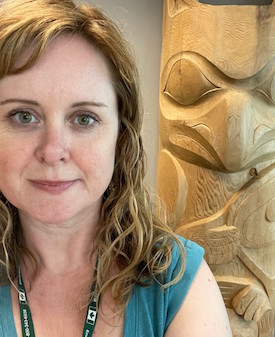 When Katie Moran began to research masters’ programs, she was interested in finding one that would allow her to keep working full-time, and that combined online learning with face-to-face opportunities. “I attended an information session and what really drew me to Dalhousie was the blended online delivery, because I find online training pretty dull. To me, the real learning happens when you’re able to engage with others and collaborate,” says Katie.
Levelling up
Choosing the Master of Public Administration (Management) helped her move up several levels in the federal public service: when she started the program in 2017, she was a supervisor at Immigration, Refugees and Citizenship Canada. Today she’s Funding Manager for the Terrestrial Cumulative Effects Initiative (TCEI), an interdepartmental initiative led by Environment and Climate Change Canada. The TCEI is an accommodation measure for the Trans Mountain Pipeline expansion project, which funds Indigenous-led projects that study the cumulative effects of natural resource development. Katie is a key lead on the design, implementation and delivery of project funding.
Even though she was already in middle management when she started the program (and an employee of the federal government since 2005), Katie says that the MPA helped her increase her knowledge about management within the public service. “If you want to be in management, or even on the policy side, there’s just so much that you can learn. I’m always, even with lots of thought, just hitting the tip of the iceberg,” she says, adding that the courses in the MPA even helped her to formalize her knowledge of some of the latest terminology and buzzwords in the public service. The classes also gave her a new connection to a range of public servants in different areas, a helpful expansion of her network.
While in the program, Katie was pleased to discover many opportunities to apply her learning through assignments that she could base on her work. In her Intergovernmental Relations course, she wrote an intergovernmental framework on collaborative development. “I was able to write it on my own initiative, which helped me not just learning the course material, but being able to dive deeper into what I was doing in my actual job,” she says.
Collaborative learning
In her Public Service Leadership course, a group project explored Indigenous leadership, something that relates directly to her new position. “Again, that was super helpful for the work that I do because I’m often working with Indigenous leaders,” she says. Today her work with the TCEI has her doing both of these things, working collaboratively with Indigenous communities.
Katie also engaged with the in-person intensives, travelling to Calgary and Ottawa to meet with her cohort until that element went virtual after 2019 due to the pandemic. “It gave me a great chance to meet people from different levels of government, as well as in the private sector. We had lots of really great discussions, and it’s harder to have those online. I think there is no replacement for that in-person collaboration. I really feel it was instrumental in my learning process,” she says.
For Katie, the opportunity to meet other public servants was a real bonus of the program, and her advice for fellow students is to lean into both the programs and those relationships, to get as much out of the experience as they can. “Really being able to understand and get an appreciation for the different kinds of work that public servants do at the different levels of government, like municipal and provincial, that I was really grateful for, being able to meet and really just understand more from other classmates,” she says.

 People who are responsible for mass evacuations during natural disasters are confronted with significant challenges: they must allocate and coordinate limited resources in a dynamic context, often in degraded conditions, and their decisions are consequential, time-constrained and often irreversible.
 I was awarded a SSHRC Insight Development Grant to study military women’s perception of the Canadian Armed Forces (CAF) as an obstacle to female retention. From a human resource management perspective, this research project addresses female underrepresentation in the CAF. The Department of National Defence (DND) and the CAF committed in the 2017 Canada’s Defence Policy to increase the proportion of women in the military by one percent annually in the next ten years. Despite efforts to increase the proportion of women through recruitment and retention strategies, the impact on the proportion of women in the CAF is barely noticeable—women still make up only 15% of CAF members. This research project explores the perception military women hold of the CAF culture and aims to identify the beliefs and perceptions that can hinder female retention. Although the project was delayed due to the pandemic, we have just completed 32 inspiring interviews with former military personnel who shared their experiences as women in the CAF. They spoke about the constant struggles and discrimination they faced, but despite all of this, they were still able to find a place for themselves in a male-dominated organization and were eager to make it a more inclusive organizational culture. We are now in the transcription and data analysis phase. Phase 2 of the project, a survey of more military women, will be launched this winter. This research contributes to enhancing knowledge about obstacles to women’s retention in traditionally male roles and increases understanding of the levers that could contribute to making an organizational culture more inclusive.


 I believe that employee engagement and motivation are crucial to any organization. You can change an organizational structure, your processes, your policies, you can talk about leadership as much as you want, you can increase salaries and benefits, if your employees are not engaged and motivated, your organization will never perform.