Republished from Faculty of Management, Research post.
Sylvain Charlebois, School of Public Administration
A review of Canadian and international food safety systems: Issues and recommendations for the future
 In January 2019, the Safe Food for Canadians Act/Safe Food for Canadians regulations (hereafter SFCR) came into force and brought a more streamlined process to food safety practice in Canada. Food trade and production processes have evolved rapidly in recent decades, as Canada imports and exports food products; therefore, it is critically important to remain aware of the latest advances responding to a range of challenges and opportunities in the food safety value chain. Looking through the optics of the recent SFCR framework, research from the Agri-Food Analytics Lab recently published in Comprehensive Reviews in Food Science and Food Safety puts the spotlight on leading domestic and international research and practices to help strengthen food safety policies of the future.
By shedding some light on new research, the Lab also draws attention to international developments that are noteworthy, and places those in context to show how new Canadian food safety policy and regulation can be further advanced. The research benchmarks Canada through a review study of food safety best practices by juxtaposing (i) stated aspirations with, (ii) actual performance in leading Organisation for Economic Co-operation and Development (OECD) jurisdictions. This project has key practical implications. Comparing standards, acts and regulations (e.g., organizational processes, management controls, education, technologies and coordination) in jurisdictions at the supra-national level, such as the Global Food Safety Initiative (GFSI), with actual, current levels of performance will yield insight on critical considerations for Canadian food safety practices leading the coming decade of practice and potentially improve food safety.
This project, which involved the Canadian Food Inspection Agency, was published in the September 2021 issue of Comprehensive Reviews in Food Science and Food Safety.
 Thanks to artificial intelligence, chatbots have been applied to many consumer-facing applications, especially to online travel agencies (OTAs). This study aims to identify five quality dimensions of chatbot services and investigate their effect on a chatbot user’s confirmation (measuring the degree to which a user’s initial expectation from using the chatbot services is met or confirmed), which in turn leads to use continuance. In addition, the moderating role of technology anxiety (measuring a user’s perception that s/he feels intimidation, unfamiliarity and difficulty with using chatbot services) in the relations between chatbot quality dimensions and post-use confirmation is examined. Survey data were gathered from 295 users of Chinese OTAs. Partial least squares regression was used to analyze measurement and structural models. Understandability, reliability, assurance and interactivity are positively associated with post-use confirmation and technology anxiety moderates the relations between four chatbot quality dimensions and confirmation. Confirmation is positively associated with satisfaction, which in turn influences use continuance intention. This study examines how chatbot services in OTAs are considered by users (human-like agents vs. technology-enabled services) by investigating the moderating role of technology anxiety.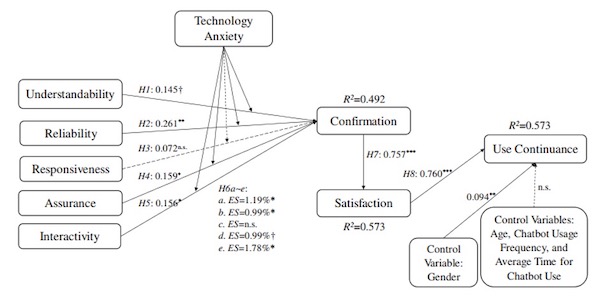








 People who are responsible for mass evacuations during natural disasters are confronted with significant challenges: they must allocate and coordinate limited resources in a dynamic context, often in degraded conditions, and their decisions are consequential, time-constrained and often irreversible.
 I was awarded a SSHRC Insight Development Grant to study military women’s perception of the Canadian Armed Forces (CAF) as an obstacle to female retention. From a human resource management perspective, this research project addresses female underrepresentation in the CAF. The Department of National Defence (DND) and the CAF committed in the 2017 Canada’s Defence Policy to increase the proportion of women in the military by one percent annually in the next ten years. Despite efforts to increase the proportion of women through recruitment and retention strategies, the impact on the proportion of women in the CAF is barely noticeable—women still make up only 15% of CAF members. This research project explores the perception military women hold of the CAF culture and aims to identify the beliefs and perceptions that can hinder female retention. Although the project was delayed due to the pandemic, we have just completed 32 inspiring interviews with former military personnel who shared their experiences as women in the CAF. They spoke about the constant struggles and discrimination they faced, but despite all of this, they were still able to find a place for themselves in a male-dominated organization and were eager to make it a more inclusive organizational culture. We are now in the transcription and data analysis phase. Phase 2 of the project, a survey of more military women, will be launched this winter. This research contributes to enhancing knowledge about obstacles to women’s retention in traditionally male roles and increases understanding of the levers that could contribute to making an organizational culture more inclusive.
 This study is the second part of a larger research project that aims to examine the identities, motivations, information behaviours, activities and social impacts of online zero waste (ZW) communities. The first study focused on ZW activities that members incorporate into their daily lives. The World Bank estimated that by 2050, waste generation will drastically outpace population growth by more than double. While large-scale ZW initiatives from corporations and government agencies are crucial in global efforts to manage waste, the World Bank report emphasized the importance of citizen engagement in tackling waste production. Despite the rapid growth of online ZW communities, the impact of ZW activities at a personal level has not been examined in any detail.