“We leave something of ourselves behind when we leave a place, we stay there, even though we go away. And there are things in us that we can find again only by going back there.”
Pascal Mercier, Night Train to Lisbon

Share.Learn.Inspire.Transform
“We leave something of ourselves behind when we leave a place, we stay there, even though we go away. And there are things in us that we can find again only by going back there.”
Pascal Mercier, Night Train to Lisbon

Morgan Rice, MREM Class of 2018
I am a nature lover at heart and hold a strong passion for the protection and conservation of our biodiversity and ecosystems within Canada. I am pursuing a career where I can connect society with conservation science in a meaningful way. In 2017, I embarked on an academic journey at Dalhousie University in the School for Resource and Environmental Studies (SRES). This course-based program allowed me to significantly improve my understanding and knowledge in innovative environmental management problem solving, providing me with real-world experience. I explored the complexities of conservation science and environmental sustainability, which provided me with the skill-sets to fulfill my goal of communicating scientific knowledge on these topics and, in so doing, help build sustainable communities.

Crawford Lake, Photo Credit Morgan Rice
A highlight of my studies was working together with my mentor, Professor Karen Beazley of SRES, to plan the first Canadian Maritimes Ecological Connectivity Forum which was held at Dalhousie University on April 24th and 25th, 2019. With over 110 attendees representing regional government departments, academia, industry, First Nations organizations, and non-government organizations, the forum cultivated a social network to advance efforts in implementing connectivity on everyone’s agenda. This network of partnerships will allow for improved collaboration between various groups who would not be able to reach their goals working alone.
I gained much more than a Master of Resource and Environmental Management degree from SRES. I now have life-long friendships with fellow students, faculty and staff. The SRES community became my extended family, a home away from home. This support and encouragement gave me strength to embrace the challenges and obstacles of life as a graduate student.
I look forward to joining the Centre for Executive and Graduate Education this summer as the Program Assistant. Dalhousie continues to provide extraordinary opportunities for sharing knowledge that fosters positive outcomes for society and our world.
Morgan Rice, MREM
August 2019

Republished from Dal News
Matt Reeder – January 10, 2019

Alan Syliboy (left) and Mark Austin. (Provided photo)
Convocation ceremonies at Dalhousie will soon look a little different thanks to a new ceremonial object that will replace the university mace currently used at the annual milestone event.
While the object won’t be unveiled until its completion in the spring of 2019, lead artists Mark Austin and Alan Syliboy have been busy working with a team of artists across Nova Scotia to craft a compelling new symbol for the university.
Austin says replacing the mace with a new ceremonial object represents an opportunity to identify a symbol that reflects the current diversity of the Dal community and its values, while still paying tribute to the university’s history and heritage.
“There is a purpose in this whole endeavour, which is to express a greater sense of belonging,” says Austin, a community and economic development professional with a background as an artist and filmmaker. Austin has roots in Cumberland County and grew up in various places as part of a military family, returning to Nova Scotia in 1989.
A collaborative effort
A Mace Re-Visioning committee was established in 2016, led by Peter Dykhuis, director and curator of the Dalhousie Art Gallery. The committee received proposals from various artists.
Austin and Syliboy, who have worked together for years, teamed up to put a proposal together.
An award-winning Mi’kmaq artist from Millbrook First Nation whose paintings and other works have earned him recognition across Canada and abroad, Syliboy is no stranger to collaboration. A limited-edition (25,000) gold coin for the Canadian Mint in 1999 sold out, while his animation and illustrations have been used in books and even as part of the Vancouver 2010 Olympics.
His culturally-rooted artistic works, which incorporate elements of Mi’kmaq petroglyphs in Nova Scotia and deal with themes of family, struggle, and strength, have been shown alongside the likes of surrealist great Salvador Dali.
“Kudos to Dalhousie for embracing a future with a more accurate recognition of the past,” says Syliboy.
Austin says the process itself is key to creating an object that authentically reflects the diversity of the Dal community.
That’s why he and Syliboy have teamed up with artists from Mi’kmaq, African Nova Scotian and other communities from across Nova Scotia to contribute to the object.
By bringing in artists from the Mi’kmaq or African Nova Scotian communities, for instance, the object recognizes that Dalhousie exists in a geographic place of cultural significance — one that has not always been as openly acknowledged and celebrated as it is today — and has become an institution of diverse peoples and ideas.
Developing a community symbol
A separate design committee at the university provided input into the development of the object but left the detailed creative decisions to the artists.
“They left space for us to say, ‘I think a symbol that would work best here is this’, for instance,” says Austin, who’s diverse career has included teaching aesthetics and consulting on community and economic development issues.
Austin, whose work has taken him into communities across Nova Scotia, says the collaborative approach has ensured that the object being created conveys authentic community.
The artists say the choices of materials and techniques used in the creation of the new object endeavour to embody Dalhousie as a place within a place. That means Nova Scotian materials, including existing re-purposed elements, are being used when possible.
“Hopefully everybody can find something that says, ‘oh yeah, that represents me,’” says Austin. “The whole thing is meant to express achievement and belonging.”
The power of symbols
Dal’s decision to call for a redesign of the mace arose as part of the university’s strategic initiative on diversity and inclusiveness, a key pillar of Dal’s broader institutional Strategic Direction.
“We know how important symbols are to ensuring people of all backgrounds feel represented, and it’s incredibly exciting to see this new ceremonial object emerge in such an inclusive and collaborative fashion,” says Dykhuis, the committee lead. “This project signifies another important step in our efforts to build an even more inclusive, diverse and respectful campus community at Dal.”
Austin says their aspiration for the ceremonial object is that it inspire the Dal community.
“The goal is that it looks elegant and from a distance has some kind of gravitas to it,” says Austin “And then the more you look at it and the closer you are, you realize there are layers of story and identity forming the whole, just like Dalhousie.”
Update: May 10, 2019
Dalhousie’s new ceremonial object was unveiled at the first Spring Convocation ceremony held on Friday, May 10 at the Agricultural Campus.
“May what I do flow from me like a river, no forcing and no holding back, the way it is with children.” Rainer Maria Rilke


Tony Robert Walker, Dalhousie University
About 60,000 merchant ships sail the world’s oceans, including container ships, oil tankers and dry bulk carriers loaded with everything from grain to coal. Most operate on carbon-rich fuels such as heavy diesel, and their emissions have negative environmental impacts, are harmful to human health and contribute to global warming.
Last year, the International Maritime Organization (IMO), a UN agency that is responsible for environmental impacts of ships, adopted ambitious targets to reduce greenhouse gas (GHG) emissions from maritime shipping. The IMO plan regulates carbon dioxide emissions from ships and requires shipping companies to halve their GHG emissions, based on 2008 levels by 2050.
Officials from the marine environmental protection committee of the IMO met in London this week to discuss the shipping sector’s contribution to climate change. Establishing resolutions to reaffirm existing commitments and frames of reference for a fourth IMO GHG study was high on the agenda.
But decarbonizing maritime transportation represents a major challenge that will require a revolutionary shift to alternative renewable fuels.
Shipping accounts for about three per cent of global GHG emissions, producing roughly the same amount as Germany or Brazil do annually. Shipping emissions are not covered under the Paris climate agreement because they cannot be credited to any one nation.
Maritime shipping is far more efficient than shipping by truck, rail or air, and is responsible for moving more than 80 per cent of traded goods (by weight) worth billions of dollars daily. Demand for shipping is growing rapidly and could produce as much as 17 per cent of global emissions by 2050, if not mitigated. In order to meet the goals of the Paris agreement, shipping emissions need to be regulated.
Read more:
The urgency of curbing pollution from ships, explained
In addition to its long-term strategy to cut GHG emissions by 50 per cent by 2050, the ambitious IMO strategy includes short- and mid-term measures, although the details haven’t yet been decided. Short-term measures could be finalized and agreed to between 2018 and 2023; mid-term measures, between 2023 and 2030; and long-term measures to half GHG emissions, beyond 2030. The IMO’s ultimate goal is to completely decarbonize marine shipping.
The shipping industry is already struggling to adapt to the IMO goals. Low- or zero-carbon propulsion technologies are not widely available. The rapidly approaching deadline for implementing short-term emissions reduction measures has led shipping companies to change the way ships are operated, such as by reducing ship speeds, also called “slow-steaming”.
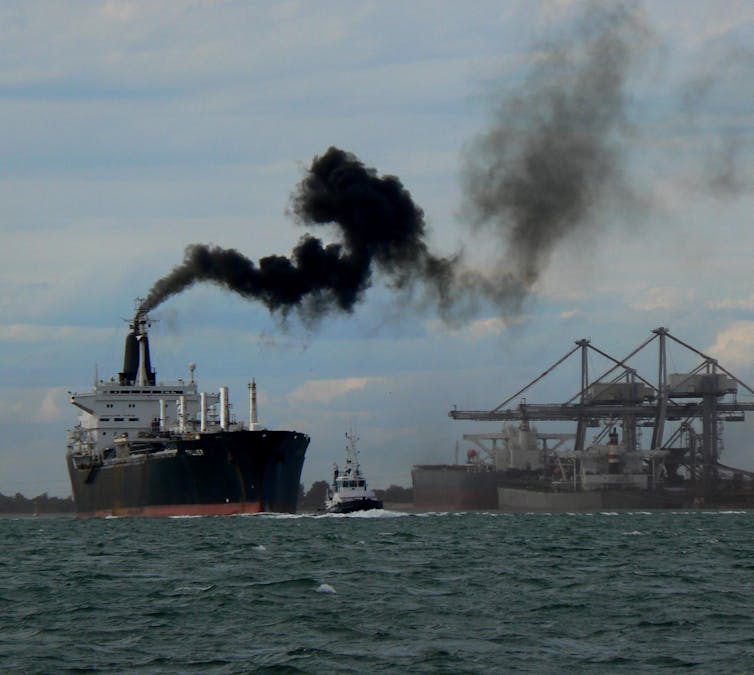
Slow-steaming is the most effective way to reduce greenhouse gas emissions from ships in the short-term, but it is hardly an emissions silver bullet. Slow-steaming significantly reduces fuel consumption, but the longer voyage times lead to higher operating costs, insurance and employment expenses that come with operating a greater number of ships at any given time.
Researchers have criticized the slow-steaming approach because it is inconsistent with IMO’s ultimate emissions goals to completely decarbonize marine shipping
Currently, most of the global shipping fleet, about 60,000 vessels, relies on diesel — only 600 ships use alternative fuels. The sector clearly needs to accelerate adoption of low-carbon fuels.
Alternative low-carbon fuels include liquified natural gas (LNG), biofuels, batteries, wind, nuclear and hydrogen fuel cell systems with zero emissions. A solar-powered ship is currently under development.
Read more:
Designing green ships, from sails to micro-bubbles
Unlike conventional fuels such as heavy fuel oil and diesel used in maritime shipping, LNG produces 15 per cent to 29 per cent less carbon dioxide. It also produces less sulphur oxides, particulate matter and nitrogen oxide, which reduces air pollution and the threat to human health.
By 2030, 10 per cent of the global shipping fleet will be powered by LNG. However, switching to LNG combustion does not come without risks. The extraction, processing and transport of natural gas produces leaks and greenhouse gas emissions, and LNG is carbon-based, making it a transitional fuel.
Switching the rest of the global fleet to other low-carbon fuel alternatives will be driven by market-based strategies, such as taxes or levies on heavy fuel oil and diesel. However, there is still a long way to go to meet 2050 targets.
Emerging economies are also playing a role in reducing emissions in the maritime shipping industry. China, for example, has implemented widespread onshore charging stations and will have 500 shore power units installed by 2020 to allow ships to turn off their engines and use local electricity to power refrigeration, lights and other equipment when docked. This is particularly effective at reducing greenhouse gas emissions when powered by renewables. The country has also launched local incentive programs to encourage the shipping industry to increase its use of renewables.
There is no one single silver bullet to help reduce greenhouse gas emissions from maritime shipping. Achieving IMO GHG emission reductions targets will require all stakeholders, including ship owners, ship builders, governments, industry and researchers, to help the maritime shipping industry transition into widespread use of multiple renewable-fuel technologies.
Read more:
Five ways the shipping industry can reduce its carbon emissions
As the maritime shipping industry faces increasing challenges to reduce environmental impacts such as underwater noise, ship-strikes on whales and ballast water and air pollution, these IMO GHG emissions reduction targets will be one more regulatory hurdle to wrestle with.
Although 2050 is still 30 years away, the average operational life of a ship is roughly the same, so we still have a long way to go. We need to phase out existing fleets which would fail to meet 2050 IMOs standards and replace with new ships powered by low-carbon fuels as quickly as possible.
It may not be smooth sailing, but the maritime shipping sector needs to stay on course by accelerating adoption of low-carbon fuels.
Tony Robert Walker, Assistant Professor, Dalhousie University
This article is republished from The Conversation under a Creative Commons license. Read the original article.

Dr. Oksana Shkurska, Assistant Professor; Communication Support Specialist for International Students
Dalhousie University’s Faculty of Management celebrated its graduates on Saturday, June 1, 2019. Convocation ceremonies at #DalhousieU are rich in history and tradition, where each year the Dal community welcomes hundreds of new alumni into our network of over 130,000.
Dr. Oksana Shkurska was chosen to deliver the convocation address to the graduating class of the Faculty of Management, Spring 2019. We are privileged to have Dr. Shkurska share her insights on CEGE Connection.

Dr. Oksana Shkurska
Good morning, President McKinnon, Madame Chancellor, Dalhousie Officials, honoured guests, colleagues, our dear graduates, families and friends. It is a great pleasure and honour to be here today, delivering the Convocation Address. Thank you for inviting me
When I entered the building today, my first thought was: Wow, I can feel the excitement in the air! Delighted graduates, proud parents, happy friends and relatives – we all share in this exhilarating event.
I remember 17 years ago sitting at my convocation ceremony as you are now, listening to the speakers, enjoying the moment, and asking myself a question: what is next?
I had already been hired for a job that I was sure would not make me happy. I dreamed big and my goal was to become a university professor to make a positive difference in my students’ lives, but I had no idea what to do to make this dream come true.
On the day of my convocation, I shared my thoughts with one of my professors. Even now, I am grateful to her for the encouraging words I heard:
“No matter how far your destination is, if you are determined enough to overcome all the obstacles, one day YOU WILL GET THERE.”
Those words changed my life. From that moment, I set a goal and made a commitment to follow my dream.
We all know that life is not only sunshine and rainbows, and unfortunately it is full of failures and disappointments. However, it is not the absence of failures that predetermines our success, but it is our ability to get up and continue to move forward.
Confucius once said: “Our greatest glory is not in never falling, but in rising every time we fall.” Just think about it: “our glory is in rising every time we fall”.
When I was a child, I was in love with mountains. What is interesting, however, is that I never saw them in reality. Once I saw a picture of someone standing on the top of the mountain with all those breathtaking views below. You know this feeling, right? I promised myself that one day I would fulfill my dream and reach the top of the mountain. When I was eighteen, I gained an opportunity to hike up the mountain. I was still very young and immature, but you can imagine how excited I was! My dream was going to come true!
However, I didn’t reach the top; I failed. I made three mistakes that prevented me from reaching my goal.
The first mistake was being absolutely unprepared for the hike: my shoes were inappropriate for the rocky path I had to take. Do you know what I was wearing? Can you guess? I was wearing flip-flops, and this is how I hoped to reach the mountaintop!
The second mistake I made was going on a hike without MAPPING OUT my route. I did not break down my route into small doable segments to have a rest and to decide on next steps after each segment. In other words, I did not give myself an opportunity to recharge my batteries and think about the next steps. As a result, I did not have a clear picture of how far I walked, which discouraged me.
The third mistake was not allowing for unpredictable weather changes. When I started to doubt that I should continue my journey, heavy rain and a thunderstorm started. I was not ready for this. I did not have either a raincoat or an umbrella. Just imagine me with an umbrella in the mountains. There was no shelter to protect me. It was really scary! (If you have ever experienced a thunderstorm in mountains, you know how scary it is.) I was extremely disappointed. That’s it, I thought. Never in my life will I do this again! The problem was that I was not ready for weather changes. In fact, I was not ready for any changes at all.
I learned a lot from this failure, however. Now I understand how important it is to be well equipped and prepared for any life journey I take. I also know that I should break my big goal into small doable goals before I start moving towards the big goal I want to achieve. And what is even more important, I know I should always be ready to learn new skills and adapt to any changes in my life, as change is inevitable.
Learning from mistakes is an important part of our growth, so do not let your failures define you. On the contrary, each time you make a mistake, learn from this failure, apply what you have learned to your life, and keep moving forward. Just keep moving forward!

We prepared you to be the leaders of tomorrow. We helped you to develop your skills. But what is even more important, we taught you that a good leader cannot be indifferent to others. A good leader cannot be indifferent to other people’s lives, feelings, and sufferings. These are not just words: each of you is powerful enough to make positive changes in other people’s lives. So, when you achieve your goal, help others to find and achieve their goals as well.
I am happy today to have my dream job that allows me to make a positive difference in your lives. Your success inspires me. Your achievements help me to move forward, and your accomplishments help me to succeed as well. I would like to thank you for this: for all those wonderful moments that I have had with you in class and for the success that you have experienced.
Without you, I would not be here today, and because of you, I learned the most important thing in my life: it is better to give than to receive, and the more you give, the more you will receive.
Those were the most important things I have learned in my life: to succeed in life, be determined to achieve your goal, learn from your failures, and help others to grow.
Wait! There is one more thing!
Knock, and the door will be opened for you. Do not stop until your dream becomes a reality. If you want to have a fulfilling career, go for it, and no matter how far your destination is, never let anyone discourage you and tell you that you will not get there because you WILL get there. Even if it takes you ten years, twenty years, or your whole life, if you really want to reach your destination, eventually you will get there. YOU WILL GET THERE!
Thank you!
Editor’s Note: We invite you to view Dr. Oksana Shkurska’s address on Dalhousie’s 2019 Convocation YouTube video. Her address begins at 1:25:10.

“The garden suggests there might be a place where we can meet nature halfway.”
Michael Pollan

“I have very wonderful memories of the class of 2009; so much spirit, engagement and commitment to academic excellence.”
Michelle Hunter

Class of 2009 MBA (FS)
CEGE Connection would like to recognize the contribution of the MBA(FS)Class of 2009 as they commemorate their tenth-year anniversary. All our best goes out to these graduates on this very special milestone year. Thank you for your commitment to excellence, life-long learning and the communities in which you live and work.
Michelle Hunter & Rebecca Budd
“Governments that want to build more sustainable road networks may need to change their administrative processes, shift the work culture of the public service, and even restructure the approval bodies made up of elected officials.”
Christina Bouchard MPA(M) Class of 2019

Christina Bouchard MPA(M) Class of 2019
Christina Bouchard is a Transportation Planner and Project Manager for infrastructure engineering projects. Located in downtown Toronto, she specializes in the delivery of sustainable transportation projects. Her recent projects include transportation master planning, major capital implementation coordination, strategic policy design and infrastructure design for walking and cycling infrastructure. Following 10 years working as a public servant at Toronto City Hall, Christina now works with a variety of Canadian and international jurisdictions as a consultant. Following the completion of a Masters in Public Administration (Management) at Dalhousie, Christina will be pursuing PhD studies at the University of Ottawa. Her doctoral research will center around a comparative analysis of infrastructure delivery by Canadian municipalities.
CEGE Connection reached out to Christina for her insights on building sustainable transportation infrastructure.
Christina Bouchard:
What are the processes to construction of a road design?
As a manager of transportation infrastructure engineering projects, I have seen a lot of variability in how different jurisdictions are planning, designing and building their infrastructure. Some jurisdictions have been rapidly planning, approving and building networks of separated cycle tracks. These types of successes are great from both an environmental and public health perspective for the people living in those Cities. Unfortunately, some other jurisdictions struggle to install modest changes.
How would doing a comparative analysis of infrastructure projects in different Cities help?
No one has compared the political structures, government structures, government processes and stakeholder engagement that affect the implementation of Canada’s sustainable transportation infrastructure. Interviewing practitioners in Canada’s major Cities will help map best practices as well as the pain points that are causing projects to be installed very slowly or not at all.
The professionals that make up Canada’s transportation sector include traffic engineers, civil engineers and transportation planners. I have been fortunate to work with many capable professionals in both the public and private sectors. However, the successful implementation of transformative change goes beyond good planning or good engineering for individual projects.
Why is studying the implementation process that governments use important?
Wherever you go, everyone wants government to be efficient. Unfortunately, it is not always easy for bureaucracies to change their own structure and processes. Bureaucrats often use process and protocol as measurements of transparency and accountability. Studying implementation realities across multiple jurisdictions is a way to better understand how public value is being created.
If best practices are identified, what comes next?
Governments that want to build more sustainable road networks may need to change their administrative processes, shift the work culture of the public service, and even restructure the approval bodies made up of elected officials.
Did undertaking the Masters in Public Administration offered by Dalhousie University’s Faculty of Management influence your thinking about public sector management?
Yes, and there were many program areas that addressed problems I have witnessed in my professional career. Government structures, accounting practices, intergovernmental relations, risk assessment, information management and human resource management all play a role in the actual ability of a public service organization to address a shifting political mandate. It has been my experience that these aspects of program implementation are often inadequately addressed by advocates and reformers working in the Transportation sector.
When studying at Dalhousie, what was the blended program like?
Working all day and then doing schoolwork in the evening requires commitment, but a strength of the program is that you can tie it into your area of expertise. If you’re passionate about your work, Dalhousie’s blended program can help you learn without leaving your workplace. Continuing my work with clients allowed me to remain active and engaged with the industry I care deeply about.
Why do you want governments to succeed at building sustainable transportation infrastructure?
In Canada, there are over 10,000 people killed or seriously injured in traffic each year. Instances of serious property damage during climate change storms is increasing, and there is an obesity epidemic. Sustainable transportation infrastructure addresses all these issues simultaneously – and it’s fun! I have always been passionate about transportation sustainability. As the mother of an energetic child, the need to build infrastructure that makes walking and cycling safe for all ages and abilities has become even more immediate to me.
Editor’s Note: CEGE Connection is pleased to advise that Christina has graciously agreed to be a repeat contributor on CEGE Connection. We wish her the very best as she pursues her PhD studies at the University of Ottawa.
“Be as a tower firmly set; Shakes not its top for any blast that blows.”
Dante Alighieri

Florence, Italy