
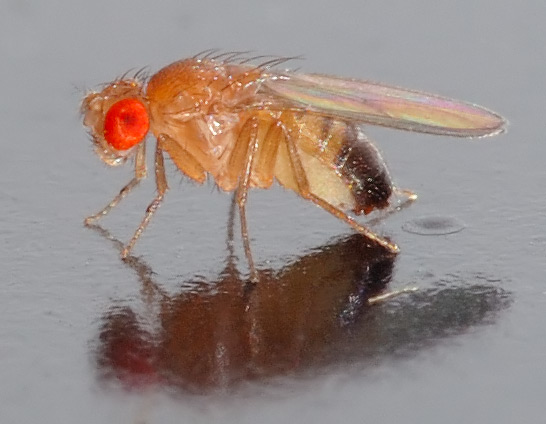
Adult male Drosophila melanogaster, also known as the common fruit fly or vinegar fly. This species is widely used in genetics and biology research. Image/reference: André Karwath,
There is a good chance your first introduction to fruit flies was not in a textbook, a laboratory or a Nobel Prize-winning discovery. It was probably beside a banana. A piece of fruit sits on the counter one day too long, and suddenly a tiny cloud of flies appears. To most people, fruit flies are simply an inconvenience. To scientists, however, fruit flies are incredibly important, and one species in particular is remarkable: Drosophila melanogaster.
Drosophila melanogaster is the common fruit fly species most widely used as a research model in biology. While there are many fruit fly species, Drosophila has become one of the most important model organisms in the life sciences. This tiny insect has helped scientists understand some of the biggest questions in biology: how traits are passed down, how bodies develop, how cells and organs work and why living things sometimes break down with age or disease. For a fly only a few millimetres long, its contribution to science is extraordinary.
Adult male Drosophila melanogaster, also known as the common fruit fly or vinegar fly. This species is widely used in genetics and biology research. Image/reference: André Karwath,
Drosophila are useful because they are easy and inexpensive to study. Fruit flies are small, reproduce quickly and can grow from egg to adult in about ten days. They also have simple chromosomes and well-established genetic techniques for studying how genes affect traits and development. This makes fruit flies a helpful model for asking many different biology questions.
This combination of practicality and biological insight is one reason why fruit flies became so important in the early 1900s. At the time, scientists were trying to understand inheritance, or how traits are passed from parents to their offspring. Before DNA became central to modern biology, researchers knew that features like eye colour, body shape and other visible traits could appear across generations, but they did not yet fully understand how this happened inside the cell. Thomas Hunt Morgan and his students helped answer this question by studying fruit flies. Their work showed that genes are located on chromosomes, which are structures inside cells that carry genetic information. They also showed that certain traits followed predictable patterns as they were passed from one generation of flies to the next. Over time, this work established fruit flies as a powerful model for studying genetics. In many ways, the fly room became one of the places where modern genetics learned to speak.

Black-and-white side portrait of Thomas Hunt Morgan, a scientist known for his work on fruit fly genetics and heredity.
But fruit flies did not simply help build genetics and then fade into the background. They continued to become useful in increasingly powerful ways. One big reason is that we are more like fruit flies than you might guess. Many of the genes that help our bodies grow, work and stay healthy are also found in flies. In fact, around 75% of genes linked to human diseases have similar versions in flies. This is one reason scientists can use fruit flies to study questions related to human biology.
This does not necessarily mean a fly is a tiny human with wings. Rather, it means fruit flies can help scientists study processes that are important in humans. Cells need to divide. Nerves need to communicate. Muscles need to contract. Tissues need to repair. Proteins need to fold, move, bind, signal and support cellular structures. Across life, biology often relies on shared molecular tools. Flies allow scientists to study these processes in a living system complex enough to teach us about biology, but simple enough for precise experiments.
So, the next time a fruit fly appears near your kitchen counter, you may still want it gone. That is understandable. But perhaps, for a moment, you can see it differently. In the laboratory, Drosophila is not just a fly. It is a research model, a genetic trailblazer — and a small organism with a major scientific legacy.
As my Openthink series unfolds, I invite you to think differently about organisms we often overlook. What makes a good model for studying life? Why has Drosophila remained so important for more than a century? And how have fruit flies helped scientists see us, our bodies, and biology more clearly?
Over the coming months, I will use my OpenThink series to follow Drosophila through the many corners of science it has helped shape. This tiny fly has moved through genetics labs, developmental biology, disease research, aging studies and muscle repair experiments, carrying big questions on very small wings.


