

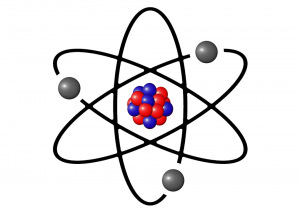
“The chemical space problem” is large and challenging. What tools do we have to tackle it? Just as in Star Trek and Star Wars, we first need to understand what “the chemical space” is made of. Molecules are one of its building blocks. Molecules are the smallest particle of a substance that still have all of the physical and chemical properties of that thing. Molecules themselves are divisible and are made up of atoms, and atoms made up of protons, neutrons, and electrons. After this we must turn to a branch of physics called quantum mechanics to understand how these molecules and atoms behave.
For my work I use a method called Density-Functional Theory (DFT), the ‘spaceship’ I use to explore chemical space. DFT is a quantum mechanical method that has emerged as the pre-eminent tool for computational modelling in many fields such as chemistry, materials science, and biochemistry. Computational modelling techniques allow us to probe this chemical space without ever needing to create the individual molecules within a lab. DFT’s wide success is due to the placement of DFT at the crossroads of accuracy and cost, with alternative computational methods typically skewing to one side or the other. Some tools are highly accurate but can only be applied to very small systems that have limited chemical relevance, while others are very efficient and allow simulations on larger systems but have low predictive accuracy.
Its balance between accuracy and efficiency allows DFT to be used as the tool of choice to study many chemically realistic and relevant systems. In recent years, DFT has been asked to deliver even higher accuracy for increasingly challenging problems, including the design and development of new materials that go into our cars, computers, electronics, and drugs. DFT allows us to send probes into this alien chemical space.
Although DFT is a popular and successful tool for computational modelling of matter in gas, liquid, and solid phases, it hasn’t reached its full potential for theory-driven design due to something that has been called its greatest outstanding challenge – delocalisation error.
Delocalisation error is an overarching term describing a collection of common errors in DFT when dealing with electrons that are highly delocalised in space. This means that the electron has a very poorly defined position in space. Delocalisation error can be seen in even some of the most fundamental and simple chemical systems, such as the Hydrogen (H2+) molecule, which consists of just two protons and one electron that is shared between them, i.e., it is highly delocalised. DFT as it currently exists is inherently local and so cannot accurately represent where that electron is in space, and the calculation greatly overestimates the bond energy. Delocalisation errors range from being mere nuisance to yielding results that are entirely incorrect, which consequently makes drawing reasonable conclusions from DFT impossible. But all is not lost. Work is being done to address these shortcomings within DFT and catapult it to the next stage of the journey through chemical space.


