
So, what is EEG anyway? How does it work?
EEG stands for electroencephalogram (no wonder we say EEG instead!). When broken down from its Greek origins, (electro-, encephalo-, and -gram), electroencephalogram literally means electricity-brain-written record. Brain activity is a result of electrical and chemical signaling, and these signals can be recorded with specialized equipment (and then stored as data, in research, on a computer).
Your brain is only 2% of your body weight but uses 20% of your energy! Small organ, HUGE diva. Why? This electrical powerhouse runs everything in your body—not just your thoughts! And these electrical signals are small but mighty! Your brain and body are kept online with electrical activity, which, when measured at the scalp, is equivalent to about one millionth of a volt. To put that into perspective, your phone charger outputs around 5 volts, and the outlet on your wall outputs about 120 volts.
To put it simply, in EEG research, we record those tiny brainwaves (which we refer to as data), and store that data on a supercomputer (yes, that is what it’s actually called!). Your data, and that of other participants, is looked at later and compared to see if we can find any patterns.
Can you read my mind?!
Definitely not! Let’s start by clearing up a few common misconceptions.
Things we can’t do with EEG data/equipment: we can’t read your mind, diagnose you or put signals into your brain, and we can’t identify you by looking at your brainwaves; they’re not like fingerprints. Things we can do when we see your EEG data: we can tell if you are really relaxed or if you fall asleep, and we can tell when you blink, clench your jaw or move your eyes side to side. Importantly, EEG equipment and data collection will not hurt you or damage your hair.
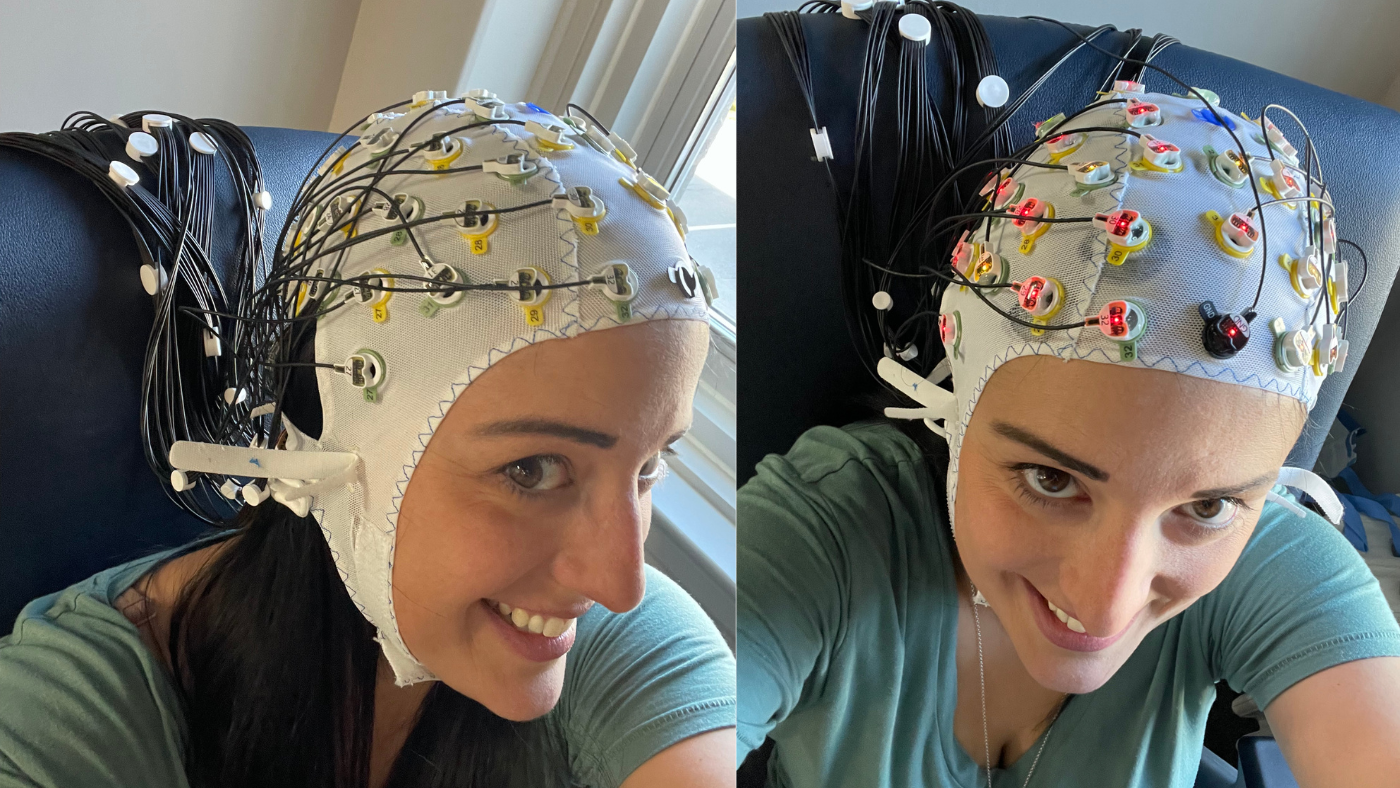
So, what does EEG setup actually look like? Welcome to a day in the life of an EEG researcher, where turning people into futuristic bionic mermaids is part of the job description!
First comes measurements and cap placement: we measure the circumference of your head to find the right-sized cap (think stretchy swim cap with holes). A bad fit can make the data useless, so precision matters. Then we measure front-to-back and side-to-side to center the cap on your scalp before securing it with a chin strap.
Next up is conductive gel: Saline gel is squeezed into each hole in the cap to create a pathway between the electrodes and the scalp. Those tiny electrical signals are buried under hair, scalp, skull and several protective layers (head bangers, rejoice!), so gelling is essential. But we can’t be heavy-handed; too much gel creates a “bridge” between electrodes, blending their signals together into messy data. Think of gelling as a weird art form where less is always more!
Then come the electrodes: 128, to be exact (research typically uses anywhere from 16 to a whopping 256!). Each hole in the cap holds an electrode – a tiny metal sensor attached to a long wire that records your brainwaves. We gently push the electrodes into place, where they fit snugly enough not to budge. Researchers follow a labeling system to ensure proper placement of the electrodes (if you can do color-by-numbers, you’d be an electrode-placing pro!).
And then…more electrodes. We also place 7 electrodes on your face, because facial muscles produce electrical signals too. Blinking, smiling, squinting—you name it—if your face does it, it creates electrical activity we don’t want to mistake for brainwaves! The face electrodes get attached with tiny stickers and a dab of conductive gel.
So, you’re wearing a snug cap covered in electrodes and trailing wires like some kind of bionic mermaid with luscious long locks; equal parts neuroscience, deep-sea creature and glamour! You’re just about ready for the research tasks.
Next, we (carefully) move you into the EEG room. EEG is extremely dramatic about electrical interference; just about anything electrical can cause noisy EEG data (don’t say I didn’t warn you about this prima donna!). We keep the room dim. Phones, watches, Fitbits, smart rings and any other smart devices have to stay outside the room. But don’t worry—you can still take a bionic mermaid selfie in between research tasks. 😉
Finally, we connect everything to the amplifier. Think of it as a magnifier, amplifying that tiny signal so we can actually see it. Then we run an impedance check — this is to make sure each electrode has a good signal. If we’re not getting a good signal, don’t worry, it’s not your brain! Usually, we just add a little more gel or move some hair around to fix it. Once everything looks good, you’re ready to start the research tasks.
Happy participating!
In my next blog I’ll break down how to choose a questionnaire for research, and why that’s especially important in my research on childhood trauma — stay tuned for A study is only as good as it’s measure!


